
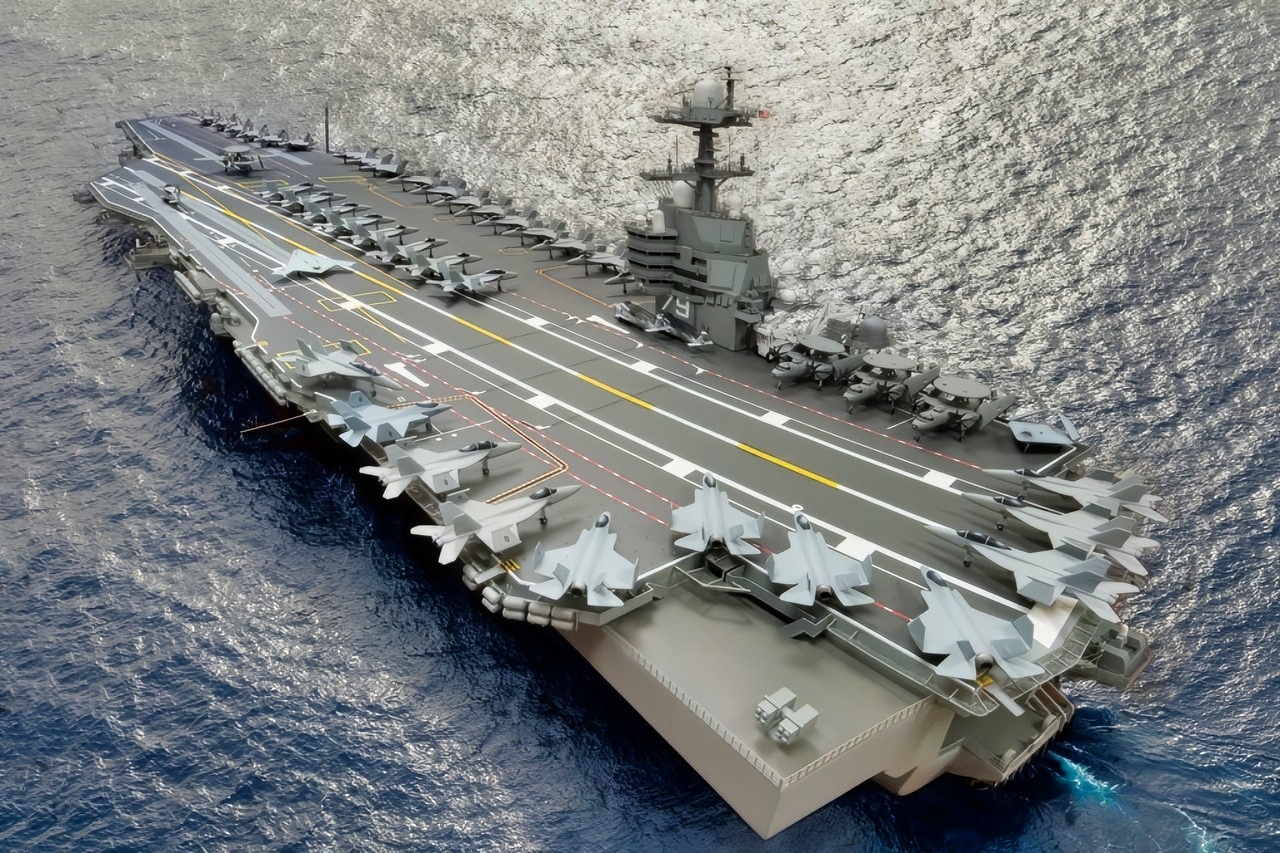
HII's Newport News Shipbuilding division announced August 16 that the future USS John F. Kennedy (CVN-79) has completed acceptance sea trials, the carrier's second and more consequential round of at-sea testing following eight days of builder's trials back in February. "It is an honor to take Kennedy to sea to demonstrate the quality work and commitment by our shipbuilders," said Derek Murphy, NNS vice president of new construction aircraft carrier programs, in HII's press release, which runs to barely four short paragraphs and offers no detail on what was actually tested, what results were recorded, or whether any deficiencies were noted during the trials. Kennedy now returns to the shipyard, with preliminary acceptance, allowing the Navy to begin its own underway test and evaluation, as the stated next step.
That last detail is worth sitting with, because "successfully completed acceptance sea trials" and "ready for delivery" are two entirely different milestones, and coverage running purely off the press release risks conflating them. This blog covered Kennedy's trials when they began on August 12, noting the carrier's history of schedule slips tied to Advanced Arresting Gear certification and Advanced Weapons Elevator integration, the same two subsystems that pushed delivery from an original July 2025 target to the current March 2027 date. The Aviationist's coverage of the trials' start is explicit that commissioning "will not mean the ship will then be ready for active operational service," and The National Interest's reporting goes further, noting that even after formal March 2027 delivery, Kennedy likely won't begin actual operational duties until at least 2028, with months of additional post-delivery testing, shakedown cruises, and air wing integration still required before the ship deploys anywhere.
The press release's brevity also glosses over just how contested "successful" is as a description for this program's track record. Kennedy's own schedule has slipped from an original 2022 delivery target to July 2025, then to the current March 2027 date, a five-year cumulative delay driven specifically by the same AAG and AWE systems this trial phase was meant to validate. USNI News and the Government Accountability Office have both previously flagged continuing AWE construction delays as a direct risk to even the current, already-slipped schedule, and while HII's announcement frames this trial phase as validating "the quality work and commitment by our shipbuilders," it notably doesn't specify whether AAG and AWE performance during these trials met certification standards or whether further remediation work remains before preliminary acceptance can actually proceed. A press release built around institutional pride is a normal and expected communications choice from a shipbuilder, but it's a different document than an engineering status report, and readers treating the two as equivalent risk assuming problems are resolved that the release simply doesn't address either way.
There is a genuinely positive, substantive detail buried in the broader reporting around this milestone that HII's own release doesn't emphasize: Congress mandated, specifically to avoid repeating USS Gerald R. Ford's post-delivery retrofit problems, that Kennedy be delivered capable of operating F-35C Lightning IIs from its first deployment, including reinforced jet blast deflectors and specialized equipment the Ford still lacks years after its own delivery. That's a real, concrete lesson-learned improvement baked into Kennedy's construction rather than deferred to an expensive post-delivery modification period, and it's arguably a more meaningful marker of program maturity than the trials announcement itself.
Set against the fleet-availability story this blog has already tracked, Nimitz's retirement dropping the Navy to 10 operational carriers until Kennedy arrives, this trial completion is genuinely good news worth reporting, just not the finish line HII's framing implies. The realistic timeline running from here is preliminary acceptance, formal delivery around March 2027 assuming no further AWE-related slippage, and then a further year or more of shakedown and integration before Kennedy is actually available to reduce the strain the temporary ten-carrier fleet is placing on Pacific, Middle East, and Mediterranean deployment rotations simultaneously. The ship cleared a real hurdle this week; it has not yet cleared the ones that have already cost this specific program five years.

No comments:
Post a Comment