
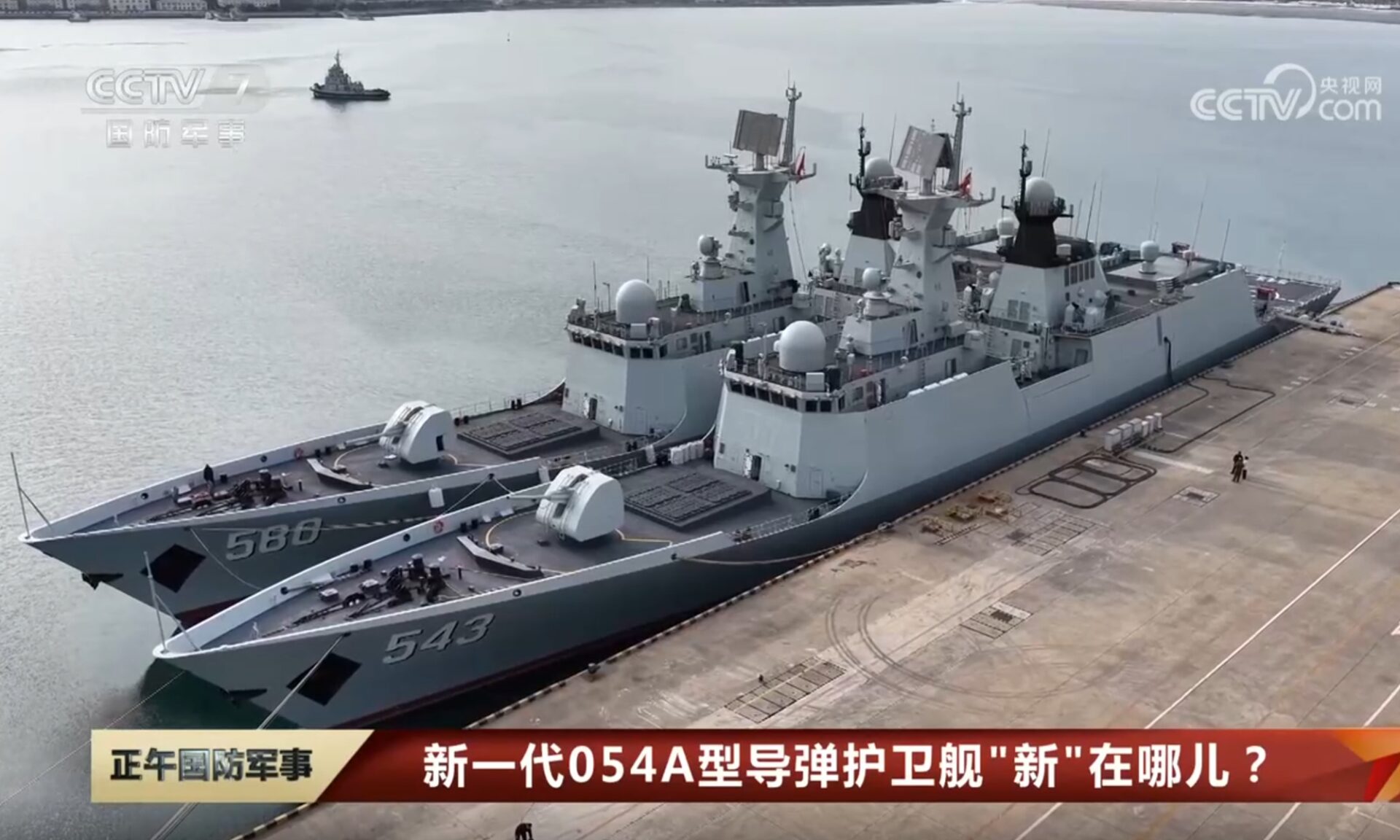
Satellite imagery captured by U.S. intelligence firm Vantor on June 28 shows the third Type 054B frigate under construction at Shanghai's Hudong-Zhonghua shipyard fitted with six modules of eight-cell vertical launch units at its bow, up from the four-module, 32-cell arrangement on the first two ships in class, the Luohe and Qinzhou. If that configuration holds through fitting-out, it would give the vessel 48 VLS cells, a 50 percent increase over its sister ships, and outlets from Bloomberg to the South China Morning Post to Interesting Engineering have run with variations of the same framing: China is closing the missile-capacity gap with the U.S. Navy, one frigate at a time.
That framing isn't wrong exactly, but it obscures a more precise point buried deeper in the coverage, one that Meta-Defense's analysis draws out explicitly while most other outlets gloss over it: the additional 16 cells wouldn't add any new weapon type or mission capability to the Type 054B, they'd simply increase the reserve of the exact same two systems the ship already carries, the HHQ-16 surface-to-air missile and the Yu-8 rocket-assisted anti-submarine torpedo. Critically, the cells reportedly wouldn't be lengthened to accommodate the longer HHQ-9 surface-to-air missile or the YJ-anti-ship ballistic missile family China's destroyers carry, meaning this upgrade doesn't turn the 054B into a longer-range air-defense combatant, it just lets an already-capable frigate carry more of what it could already shoot.
Chinese military commentator Song Zhongping's own explanation for the change, cited across multiple outlets, actually supports this narrower reading rather than the "firepower boost" headline: he framed the expansion around a magazine-depth problem, arguing the original 32-cell configuration could restrict available weapons during sustained combat, giving commanders less flexibility to balance air-defense rounds against anti-submarine rounds before the ship needs resupply. That's a real and legitimate design fix, but it's a sustainment and endurance improvement, not a leap in capability the way "50 percent more firepower" implies to a casual reader. A ship that can now fire 48 of the same two missile types before returning to port is meaningfully different from a ship that can suddenly threaten a wider range of targets or engage at longer ranges, and conflating the two overstates what satellite imagery of empty missile tubes can actually tell you before the vessel has even entered service.
Where this upgrade does matter strategically is less about any single frigate's punch and more about what it signals for PLAN fleet architecture at scale. Army Recognition's coverage of the broader Type 054B production ramp places the class within an increasingly coherent layered escort doctrine: Type 055 destroyers handling high-end area air defense and command functions, Type 052Ds contributing multirole firepower, and Type 054B frigates thickening the screen around carrier, amphibious, and replenishment formations, freeing higher-value destroyers from routine escort duty. A 48-cell 054B fits that role considerably better than a 32-cell one, not because it individually outguns anything, but because it lets the PLAN distribute magazine depth across a larger number of moderately capable hulls rather than concentrating all of it in a smaller number of expensive destroyers, complicating an adversary's targeting calculus by multiplying the number of vessels worth defending against or accounting for in a strike package.
It's also worth registering the pushback offered by more skeptical American commentary on this same story: analysis from outlets like The Gateway Pundit has characterized the Type 054B broadly as a genuine but incremental improvement relevant mainly within China's near-seas operational envelope, one that doesn't meaningfully close the overall gap with a U.S. Navy that retains carrier air wings, allied interoperability, and roughly seven times the aggregate fleet displacement by some rankings. Both readings can be true simultaneously: the VLS expansion is a real, sensible fix to a genuine endurance limitation in the original design, and it still leaves the Type 054B a moderate-tonnage escort frigate rather than the kind of platform that shifts the broader naval balance on its own. The accurate headline here isn't "China boosts frigate firepower 50 percent," it's "China fixed a magazine-depth problem on a ship that was already a reasonable design," a considerably less dramatic but more precise description of what the satellite imagery actually shows.

No comments:
Post a Comment