
Retired Air Marshal Anil Chopra, former director-general of India's Centre for Air Power Studies, published a pointed analysis this week arguing India squandered a head start on China in high-thrust jet engine development despite both countries launching indigenous programs in the mid-1980s. His core argument, drawn from decades of firsthand experience in the IAF, is worth taking seriously as expert opinion rather than dismissing or treating as settled fact: China spent an estimated $42 billion on its aero-engine program since 1986 against India's roughly $239 million on the Kaveri effort, pursued a patient 25-to-30-year roadmap with consistent state backing, and pragmatically reverse-engineered Russian AL-31F engines while building indigenous expertise, ultimately fielding the WS-15 in serial production to power the J-20. India, by contrast, tried to leapfrog straight to a competitive high-thrust engine, hit a metallurgical wall on turbine blades capable of surviving temperatures above 1,500°C, and, according to Chopra, spread the effort across multiple agencies without the institutional focus China applied.
That comparison holds up reasonably well against the historical record, and it's worth noting India did eventually clear the metallurgical hurdle Chopra describes: the Defence Metallurgical Research Laboratory in Hyderabad achieved indigenous single-crystal turbine blade production in 2021, and the dry, non-afterburning Kaveri derivative now produces roughly 46-48 kN of thrust, enough to power the DRDO Ghatak unmanned combat aircraft even if it never became competitive for the Tejas itself. But Chopra's piece, framed around a binary choice between Rolls-Royce and Safran for the AMCA's future high-thrust engine, is already behind the pace of what's actually unfolding, and the more current picture is considerably more interesting than a two-way vendor competition.
What Chopra's framing misses is that India isn't actually choosing between Rolls-Royce and Safran in the way his piece implies, it's running two parallel tracks that emerged at different times through different channels. The Gas Turbine Research Establishment already established a joint venture with Safran at the end of 2025 to co-develop a 120 kN-class engine, built around a reported $7 billion commitment, and that government-to-government track was reportedly nearing final Cabinet Committee on Security approval right around the same week Chopra's piece published, positioned as a symbolic Independence Day milestone for India's self-reliance push. Reliance Industries and Rolls-Royce, meanwhile, announced their own separate strategic partnership just two days before Chopra's piece appeared, proposing a dedicated Aerospace Gas Turbine Complex and a full technology-transfer, IP-ownership offer of its own, explicitly entering the field as a private-sector challenger to the already-advancing GTRE-Safran government track rather than as a settled alternative to it.
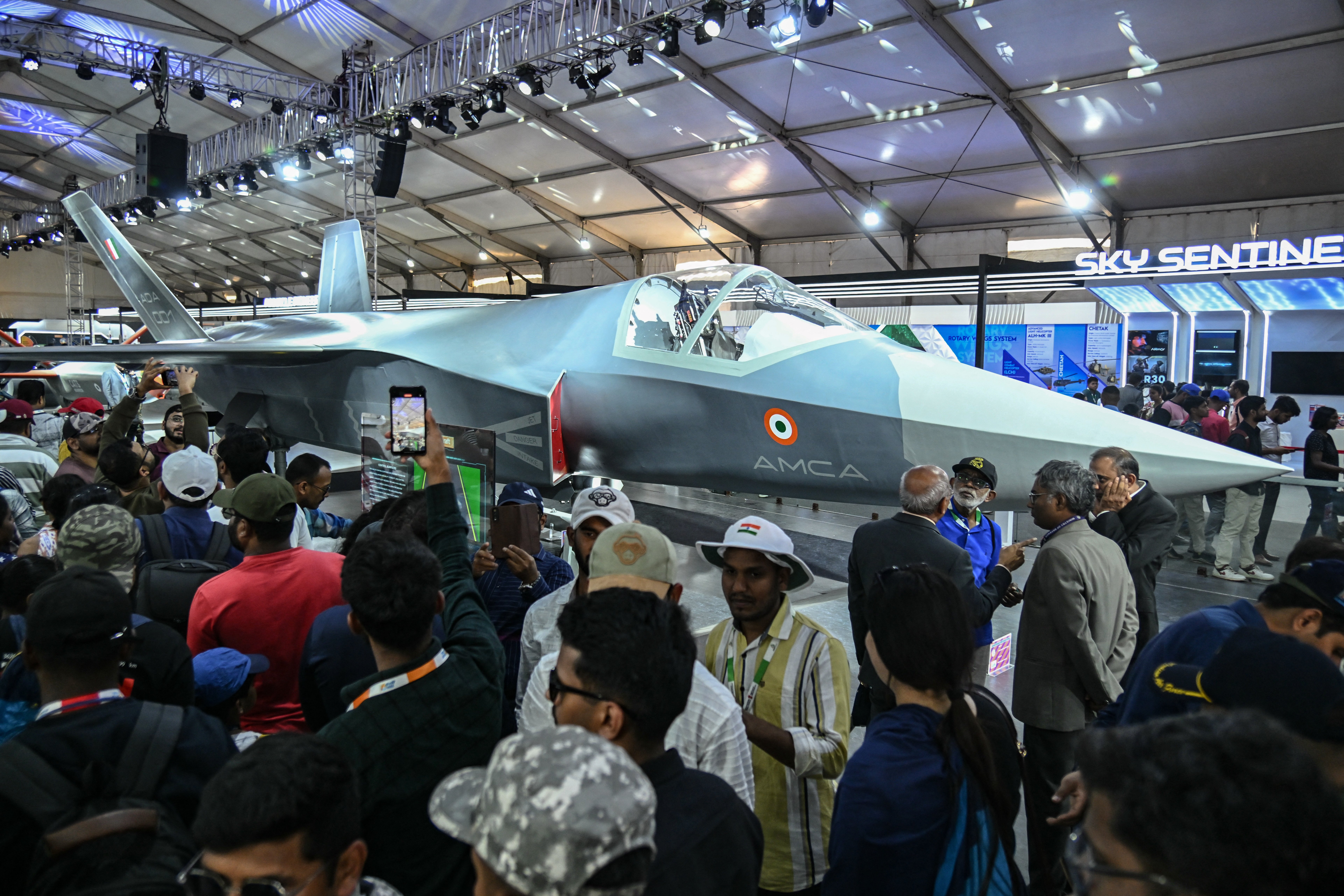
That timing matters because it changes the actual strategic question India faces from the one Chopra's piece poses. It's not simply "which foreign partner should India pick," it's "does India let an already-advancing government joint venture proceed, or does a well-funded private entrant with its own full-IP-ownership pitch actually displace it," a genuinely live and unresolved competition between a state-run and privately-backed track that didn't exist in this form even a few months ago. The urgency behind both offers also has a dimension Chopra's historical China comparison doesn't dwell on: India's current AMCA Mark-1 batches will fly on American GE F414 engines under a licensing deal, and that dependency carries real geopolitical exposure since ITAR export controls give Washington end-use monitoring rights and theoretical leverage over spare-parts supply during any future diplomatic disagreement, a vulnerability neither the Rolls-Royce nor Safran pitch would fully eliminate on the AMCA Mark-1 but which both are explicitly designed to end for the Mark-2 generation.
None of this undercuts Chopra's underlying historical argument, which remains a fair and well-informed account of why China's aero-engine program succeeded where India's struggled for decades. But readers should treat his piece as one veteran analyst's assessment of the past rather than a complete picture of where things stand right now, since the actual competitive landscape for India's engine sovereignty shifted meaningfully in the 48 hours before and after his analysis published, and the real story this week isn't Rolls-Royce versus Safran, it's a state-backed joint venture nearing approval running headlong into a fresh, well-capitalized private challenger for the same prize.

No comments:
Post a Comment