
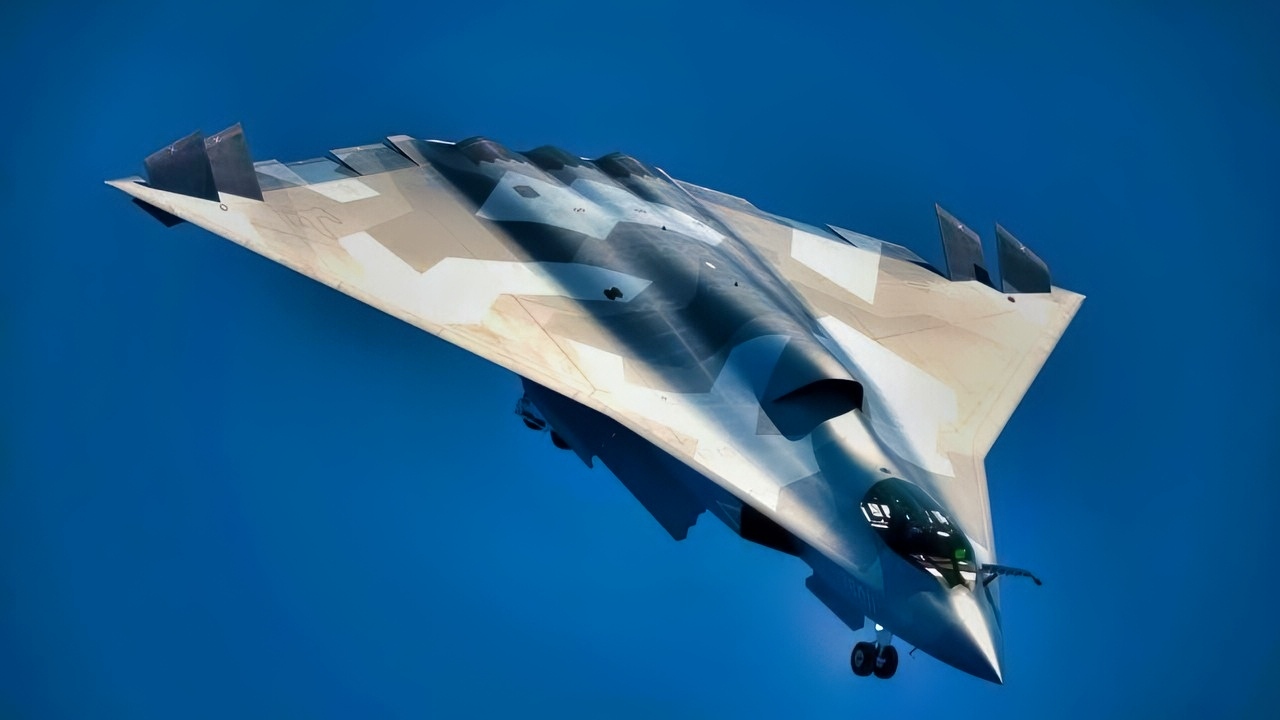
Chinese state media offered its clearest public acknowledgment yet of the aircraft popularly known as the J-36 on June 28, 2026, featuring a tailless silhouette and the nickname "Little Six" in a PLA-produced anniversary video for the Y-20 transport, and footage since then has shown the jet executing genuinely tight, sustained maneuvers rather than the short experimental hops that characterized its first sightings. That's a real milestone: since the aircraft first appeared over Chengdu in December 2024, at least four to five distinct prototypes have flown, cycling through at least three major configuration changes to intakes, exhaust arrangement, and landing gear, an unusually fast iteration pace that Chengdu Aircraft Design Institute engineer Yang Shuifeng has publicly credited to a "revolutionary process" for building sixth-generation airframes quickly. A second, smaller tailless design from Shenyang, unofficially designated the J-50 and believed aimed partly at carrier operations, has been flying in parallel, giving China two competing sixth-generation prototype lines simultaneously.
Set against Boeing's F-47, the U.S. Air Force's selected NGAD platform, which remains under construction in St. Louis with a first flight not expected until 2028, the optics genuinely favor Beijing, and multiple outlets, along with Chinese state-linked commentary, have leaned hard into a "China is flying, America is still drawing" framing. That framing is worth taking seriously, but it also skips past two structural realities that matter more than which country's jet left the runway first.
The first is that first flight and operational readiness are not the same milestone, and the gap between them has historically run over a decade even for successful programs. The F-22 took roughly fifteen years to go from its YF-22 prototype to operational status, and the Pentagon's own assessment, according to reporting from 19FortyFive, places China roughly a decade from turning the J-36 or J-50 into a fielded, combat-ready fighter with trained pilots, mature weapons, and a functioning sustainment system behind it, despite the flying prototypes being a genuine and significant achievement in their own right. Beijing's own history offers a useful data point in the other direction, though: the J-20 went from first flight to operational service in roughly six years, considerably faster than the American pattern, which is precisely why analysts aren't dismissing China's timeline outright even while cautioning against reading first-flight footage as evidence of near-term fielding.
The second, and more concrete, reality is propulsion, and it's the area where the "China is ahead" narrative runs into the most direct technical pushback. What engine is actually powering the J-36 and J-50 prototypes remains publicly unclear, and multiple outlets covering China's aviation industry have specifically flagged mature jet engine technology as a persistent, unresolved weak point even as airframe development has moved at genuine speed. That's not a minor caveat for a sixth-generation design; both American competing engine programs under the Next Generation Adaptive Propulsion effort, General Electric's XA102 and Pratt & Whitney's XA103, are built around variable-cycle, adaptive propulsion specifically because sixth-generation range, persistence, and thermal management requirements exceed what conventional engines can deliver, and both have already passed Assembly Readiness Reviews and moved toward physical hardware. If China's flying prototypes are currently powered by interim or non-adaptive engines while final propulsion remains unresolved, and available reporting suggests exactly that ambiguity, the airframes photographed performing tight maneuvers this summer may be considerably further from their eventual operational configuration than the maneuvering footage alone suggests.
None of this should be read as dismissing what China has actually accomplished, flying two independent sixth-generation prototype lines from separate design bureaus simultaneously is a genuine demonstration of aerospace-industrial depth that rivals, and in raw prototype-to-flight speed currently exceeds, America's own program. But the more accurate framing than "world's first sixth-generation fighter" is that China has won the opening lap of a race whose finish line, a fielded, combat-sustainable aircraft with resolved propulsion and proven reliability, is still roughly a decade out by the Pentagon's own estimate, and where America's classified X-plane flight-test history, running back to 2015 and accumulating hundreds of undisclosed flight hours before the F-47 competition was even announced, means the public visibility gap between the two programs is considerably larger than the actual capability gap it's often assumed to represent.

No comments:
Post a Comment