
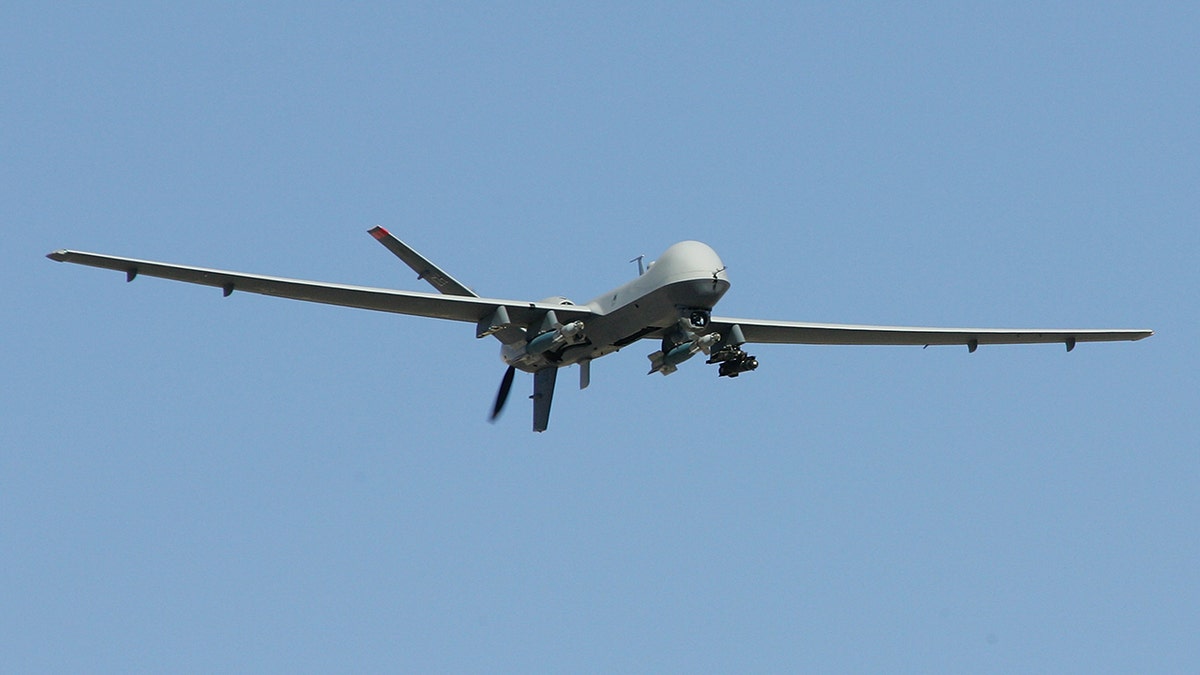
The Washington Post reported this week that at least 45 MQ-9 Reapers have been shot down or crashed since Operation Epic Fury began on February 28, and a day after that report, the U.S. may have lost a 46th near the Strait of Hormuz, with wreckage photos circulating on social media and the shootdown attributed to IRGC forces over Hormozgan province. If the Washington Post's figures hold, that's roughly a quarter of the entire Reaper fleet destroyed in under six months, a sharp acceleration from the 24 losses a May 2026 Congressional Research Service report documented and the roughly 30 a defense official cited in early July, meaning losses have nearly doubled in the five weeks since fighting resumed over control of the Strait of Hormuz. At $30-50 million per airframe, the tally puts direct losses north of $1.3 billion, and that's before adding the 15-20 additional Reapers Yemen's Houthi movement claims to have downed in a separate campaign between 2023 and 2025.
USAF Chief of Staff Gen. Kenneth Wilsbach's response to this attrition rate has been to publicly defend the platform rather than reassess it, calling the MQ-9 the war's "Most Valuable Player" and noting "no other platform is even close" in terms of strikes conducted against Iran, all without putting a pilot's life at risk. That's not an unreasonable point on its own terms, an unmanned platform absorbing this level of attrition instead of a crewed aircraft is a genuine trade worth making. But the "MVP" framing sidesteps the more uncomfortable question the loss rate actually raises: why a platform originally built for permissive, low-threat counterterrorism environments has kept flying repeated missions into one of the most densely defended airspaces in the world, IRGC coverage layered with Russian S-300s, the indigenous Bavar-373 and Khordad systems, and a thick web of radar-guided SAMs, without a survivability upgrade to match the threat environment it's actually operating in.
The Reaper's specific vulnerabilities read almost like a checklist of everything that gets punished in high-intensity, contested airspace rather than the low-threat counterinsurgency work it was designed for: a large radar cross-section with no meaningful stealth shaping, minimal onboard electronic countermeasures, low speed and low-to-medium operating altitude to keep its sensors effective, and heavy reliance on satellite datalink and GPS that makes it a natural target for jamming and spoofing, a vulnerability the Washington Post's own reporting ties directly to several of the confirmed losses through communications failures rather than direct kinetic kills. None of these weaknesses are new or secret; they're the well-understood tradeoffs of a drone optimized for over a decade of counterterrorism work in Afghanistan, Iraq, and the Sahel, airspace where nobody was shooting back with a layered, radar-guided air defense network.
This connects directly to the broader munitions-and-platform attrition story this blog has tracked since Rafferty's SMD Symposium disclosures on Patriot and THAAD stockpiles, and it's not a coincidental parallel, it's the same underlying economics playing out in a different domain. Reuters has separately reported the Pentagon has used nearly all of its long-range precision munitions during this same conflict, and CNN's reporting on depleted air defense interceptors matches the CSIS stockpile figures already covered here. Whether the platform in question is a Patriot interceptor costing millions per shot or a Reaper costing tens of millions per airframe, the pattern is identical: expensive, exquisite systems built for a different threat environment are being consumed faster than they can be replaced once they meet an adversary with a genuinely capable, layered defense network, rather than the permissive environments most of America's post-9/11 procurement was optimized against.
The USAF's own quiet acknowledgment of this problem is arguably the most telling detail buried in the reporting: the service has already begun defining requirements for a cheaper Reaper successor, explicitly built to be produced rapidly at scale and to accept higher attrition rates as a feature rather than a failure. That's the same logic already driving CENTCOM's Task Force Falcon Strike and its LUCAS drones, a platform reverse-engineered from Iran's own Shahed-136 specifically to be attritable and cheap rather than exquisite and irreplaceable. Read together, the MQ-9's mounting losses and the Air Force's response to them aren't really a Reaper story at all, they're the latest data point in a broader institutional realization that this blog has now tracked across interceptors, drones, and now manned-adjacent unmanned strike platforms alike: America's post-9/11 generation of exquisite, expensive hardware wasn't built for the kind of contested, high-intensity fight it's now being asked to survive, and no amount of "MVP" framing changes the production math that keeps forcing the point.

No comments:
Post a Comment