
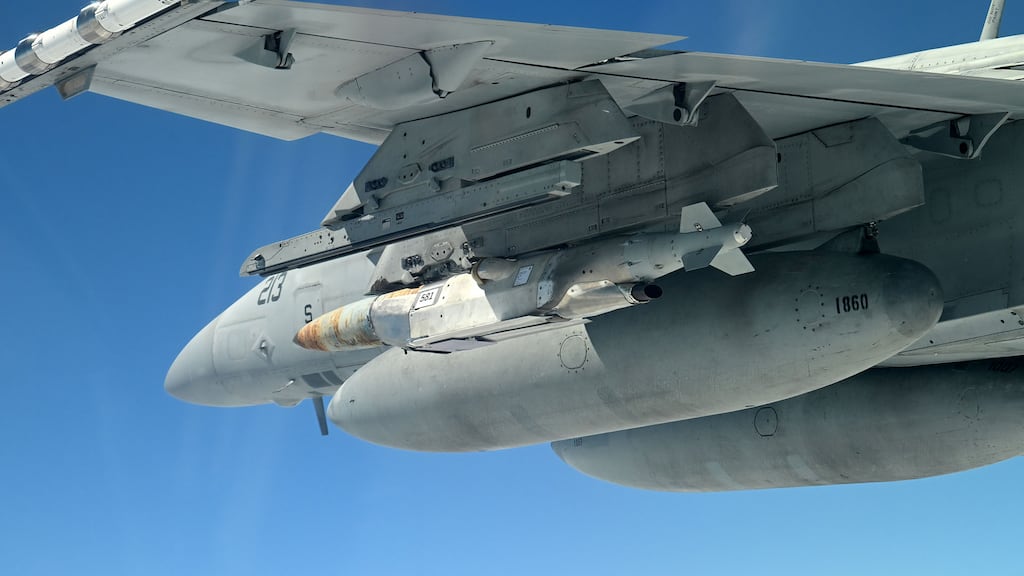
In a significant expansion of the U.S. military's long-range precision-strike inventory, Defense News (authored by defense acquisition correspondent Jen Judson) reports that Boeing has been awarded its first official low-rate initial production (LRIP) contract for the jet-powered Joint Direct Attack Munition Extended Range (JDAM-ER). The award, valued at approximately $280 million, mandates the production of several hundred units of the new variant, specifically engineered to provide tactical aircraft with an affordable, high-volume, stand-off strike capability capable of penetrating heavily contested airspace.
The jet-powered JDAM-ER represents a transformative evolution of the classic precision-guided glide bomb. By integrating a small, low-cost turbojet engine with the proven modular guidance tail-kit, the munition’s operational range is extended dramatically compared to the baseline wing-kit variants. According to the report, the engine integration allows the weapon to maintain a high-subsonic cruise speed, providing operators with a flight envelope that can circumvent traditional point-defense radars and reach targets located well beyond 200 kilometers, depending on launch altitude and release velocity.
A primary driver for the accelerated procurement is the urgent need to replenish stockpiles depleted by high-intensity combat operations and to counter the proliferation of sophisticated Integrated Air Defense Systems (IADS). As modern adversaries increasingly employ long-range, area-denial weapon systems, tactical aircraft have been forced to release munitions from further away. The new variant provides a critical middle-ground capability, offering a much more cost-effective alternative to expensive, stealth-optimized cruise missiles while delivering significantly greater standoff range than conventional guided bombs.
Industry experts note that the contract award also signals a victory for modular defense architecture. Because the jet-powered conversion relies on the existing JDAM supply chain and shares the vast majority of its electronic components with current guidance kits, the integration process for existing fighter inventories—such as the F-15EX, F/A-18E/F, and the F-16—is expected to be seamless. This "plug-and-play" compatibility allows military commanders to rapidly scale up long-range strike capacity without requiring extensive modifications to aircraft weapon management systems.
The production timeline outlined by the Department of Defense suggests that the initial batches will be prioritized for rapid field deployment to key theater combatant commands. As Boeing ramps up manufacturing at its St. Louis facilities, the contract includes options for potential follow-on orders, reflecting the Pentagon's long-term commitment to fielding mass-producible, standoff-capable smart weapons. The initiative underscores a broader industrial shift toward fielding "affordable mass" to overwhelm sophisticated enemy defenses, ensuring that strike forces can sustain operational tempo even under high-attrition scenarios.

No comments:
Post a Comment