
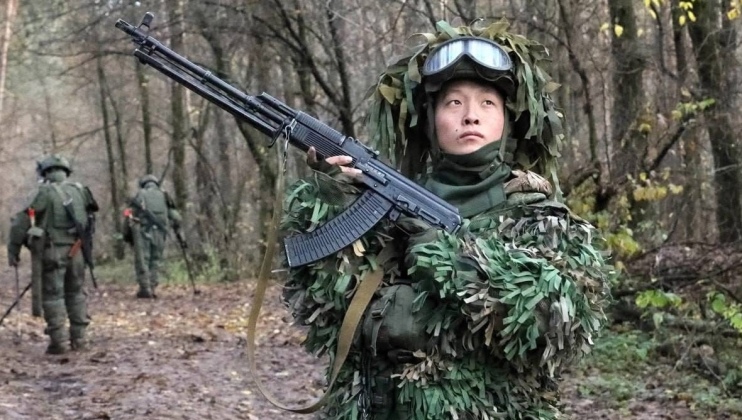
An investigative defense assessment published by Military Watch Magazine (compiled by their editorial staff) has examined explosive intelligence disclosures regarding a potential major expansion of North Korean military involvement in the Russia-Ukraine war.
The core motivation driving Pyongyang's expanding footprint involves gaining invaluable, real-world experience in modern high-intensity warfare. Modern combat in Ukraine—defined by ubiquitous drone reconnaissance, electronic warfare saturation, and persistent aerial surveillance—offers the Korean People's Army a rare laboratory to study contemporary tactics, test command-and-control networks, and refine counter-drone measures.
Even if a large portion of the incoming personnel are utilized in supportive capacities—such as bolstering border security in secondary sectors, executing critical engineering and mine-clearing operations, or managing logistics hubs—their presence indirectly alters force allocation.
The prospective deployment has inevitably triggered sharp geopolitical shockwaves across Western and Indo-Pacific capitals. Neighboring South Korea is closely monitoring the partnership, particularly given reciprocal reports that Moscow is transferring advanced aerospace technology, air defense components, and electronic warfare assets to Pyongyang in exchange for military hardware.
Ultimately, the reported scaling of North Korean personnel inside the Russian theater highlights how localized European conflicts are increasingly drawing in cross-continental alliances. As intelligence agencies attempt to verify the exact composition and timeline of the deployments, the evolving nexus between Moscow and Pyongyang signals a dangerous new chapter in international security, where trans-regional military exchanges actively reshape the balance of power on multiple fronts.

No comments:
Post a Comment