
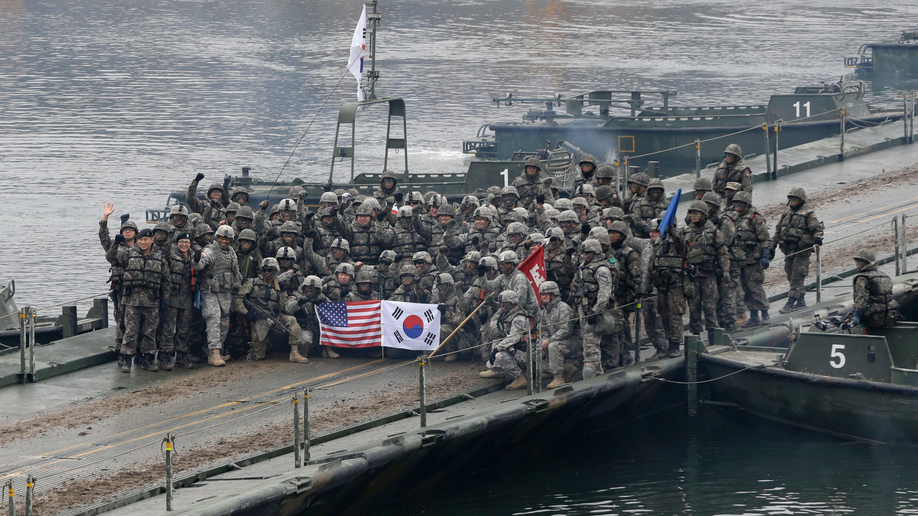
President Trump instructed the Pentagon on August 17 to "substantially reduce" joint military exercises with South Korea, posting on Truth Social hours before the annual Ulchi Freedom Shield drills were set to begin that he was "not happy" the U.S. had agreed to participate, while highlighting his "very good relationship" with North Korean leader Kim Jong Un. Trump tied the decision explicitly to cost and to Seoul's refusal to join denuclearization efforts against Iran, writing that when he asked South Korea to participate they said "No thanks!" South Korea's Joint Chiefs of Staff confirmed the roughly 18,000-personnel exercise proceeded on schedule regardless, and Seoul's presidential office responded carefully, expressing hope that warm Trump-Kim relations might eventually produce genuine U.S.-North Korea dialogue while affirming the allies would keep coordinating combined defense posture.
Analysts reading Trump's move split on the underlying motive, and both readings are worth holding simultaneously rather than picking one. Jenny Town of the Stimson Center's 38 North program characterized it as an attempt to create diplomatic space with Pyongyang, while cautioning the move's "haphazard nature is unlikely to make much of an impression in Pyongyang," and CSIS Korea program head Victor Cha offered a second reading entirely, that Trump may be trying to peel Kim away from his deepening alignment with Moscow, given North Korean troops have been fighting alongside Russian forces in Ukraine and Ukraine confirmed just last week that North Korean-made missiles struck a Zaporizhzhia steel plant in a Russian attack. Neither explanation requires dismissing the other, and both sit awkwardly next to a third fact the same reporting surfaces: Lt. Gen. Joseph Jarrard, a senior NORTHCOM official, warned last week that North Korea has successfully tested ICBMs with enough range and payload capacity to strike anywhere in North America, a threat trajectory that hasn't reversed regardless of the warmth in Trump's public language toward Kim.
What matters more for the strategic picture than the exercise cutback itself is the moment it's landing in South Korea's own defense trajectory, one this blog's Japan white paper coverage already identified as part of a broader Indo-Pacific pattern. Seoul has been pursuing genuine defense autonomy for over a year now under President Lee Jae Myung, formalized through a new Future Defense Strategy Committee and anchored by the "Jang Bogo N Project," an indigenously designed and built nuclear-powered submarine program the U.S. approved fuel-supply cooperation for in November 2025, with construction targeted for the late 2020s and an operational boat expected by the mid-to-late 2030s. Lee's own framing of that program has been pointed rather than defensive: "Only with a strong will for autonomous national defense can we gain the respect of friends and further strengthen our alliances," he told his cabinet in May, adding "I guess a mindset of dependency still has a foothold in defense circles." South Korea has simultaneously built itself into a genuine global arms exporter across armored vehicles, artillery, jets, and missile defense systems, and Lee used a July NATO forum appearance to float expanded South Korea-NATO defense-industrial ties, a suggestion Pentagon policy chief Elbridge Colby publicly pushed back on, insisting no alternative supplier base can match America's "in quantity or quality."
That tension, Seoul actively building autonomy while Washington insists on remaining indispensable, is the real backdrop against which a unilateral, Truth-Social-announced exercise cutback lands differently than it would have a few years ago. Public support for South Korea developing its own nuclear deterrent has held around 73-76 percent through 2025 and into 2026 according to polling cited by Foreign Policy, a skepticism about U.S. security guarantees that predates this specific announcement but that an abrupt, unexplained reduction in joint training only reinforces. Read alongside this blog's coverage of the U.S. Navy's carrier-free Pacific gap, itself driven by the same Iran-war resource diversion Trump cited as partial justification for the Korea cutback, a pattern becomes hard to miss: American attention and hardware pulling toward the Middle East is now visibly touching multiple Pacific alliance relationships simultaneously, and allies aren't waiting to see how it resolves before hedging their own bets.
None of this means the U.S.-South Korea alliance is unraveling, Seoul's own response to Trump's post was notably measured, reaffirming continued coordination rather than escalating publicly, and RAND's own analysis has framed Korea's submarine ambitions as complementary to alliance goals rather than a rupture with them. But an administration citing cost and a one-off diplomatic snub to cut back exercises with a nuclear-armed neighbor's direct counterpart, timed to a week when Jarrard is warning about validated North Korean ICBM range and Pyongyang's troops keep gaining combat experience in Ukraine, is the kind of decision that reads very differently in Seoul than in Washington, particularly for a South Korean government that has spent the past year building the case, methodically and often explicitly, that it can no longer take the current alliance structure entirely for granted.

No comments:
Post a Comment