
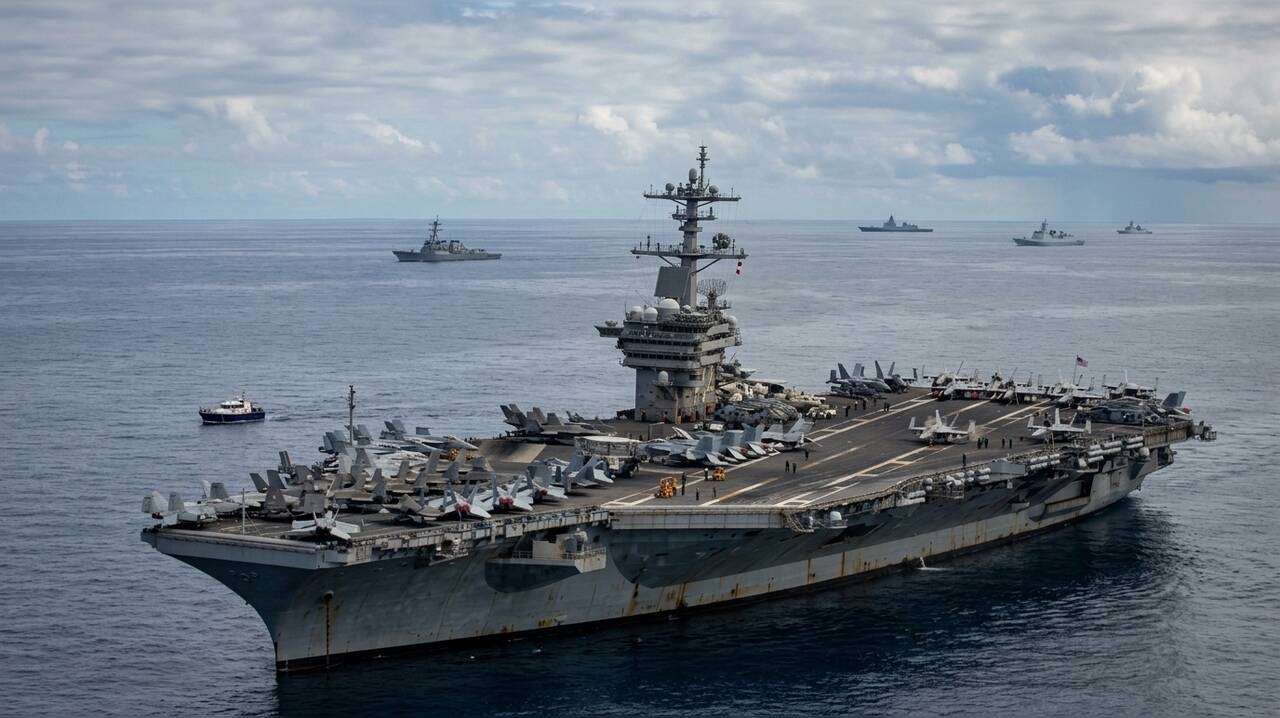
The USS George Washington departed the Pacific this week, expected to relieve USS Abraham Lincoln in the Middle East, leaving the western Pacific without a single U.S. aircraft carrier for the first time in this stretch of the Iran conflict. The swap is driven by genuine welfare concerns aboard the Lincoln, which has logged more than 240 consecutive days at sea, a record uninterrupted deployment, with its return extended well past its original May date specifically to sustain operations against Iran, amid what multiple outlets have reported as mounting mental health and supply strain among the crew. Navy officials insist the gap is temporary, and Bryan Clark, a defense analyst at the Hudson Institute, was blunt about the diplomatic optics regardless: "they're using this as part of the narrative to demonstrate to the Philippines, to Japan, to Indonesia and others that the US is not the big dog in the western Pacific anymore."
The Navy's own numbers make clear this isn't simply bad luck, it's the arithmetic finally catching up to a fleet that was already stretched thin before this rotation even began. Clark noted the Navy operates 11 carriers total and typically deploys just two or three at any given time, and this blog's earlier coverage of USS Kennedy's delayed trials already flagged that Nimitz's retirement was set to temporarily drop the total operational fleet to 10 hulls, a reduction in surge capacity that compresses the maintenance-and-deployment rotation across a smaller pool of ships precisely as demand from multiple theaters spikes simultaneously. What's happening now with the George Washington-Lincoln swap is that compression made visible in real time: an open-ended Middle East commitment eating directly into the Pacific's operational carrier presence because there simply isn't enough hull capacity to fully cover both regions when one theater refuses to wind down on schedule.
CSIS's Greg Poling captured the policy contradiction this exposes more sharply than any single military detail could: the administration has repeatedly framed the Pacific as its top strategic priority behind only the Western Hemisphere, yet is "doing the exact opposite" of its stated goal of reducing Middle East entanglement, with Poling noting regional allies are increasingly unsettled by the gap between rhetoric and actual carrier presence, while Beijing "is quite happy with U.S. distraction." That's not an abstract concern given what this blog has already documented about China's own naval trajectory during this same window, Fujian's commissioning and its KJ-600 airborne early warning trials closing a surveillance gap that previously distinguished U.S. carrier aviation, and China's shipbuilding capacity assessed at more than 200 times America's own. A carrier-free western Pacific, even a temporary one, lands at almost exactly the moment China's own carrier program has the most reason to appreciate the optics of American absence.
The Ford-class program's own struggles compound the timing further. This blog's coverage of USS Kennedy's acceptance trials already noted the ship remains roughly seven months from even preliminary acceptance, let alone the additional year or more of shakedown before actual deployment readiness, meaning the newest and most capable carrier class the Navy is counting on to eventually ease exactly this kind of scheduling strain isn't available to help right now, and won't be for some time. Meanwhile Gerald R. Ford's own most recent deployment ran 11 months, the longest since Vietnam, and included an unplanned diversion back to the Mediterranean after a laundry-space fire displaced hundreds of sailors, a maintenance-driven detour that likely tightened the broader carrier rotation schedule further still.
Chief of Naval Operations Adm. Daryl Caudle has reportedly been pushing since February to convince regional commanders to rely more on smaller, newer ships rather than defaulting to full carrier strike groups for every mission, an institutional acknowledgment that the carrier fleet's current size can't sustainably cover simultaneous Middle East, Pacific, and other global commitments the way Navy planning has traditionally assumed. Whether that shift happens fast enough to matter is a separate question from whether the underlying diagnosis is correct, and this week's Pacific carrier gap, following directly on the interceptor depletion, the delayed Kennedy delivery, and the broader shipbuilding capacity crisis this blog has tracked across the summer, reads less like an isolated scheduling hiccup and more like confirmation that America's carrier fleet, however individually dominant each hull remains, is simply too small right now to be everywhere its own strategic priorities say it needs to be.

No comments:
Post a Comment