
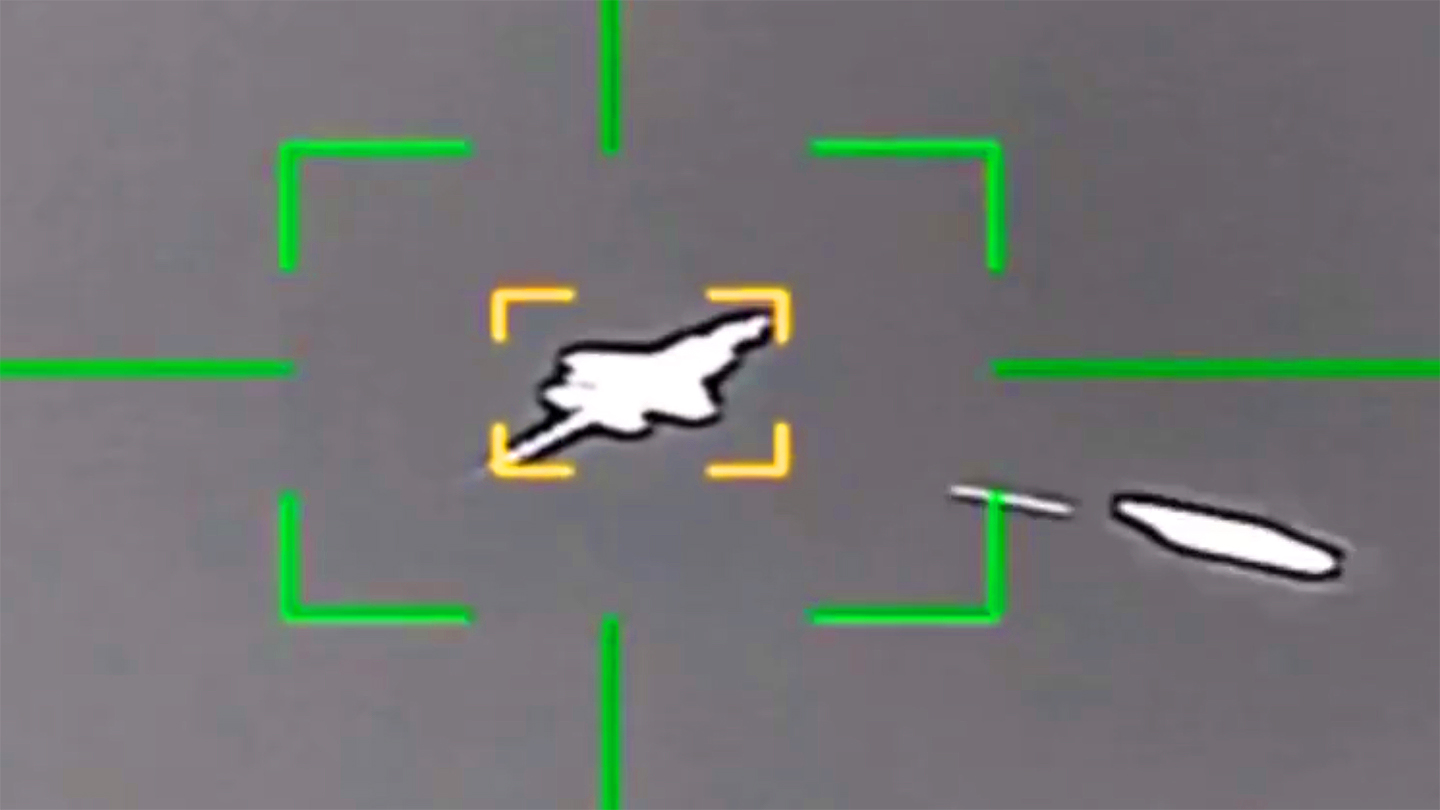
Chinese state broadcaster CCTV aired footage on August 8 showing PLA soldiers coordinating man-portable air-defense systems (MANPADS) with HQ-16 medium-range missiles specifically to hunt stealth aircraft, with two operators firing infrared-guided MANPADS in near-perfect synchronization to strike a stealth target drone simultaneously at night, a level of coordination CCTV emphasized is technically demanding since a second missile fired even slightly late risks locking onto the first missile's heat plume instead of the target. The logic behind the tactic is straightforward: most air-defense systems rely on radar, which struggles against a reduced radar cross-section, while infrared-guided MANPADS hunt heat signatures instead, exploiting the fact that stealth aircraft reduce but don't eliminate the thermal signature generated by engine heat and airframe heating. Chinese state media explicitly tied the demonstration to reports that Iran used infrared detection to hit a U.S. F-35 earlier this year, without offering further detail on that incident.
That underlying premise deserves considerably more scrutiny than the CCTV segment gave it, because the actual F-35 incident it's citing remains genuinely unresolved more than four months later. What's actually confirmed: an F-35 made an emergency landing at a regional base in late March after sustaining damage during a combat mission over Iran, with the pilot reported in stable condition and the cause placed under investigation. What's disputed: Iran's IRGC claimed credit for the strike and released footage, but CENTCOM never confirmed the cause, and this sits inside a broader pattern of Iranian claims during the war that the Pentagon has explicitly described as exaggerated or fabricated, including a widely circulated claim of a second F-35 downed weeks later that Central Command neither confirmed nor denied, and at least one entirely fabricated F-35 wreckage image later debunked by reverse-image search. Iran separately claimed to have destroyed three F-35s and three other aircraft in an attack on a Jordanian base, which CENTCOM flatly denied, stating no U.S. aircraft were damaged in that specific incident. In short, China appears to be building an anti-stealth training doctrine partly around an incident whose actual cause the U.S. has never acknowledged and whose broader claim pattern includes confirmed fabrications.
The technical skepticism EurAsian Times' own reporting captured from Indian Air Force veteran Air Marshal G.S. Bedi is worth taking seriously independent of the F-35 sourcing question, and it's a rare instance of a source article building in a genuinely sharp counterargument rather than just amplifying the original claim. Bedi dismissed the drill as "hype" and a "typical copy-book scenario," pointing out that MANPADS' short range means a stealth aircraft would need to be dangerously close for the tactic to work at all, a proximity that runs directly against the standoff-strike doctrine every advanced air force, including China's own, is actively moving toward. His sharpest point cuts at the coherence of China's broader anti-stealth messaging: "if stealth is so easily detectable and defeatable, why is China investing in production of so many J-20s, and now, the J-35s?" That's a fair question this blog's own coverage of the J-36/J-50 sixth-generation prototypes reinforces, China isn't hedging against stealth's obsolescence, it's racing to field more of it.
This drill also isn't an isolated claim, it's the latest entry in a now-lengthy pattern of Chinese anti-stealth announcements that EurAsian Times' own reporting history lays out candidly: a bistatic space-radar system claimed last year, the JY-27V meter-wave radar unveiled in May 2025 that reportedly failed to detect U.S. stealth jets during a January 2026 operation despite the earlier claims, BeiDou-based refraction detection claimed in October 2024, and a 2022 claim of an IRST system capable of tracking a B-2 from 150 kilometers. None of these claims have been independently verified, and the same EurAsian Times reporting notes military experts and skeptics have repeatedly voiced doubt about China's theoretical, ambition-heavy announcements in this space specifically. The pattern that emerges isn't necessarily that China's anti-stealth research is worthless, multistatic radar, IRST, and networked sensor fusion are all legitimate, real approaches every major air power invests in, but that China's public messaging around each individual claim consistently outruns what's actually been demonstrated or confirmed in genuine combat conditions.
The more grounded reading of this drill, then, isn't "China has found the F-35's fatal flaw," it's a country investing seriously and rationally in complementary anti-stealth sensor layers, as EurAsian Times' own conclusion notes, while periodically attaching those investments to combat narratives, the Iran-F-35 connection among them, that don't hold up cleanly to the verification the claims are asked to bear. Given this blog's own coverage of how murky and contested combat claims have proven throughout the Iran war, from the Su-57's disputed AEW&C kill to Pakistan's contested Rafale claims, treating any single unverified incident as the empirical foundation for a new doctrine, whether that's done by Chinese state media or by anyone repeating the claim uncritically afterward, is exactly the kind of shortcut this blog has tried to avoid across a summer's worth of these stories.

No comments:
Post a Comment