
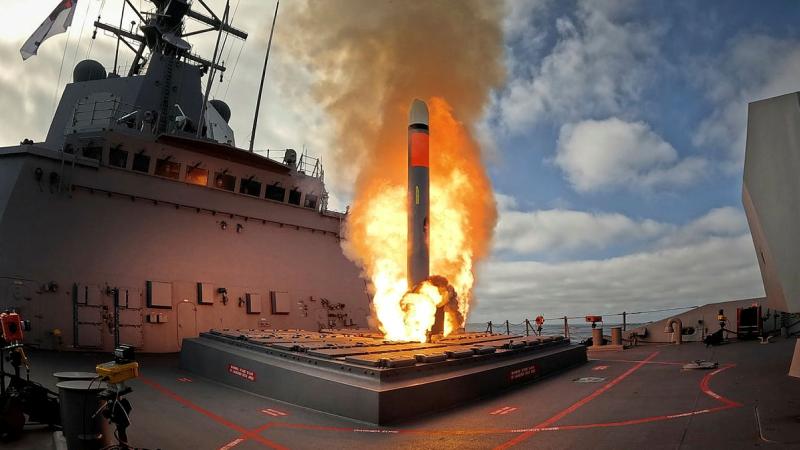
The Pentagon awarded RTX unit Raytheon a $22.9 billion contract on August 17 to dramatically scale up Tomahawk cruise missile production, a seven-year deal that firms up a framework agreement first signed in February and aims to push annual output past 1,000 missiles, up from the roughly 60 a year the company currently produces. Acting Secretary of the Navy Hung Cao framed the deal in the same "wartime footing" language this blog has now tracked across nearly every major munitions announcement this year: "We called on industry to rapidly scale up munitions output, and RTX is delivering." The announcement itself, like the SM-3 component deal covered here days earlier, runs barely a few hundred words, no breakdown of cost per missile, no discussion of what expenditure actually drove this, no mention of the timeline gap between contract signing and missiles actually reaching magazines.
That missing context is where the real story sits, and it's considerably more alarming than the press release format suggests. CSIS's April analysis found the Iran war had already depleted nearly a third of America's prewar Tomahawk inventory, more than 1,000 missiles out of roughly 3,100, and CNN reporting from early August pushed that figure toward half the stockpile, with one source describing regional Tomahawk stocks as approaching "Winchester," military slang for completely out of ammunition, even as the administration publicly insisted critical stockpiles hadn't been dangerously depleted. Each Tomahawk runs somewhere between $2.6 million and $3.6 million depending on variant, and CSIS's own replenishment modeling before this contract estimated a four-to-five-year timeline to restore prewar inventory levels even with expanded production, a stark illustration of how far a defense-industrial base built for "a dozen to a few hundred missiles annually," as CBS News described the pre-war baseline, sits from what a sustained, high-intensity conflict actually consumes in months.
The 1,000-per-year target this contract sets is a genuinely dramatic scale-up, more than 16 times current output, but it's worth being honest about what that number does and doesn't solve. Even at full production, replacing the roughly 1,000-1,500 Tomahawks expended against Iran alone would take one to one-and-a-half years of maximum output with zero missiles set aside for training, testing, or any other contingency in the meantime, and that's before accounting for the parallel drawdown in ATACMS, PrSM, and JASSM stocks CNN's reporting flagged as the primary munitions actually consumed during the war's most recent phase. Kelly Grieco of the Stimson Center's blunt assessment to CBS News captures the recurring pattern this blog has now documented across Patriot, THAAD, SM-3, and now Tomahawk: "It's been recognized that we don't have enough long-range strike capability, so we've been trying to build up these stockpiles, but we keep depleting them."
The strategic stakes behind this specific munition type are arguably higher than any interceptor shortage this blog has covered so far, because Tomahawk isn't a defensive system absorbing enemy fire, it's the primary long-range offensive strike capability the Navy has for hitting land targets from ships and submarines without risking a crewed aircraft. 19FortyFive's analysis of the Pentagon's own wargaming is the sharpest articulation of why that distinction matters: the site reports Pentagon models of a Taiwan contingency show a Tomahawk magazine emptying in days rather than months, meaning the more than 1,000 missiles just expended against a regional power with comparatively limited air defenses represent a rehearsal, whether intended as one or not, for a China scenario the current stockpile and even this expanded production rate may not be sized to survive.
Reading this contract alongside the PAC-3 seeker deal, the SM-3 component agreements, and CENTCOM's pivot toward attritable drones through Falcon Strike, the pattern across this entire year's procurement announcements is now impossible to describe as coincidental: America's post-Cold War defense-industrial base, built around low-rate, predictable-demand production lines, has met a genuinely sustained high-intensity conflict and found itself structurally unprepared for what that conflict actually consumes, across nearly every major munitions category simultaneously. A 16-fold production increase is a serious, credible response to that discovery. Whether it's a sufficient one depends less on Raytheon's new manufacturing capacity than on whether the next conflict America finds itself managing gives its industrial base the years this replenishment timeline assumes it will have.

No comments:
Post a Comment