
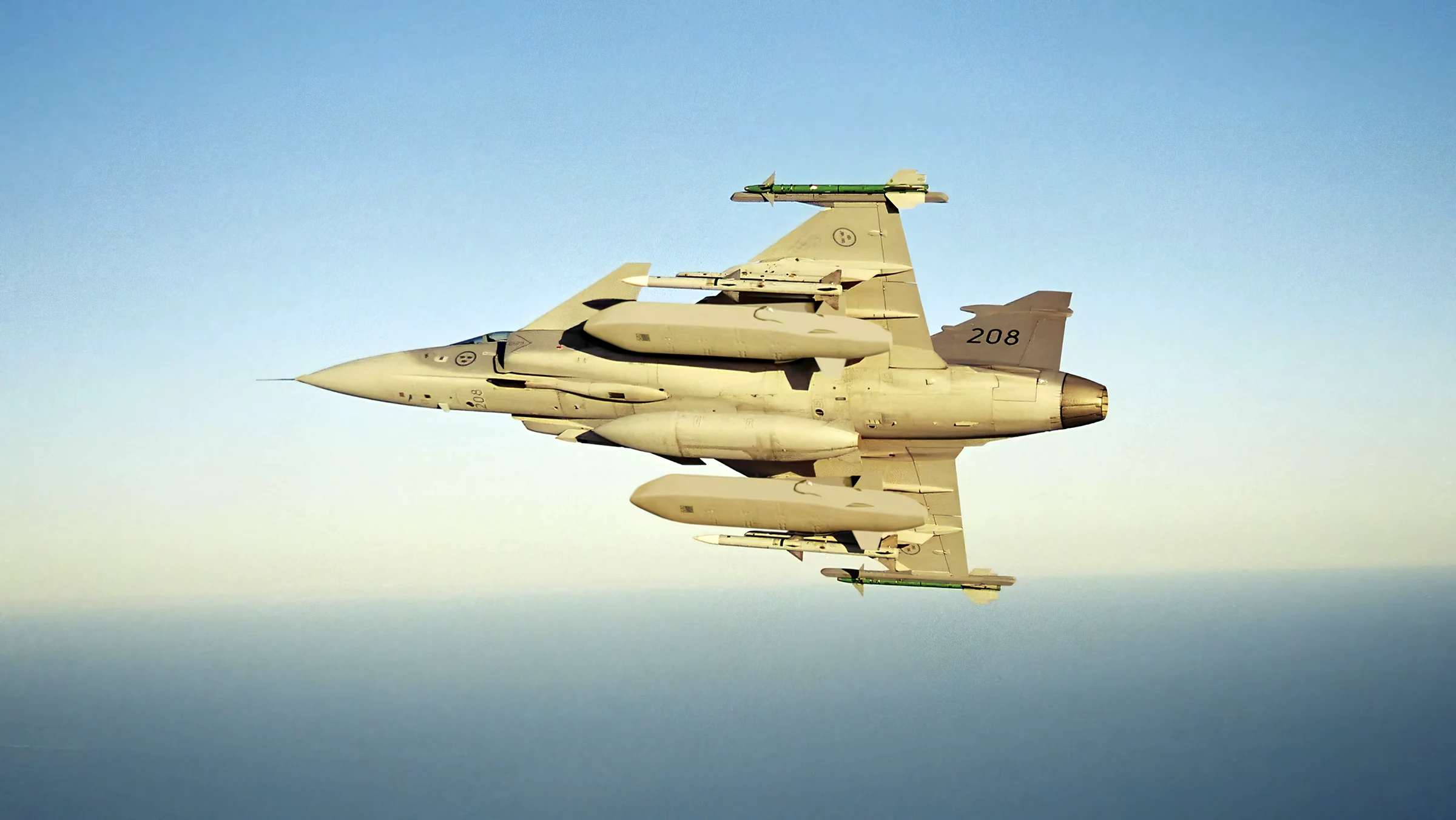
A Swedish Air Force JAS 39 Gripen C launched a live TAURUS KEPD 350 cruise missile for the first time on August 21 at the Vidsel Test Range in Norrbotten, verifying an aircraft-weapon interface that gives Sweden a genuinely new capability, striking hardened, high-value targets from beyond 500 kilometers while staying outside the range of concentrated air defenses. Swedish Air Force representative Wikman's own framing captures the scale of the doctrinal shift plainly: "we haven't had any deep-strike or offensive counter-air capabilities before... we could just put all of our money on defensive abilities, but now that is a huge shift for us." Sweden only began formally integrating and procuring TAURUS in February 2025, and the Aviationist's own reporting confirms this specific milestone arrived considerably ahead of the originally disclosed 2028 initial-operational-capability target, with the actual acceleration timeline kept undisclosed for program-sensitivity reasons.
This lands the same week this blog covered Saab's unveiling of its Autonomous Collaborative Platform drone concept, and the two announcements are worth reading together rather than as coincidental timing. That earlier piece argued Saab was positioning its ACP program as a technology on-ramp toward a future crewed Gripen successor, built through patient, spiral development rather than a collapsed multinational consortium model. This TAURUS milestone extends the same underlying story from the airframe side to the weapons side: Sweden isn't just planning its next fighter concept, it's actively transforming what its current fighter fleet can actually do, converting the Gripen from a purely defensive counter-air platform into a genuine offensive deep-strike asset within the same week Saab's own roadmap presentation was laying out where the airframe itself goes next. Both stories describe the same broader Swedish trajectory: a country rapidly expanding its military ambitions across both current hardware and next-generation concepts simultaneously, rather than choosing one focus over the other.
The strategic context behind this shift connects directly to Sweden's 2024 NATO accession, ending two centuries of formal non-alignment, and it reframes the TAURUS launch as considerably more consequential to the alliance than a single national capability upgrade. A JAS 39 Gripen C is one of the smallest, cheapest fighters in Europe, and giving it a weapon capable of holding targets at risk 500-plus kilometers inside hostile territory doesn't just benefit Sweden's own deterrent, it hands NATO's broader Northern European posture an additional, comparatively low-cost stand-off strike option against exactly the kind of command nodes, air-defense infrastructure, and hardened targets this blog's own coverage of Russian Baltic and Arctic signaling, the Kaliningrad EA-37B flight, the Kuril live-fire drills, the Pantsir buildout around Moscow, has documented all summer as increasingly relevant threat categories.
The TAURUS missile's own design logic, flying low and following terrain specifically to penetrate dense, layered air defenses, is worth setting against the Kh-31PM anti-radiation missile campaign this blog covered just days earlier, where Russian Su-35S aircraft have been documented hunting Ukrainian Patriot radar emitters specifically. Both weapons represent the same underlying doctrinal insight approached from different directions: TAURUS is built to survive a defended engagement by staying low and hard to track, while the Kh-31PM is built to actively destroy the radar infrastructure that would otherwise detect a low-flying threat like TAURUS in the first place. Reading them together illustrates the layered offense-defense contest this blog has tracked repeatedly this summer, every new stand-off strike capability invites a corresponding investment in either detecting it earlier or destroying the sensors that would.
None of this establishes that TAURUS-armed Gripens are operationally deployed today, this remains a successful test rather than declared operational readiness, and FMV's own disclosed timeline still has full Gripen E integration running through the MS20 Block 4 configuration in 2028. But a single live-fire test that took Sweden from zero deep-strike capability to a demonstrated 500-kilometer stand-off strike option, arriving the same week its own manufacturer unveiled the airframe concept meant to carry Swedish air power into the 2030s and beyond, is a genuinely significant marker of how quickly Sweden's military posture has shifted since joining NATO, a transformation this blog's own Nordic coverage, from the Norway Black Hawk sale to Sweden's own GlobalEye and Gripen export success, has been tracking build momentum across nearly every domain simultaneously.

No comments:
Post a Comment