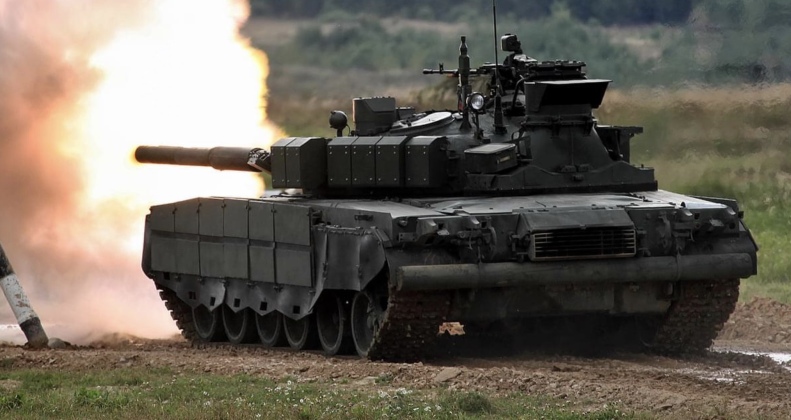
Newly surfaced media from Russian defense channels has revealed a previously unseen sub-variant of the T-80BVM main battle tank, showcasing an extensive up-armored configuration designed for high-intensity frontline combat. As Russia's most complex and costly Cold War-era armored platform, the T-80 has experienced a major operational resurgence during the conflict in Ukraine. This latest iteration introduces radical structural modifications aimed at maximizing crew survivability against modern saturation threats, most notably pervasive first-person-view (FPV) drones and loitering munitions.
The most prominent feature of the newly revealed upgrade package is a heavily redesigned, factory-integrated turret-mounted anti-drone canopy, widely known among troops as a "mangal". Moving far beyond the improvised metal slat cages hastily welded onto early-war armor, this new configuration features a low-profile, structurally integrated mesh architecture that provides comprehensive overhead and lateral coverage across the turret roof. The system is engineered to force premature detonations of incoming shaped-charge warheads before they can impact the thinner composite or upper deck armor of the vehicle.
Beneath the specialized superstructure, the T-80BVM retains its core high-performance characteristics that distinguish it from standard diesel-powered counterparts like the T-72 and T-90. Powered by an aviation-derived gas turbine engine, the tank boasts an exceptional power-to-weight ratio, delivering superior acceleration, unmatched reverse speeds, and reliable cold-weather startup performance down to extreme sub-zero temperatures. These mobility traits have made the platform a favored asset among elite Russian armored formations operating across challenging terrain in the Ukrainian theater.
The rolling modernization of the T-80 fleet also incorporates upgraded Relikt explosive reactive armor (ERA) blocks, enhanced multi-channel gunner and commander thermals, refined fire-control computers, and compatibility with advanced 125mm kinetic and guided munitions. While the extreme fuel consumption and intricate maintenance demands of its gas turbine powerplant have historically limited its mass adoption compared to simpler diesel designs, its proven combat utility has driven ongoing fleet expansions and long-term industrial re-evaluation.
Ultimately, the appearance of this heavily up-armored T-80BVM variant underscores how rapidly armored vehicle survivability doctrines are evolving to match drone-heavy battlefield realities. As defense manufacturers continue to iterate on factory-standard protective countermeasures, platforms like the T-80 remain at the bleeding edge of modern ground combat vehicle development.


No comments:
Post a Comment