
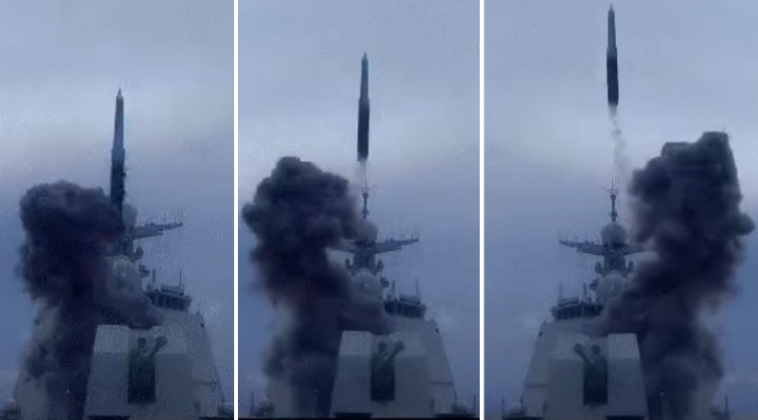
Newly released state media footage has officially confirmed the successful integration and live-firing of the YJ-20 hypersonic anti-ship ballistic missile from the Chinese People's Liberation Army Navy's backbone Type 052D class destroyers. Previously, public evidence of ship-based YJ-20 deployments was restricted to larger, heavier platforms like the formidable Type 055 class. This newly unveiled footage—showcased in a military documentary commemorating the armed forces—marks a major qualitative leap for China's most numerous frontline surface combatant.
The successful adaptation stems from the universal vertical launch system (VLS) architecture shared across modern Chinese warships, which relies on a standardized cold-launch mechanism. Compressed propellant gases eject the heavy missile safely clear of the hull before main motor ignition, minimizing thermal stress on the deck structure. Because the compact YJ-20 fits seamlessly into standard launch cells alongside routine air-defense and cruise missiles, even smaller destroyer hulls can now deploy an arsenal of strategic, high-speed strike weapons.
The YJ-20 stands out globally as one of the most capable ship-launched anti-ship munitions in existence, boasting an estimated operational range between 1,500 and 2,000 kilometers. The weapon cruises at velocities exceeding Mach 6 before diving toward its target at terminal speeds surpassing Mach 10. This extraordinary velocity, combined with an unpredictable aerodynamic and ballistic trajectory, is specifically engineered to defeat advanced shipboard defense networks and Aegis-equipped combat systems.
This technological leap is heavily supported by China's expanding domestic aerospace and defense manufacturing sector, which has optimized solid-fuel formulations and guidance suites for maritime environments. By refining internal component layouts, engineers have successfully miniaturized the heavy guidance systems required for precision long-range terminal strikes. These manufacturing enhancements allow Beijing to produce the missiles at a scale that makes widespread fleet integration economically and logistically viable.
By expanding this hypersonic capability beyond heavy cruisers and down to the much more prolific Type 052D fleet, Beijing has drastically multiplied the number of high-readiness platforms capable of long-range maritime strike missions. Defense analysts note that equipping these mainstream destroyers with weapons capable of outrunning and evading modern interception grids fundamentally reshapes naval power balances. As regional tensions persist across the Indo-Pacific, the widespread proliferation of shipborne hypersonics reinforces a growing challenge to traditional carrier strike group survivability.

No comments:
Post a Comment