
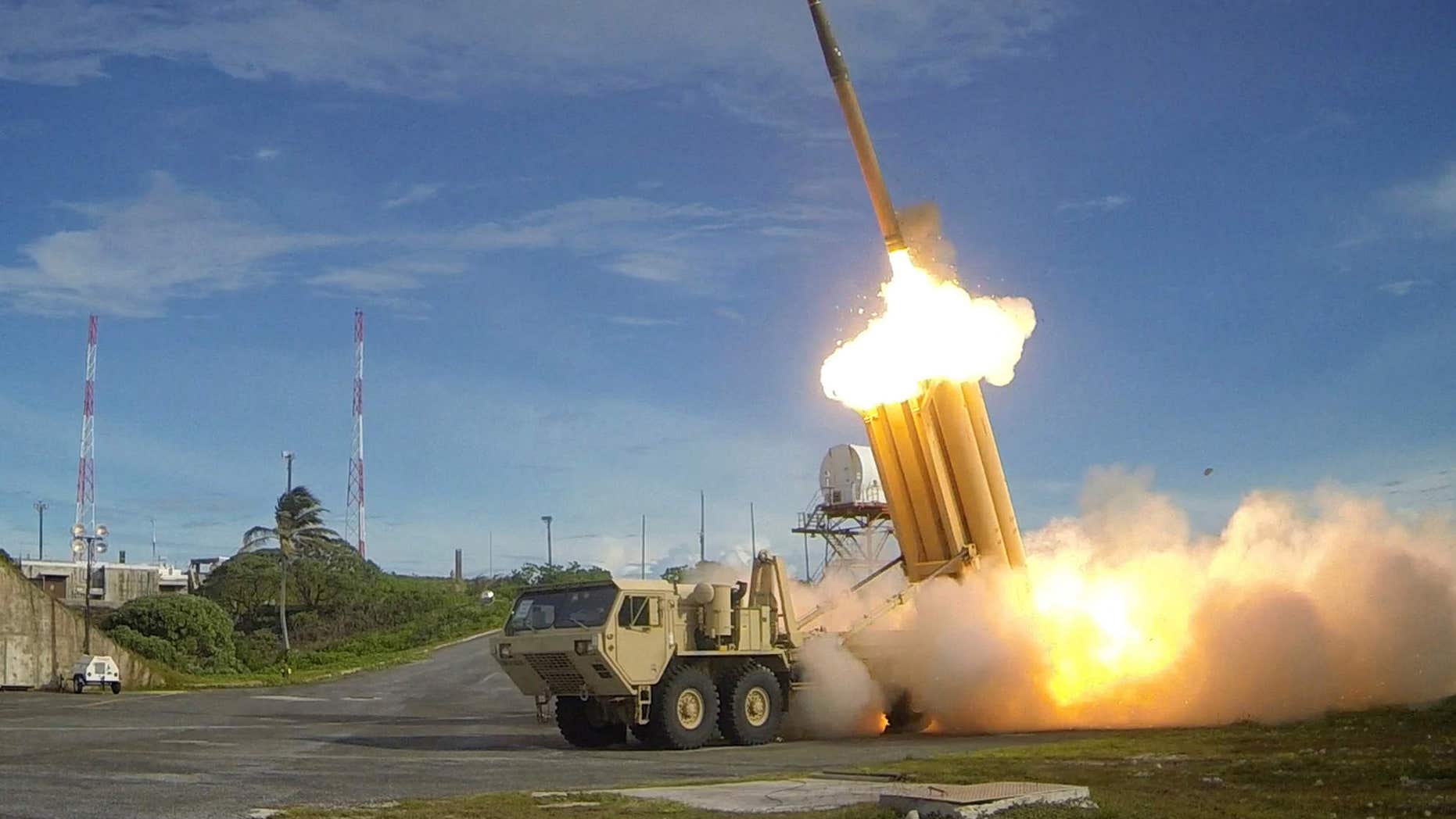
Count them: March, three framework agreements with BAE Systems, Lockheed, and Honeywell. April, a seven-year deal with Boeing to triple PAC-3 seeker production. Then an agreement with L3Harris and Lockheed to quadruple THAAD propulsion systems. June, a separate $35 billion Lockheed contract specifically for THAAD. Now, Monday's announcement, two more framework agreements with General Dynamics Ordnance and Tactical Systems and Lockheed Martin, targeting a tripling of PAC-3 MSE output and a quadrupling of THAAD interceptor capacity. That's at least six distinct missile-production deals announced in roughly six months, all aimed at the same underlying problem.
The problem itself is well-documented and getting worse, not better, even as the deals pile up. CSIS estimated in a July report that the U.S. has burned through roughly 65 percent of its pre-war Patriot inventory and 38 percent of its THAAD interceptors, drained simultaneously on two fronts, sustained combat against Iran and continued transfers of Patriot systems and Army Tactical Missile Systems to Ukraine. Missile production simply doesn't scale on a wartime timeline, which is precisely why the Pentagon keeps signing multi-year framework agreements rather than one-time emergency orders: Under Secretary of War for Acquisition and Sustainment Michael Duffey's own description of the strategy is that guaranteeing minimum annual procurement quantities over seven years gives contractors and their sub-tier suppliers "a stable, long-term demand signal," enough certainty to justify the kind of capital investment, new facilities, expanded workforce, bulk material purchases, that a single annual contract wouldn't.
What Monday's specific deal actually targets is instructive: not finished missiles, but the components that bottleneck finished-missile output, motor cases, seeker housings, midsections, and shroud deployment systems, the unglamorous subassemblies that determine how fast a prime contractor can actually turn raw material into a working interceptor. General Dynamics will build those components; Lockheed remains the prime contractor stitching them into complete PAC-3 MSE and THAAD rounds. That's a genuinely sensible way to attack a production bottleneck, expanding capacity at the sub-tier supplier level rather than just pressuring the prime contractor to somehow build faster with the same input pipeline.
There's a caveat attached to every single one of these announcements that's easy to miss buried in the press-release language, and it matters more than the headline multiplication factors do: funding for all of it is subject to annual congressional appropriations. A seven-year framework agreement isn't a seven-year funding guarantee, it's a commitment to buy at a certain rate if Congress actually appropriates the money each year to do so. Six deals announced doesn't mean six deals fully funded through their entire multi-year term; it means six demand signals sent to industry, betting that Congress keeps writing checks at the pace the Pentagon is now promising.
Whether tripling and quadrupling production capacity actually closes the gap CSIS documented is a question of years, not months. Interceptor manufacturing involves specialized components, skilled labor, and testing timelines that don't compress just because a contract says "seven years" instead of "one year." What's genuinely notable about the pace of these announcements, six in half a year, is less that any single one represents a breakthrough and more that it reflects an institution treating this as an emergency it hasn't yet solved with the previous five attempts, still building toward capacity it doesn't currently have, one framework agreement at a time.

No comments:
Post a Comment