
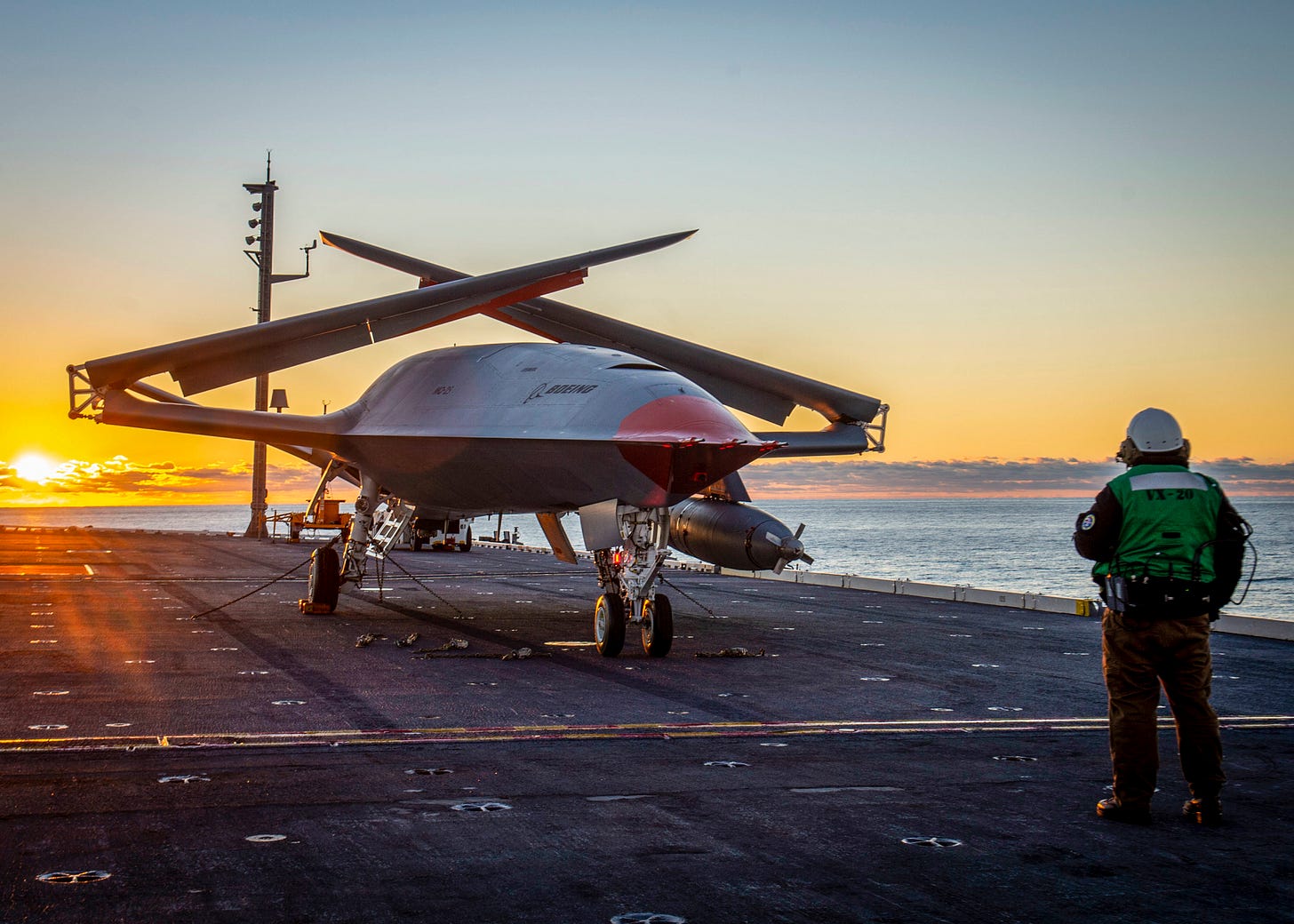
In 2024, Navy officials were clear about the number that mattered most for their planned carrier-based combat drone: keep it around $15 million a unit, because the whole point was that it's meant to be expendable, something you can afford to lose in a fight without the program collapsing. The Request for Information the Navy put out on August 31 quietly doubled that target. Contractors are now being asked to hit $30 million per aircraft, and to submit an interim manufacturing and supply chain plan for getting there. That's the same order of magnitude as a fourth-generation manned fighter, which raises an obvious question: at what price does "expendable" stop meaning anything?
The rest of the spec sheet reads like a genuinely serious attempt to build a real combat aircraft rather than a stripped-down sacrificial drone. Up to five tons of ordnance. Four external weapons up to 2,500 pounds each, carried through the full flight envelope and carrier certification testing. Catapult launches and arrested landings in sea states up to 13-foot waves, the same rough-water tolerance the Navy expects from its manned jets. Operation off both Ford- and Nimitz-class decks without requiring major modifications to either. This isn't a scaled-down toy meant to soak up enemy fire cheaply, it's a drone built to carry a real strike payload and survive real carrier operations, and that ambition is exactly what's driving the cost up.
The stated rationale for building it at all is worth taking at face value, because it's genuinely different from the usual "drones are cheaper" pitch. The Navy's own language in the RFI frames the problem around absorbing losses, not avoiding them: traditional manned platforms and surface combatants carry "high cost and extended timelines required to replace" them, which "limit the Joint Force's capacity to absorb operational losses." That's a subtly different argument than simply wanting cheap hardware. It's an admission that the Navy expects to take real losses in a serious fight and wants something it can lose and rebuild fast, without every combat loss meaning a years-long wait for a replacement F-35 or Super Hornet. A $30 million drone still replaces faster than a $100 million-plus fighter, even if it's no longer cheap in any absolute sense.
The integration requirements tell their own story about how conservative the Navy is being on everything except the aircraft's actual mission profile. The CCA has to fit within existing deck, elevator, and hangar bay dimensions, its "spot factor," how much space it eats up on a crowded flight deck, can't exceed a standard fourth-generation fighter. It has to fly using the same carrier air wing personnel already aboard, controlled through the MD-5 Unmanned Carrier Aviation Mission Control System already built for the MQ-25 Stingray tanker drone. Even the eventual specialized handling equipment the Navy wants has to work through existing EMCON, emergency communications-out, procedures without adding deck crew. Every one of those constraints is the Navy protecting its existing carrier infrastructure and workflow rather than redesigning around the drone, a genuinely sensible way to avoid the kind of disruptive, expensive integration problems this blog has already tracked with the Ford-class's own arresting-gear troubles.
Two prototypes, shore-based and carrier-qualified within three years, is the near-term target, with proposals due September 18. Whether contractors can actually thread the needle the Navy's asking for, real strike payload, real carrier-deck compatibility, genuine expendability, all at a price point that's already doubled once before the program has even selected a design, is the real test this RFI sets up. A drone this capable, at a cost creeping closer to a manned aircraft's, only pays off if the Navy is genuinely prepared to lose it in combat rather than treating it, once it's actually built, as too expensive to risk.

No comments:
Post a Comment