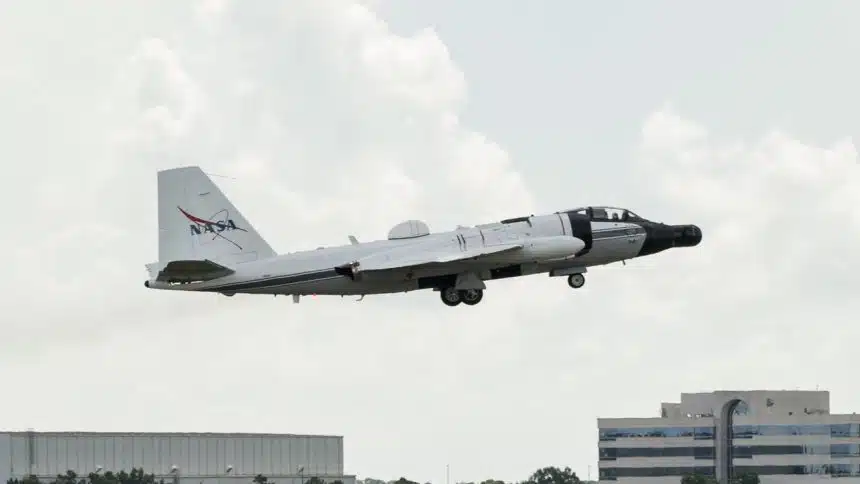
As recently reported by The Aviationist, one of NASA’s rare and highly modified WB-57F high-altitude research aircraft has arrived at Keflavík Airport in Iceland to undertake a unique scientific mission. Operating under the callsign 'NASA926', the specialized jet made the transatlantic trek from Ellington Field, Texas, via Bangor, Maine, positioning itself to intercept the path of a total solar eclipse. While European deployments of the iconic twin-engine Canberra derivative are exceedingly rare, the mission highlights the unmatched utility of high-altitude platforms in capturing critical atmospheric and solar data.
The primary objective of the deployment is to launch the aircraft directly into the eclipse’s shadow path to study solar phenomena from an altitude exceeding 50,000 feet. Flying far above the dense layers of tropospheric water vapor, atmospheric haze, and low-level turbulence gives the jet's onboard sensor suites a pristine window for observation. Operating at high altitudes allows specialized optical instruments to record sharper images and capture electromagnetic wavelengths—particularly in the infrared spectrum—that are ordinarily absorbed or distorted before reaching ground-based telescopes.
Furthermore, utilizing a high-performance aircraft like the WB-57 radically extends the observation window compared to stationary ground stations. By flying along the trajectory of the Moon's shadow, the jet can keep pace with the celestial alignment, effectively increasing the duration of totality data collection by a significant margin. This dynamic tracking capability proved invaluable during previous solar eclipse campaigns in 2017 and 2024, enabling researchers to gather high-resolution imagery of the Sun's faint outer atmosphere, or corona, and measure shifting ionization levels in the upper atmosphere.
The aircraft itself—managed by NASA’s Johnson Space Center—retains the baseline configuration of the classic British-designed Martin B-57, modified with a high-aspect-ratio wing spanning over 122 feet to sustain flight in the thin air of the stratosphere. Powered by dual Pratt & Whitney TF33 turbofan engines, the platform can loiter above 60,000 feet for hours while carrying heavy scientific payloads. Because NASA maintains a very small operational fleet of these airframes, deploying the active jet overseas underscores the high scientific priority placed on capturing multi-spectral data from rare celestial events.
As the aircraft prepares for its eclipse-intercept sortie, the mission serves as a striking reminder of how specialized military-heritage platforms continue to drive cutting-edge civilian research. By lifting sophisticated sensors far above the weather-bound constraints of the Earth's surface, NASA ensures that researchers can peer deeper into the Sun-Earth connection with unprecedented clarity.


No comments:
Post a Comment