
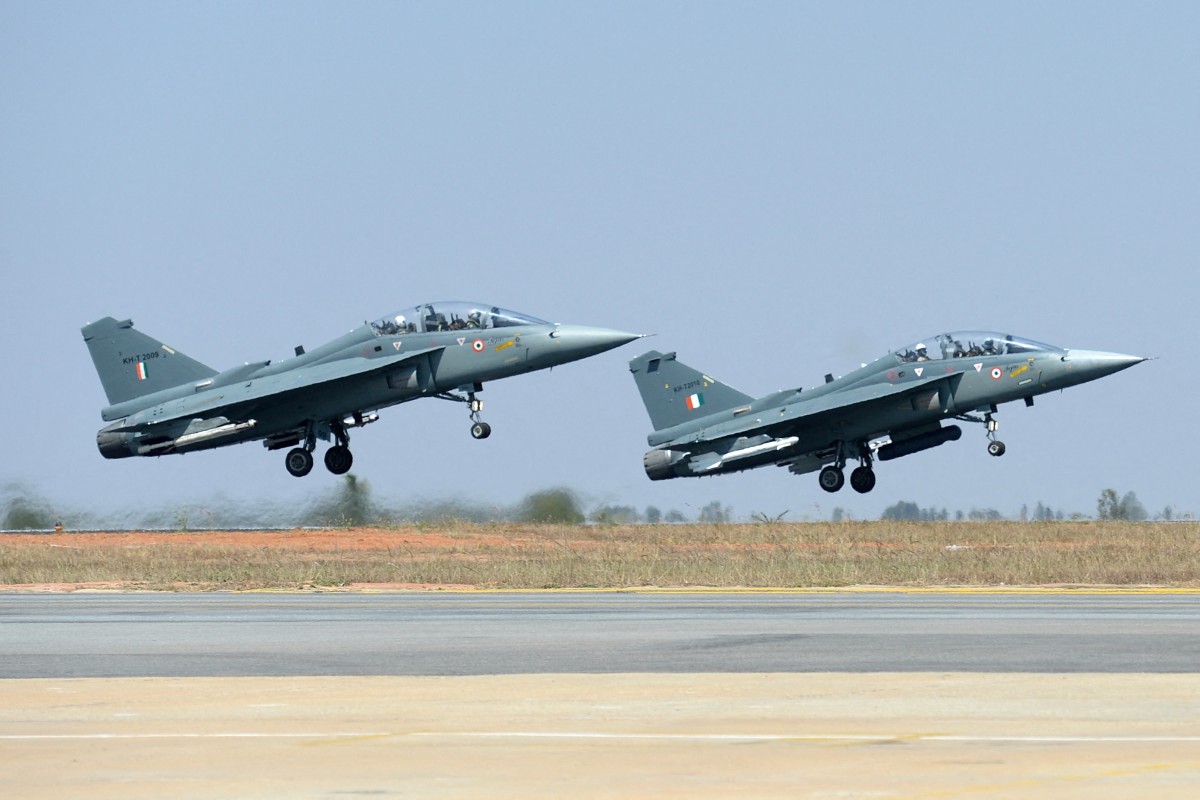
For the Indian Air Force (IAF), domestic aerospace modernization has always been a high-stakes balancing act. As military planners grapple with an acute squadron shortage—operating roughly 29 fighter squadrons against an authorized strength of 42.5—the timely induction of the HAL Tejas Mk1A light combat aircraft has become a critical operational necessity.
However, the path to fielding India’s premier indigenous 4.5-generation fighter has faced persistent turbulence, highlighted by supply-chain bottlenecks, software integration hurdles, and tight deadlines.
The Engine Bottleneck: Waiting on GE F404 Deliveries
The most visible hurdle impacting the Tejas Mk1A timeline has been tied to propulsion systems sourced from the international supply chain. Delays in receiving GE Aerospace F404-IN20 turbofan engines from the United States created a significant backlog.
Because of this supply-chain crunch, Hindustan Aeronautics Limited (HAL) found itself with a number of airframes essentially complete structurally—some having already undergone preliminary flight testing—sitting on the tarmac awaiting engines before final integration. With engine deliveries gradually stabilizing, production lines are targeting accelerated output to meet forthcoming milestones.
Complex Integration: AESA Radars and Electronic Warfare Suites
Beyond propulsion, the technical complexity of modern combat aviation has introduced software and sensor-level challenges. Integrating and synchronizing Active Electronically Scanned Array (AESA) radar systems—such as the Israeli EL/M-2052—with advanced electronic warfare (EW) suites, mission computers, and weapon architectures requires rigorous validation.
Ensuring that the radar, internal jammer systems, and beyond-visual-range (BVR) missile integration communicate seamlessly through the mission computer network has necessitated iterative software corrections. To keep the overarching modernization effort moving without triggering paralyzing program slippage, military leadership and manufacturing partners have continuously worked to streamline mandatory operational benchmarks.
A Critical Path Forward
Despite these developmental friction points, the industrial scale of the program remains unprecedented. With numerous aircraft ordered across multiple batches—backed by an extensive domestic vendor base—the success of the Tejas Mk1A is vital not just for filling immediate squadron gaps, but for validating India's long-term defense-industrial self-reliance goals.
As the program pushes forward toward its revised induction targets, balancing rigorous combat readiness with pragmatic scheduling will define whether India can successfully bridge its current capability gap and secure its skies for the decades ahead.

No comments:
Post a Comment