
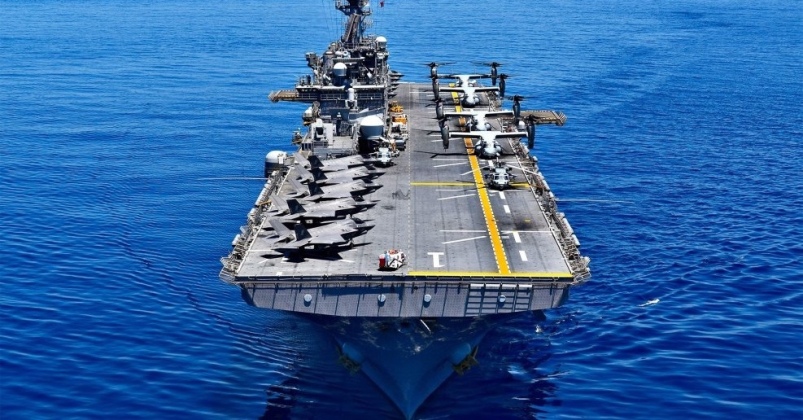
The United States Navy has officially redirected one of its premier forward-deployed amphibious strike groups from routine exercises in the Western Pacific directly into the Middle East. The sudden operational shift involves the Wasp-class amphibious assault ship USS Tripoli alongside its embarked Marine aviation force, illustrating how heavily ongoing commitments in the Central Command theater have forced Washington to reallocate strategic assets away from the Asia-Pacific command zone.
Rather than continuing bilateral training and expeditionary operations alongside regional allies in East Asia, the assault ship and its attached Marine expeditionary units were promptly reassigned to support active missions. Operating with an advanced aviation combat element capable of accommodating fifth-generation F-35B stealth fighters alongside tiltrotor aircraft, the vessel functions effectively as a lightweight aircraft carrier. This specialized configuration provides commanders with stealth combat airpower independent of traditional, heavily constrained nuclear-powered supercarriers.
Military analysts note that this high-profile redeployment highlights a growing structural strain on U.S. military resources globally. For years, the Department of Defense maintained a strict policy that countering peer adversaries in the Pacific remained its pacing scenario and top overarching defense priority. However, persistent asset drains and security demands in the Middle East have repeatedly forced the Pentagon to pull high-demand forces and tactical aviation away from other vital regional theaters.
The inclusion of the F-35B-capable assault carrier introduces enhanced tactical flexibility for ongoing operations, allowing the military to utilize short-takeoff and vertical-landing stealth jets for airborne surveillance, localized airspace control, and potential strike support. At the same time, defense experts emphasize that pulling specialized units from the Pacific leaves noticeable gaps in regional deterrence frameworks, illustrating the difficult resource compromises driving current U.S. force posture decisions.
As these amphibious assets take up station in the Middle East, military planners are carefully evaluating how long these heightened operational tempos can be sustained without degrading readiness elsewhere. The strategic trade-offs underscore the complex balancing act facing defense leaders as they attempt to manage simultaneous security challenges across multiple global flashpoints.

No comments:
Post a Comment