
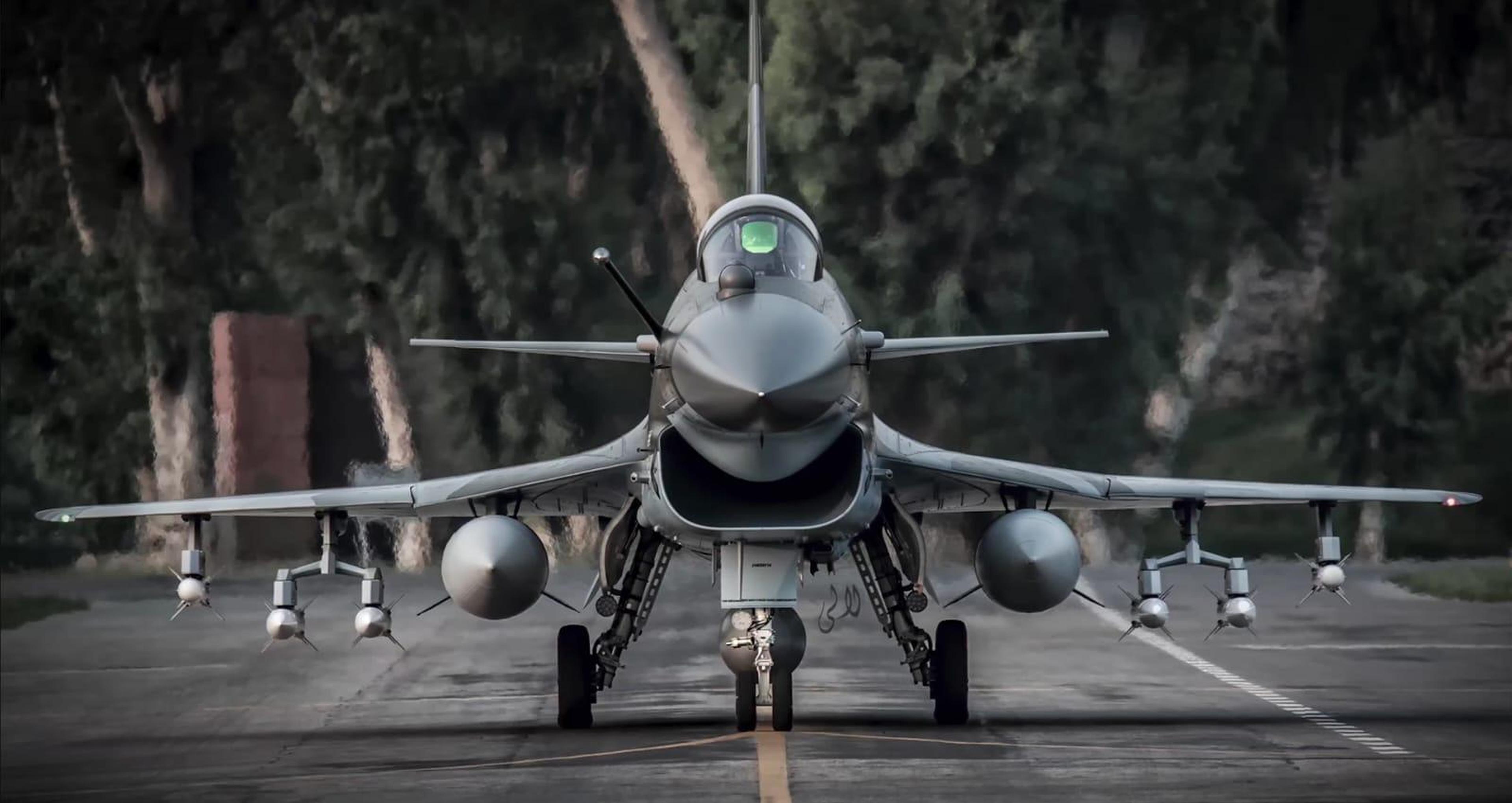
Whether Pakistan's F-16 fleet remains a credible frontline asset against India is no longer a hypothetical debate; it was effectively settled by how PAF (Pakistan Air Force) actually employed its aircraft during the four-day conflict of May 7-10, 2025. Despite operating somewhere between 75 and 80 F-16s, PAF's counter-offensive against the Indian Air Force (IAF) during Operation Sindoor and the subsequent Pakistani response was carried out predominantly by JF-17 Thunders and Chinese-supplied J-10C fighters, with Pakistani officials publicly confirming to the United States that no F-16s were flown or shot down during the engagement at all. That is not incidental. It reflects both a legal constraint and an operational judgment that together explain why Islamabad's most numerically significant fighter type sat out its own country's largest air battle in decades.
The legal constraint is the End-Use Monitoring (EUM) agreement attached to every Foreign Military Sales (FMS) transfer of F-16s to Pakistan, reinforced by a $397 million Technical Security Team program approved by Washington in February 2025 specifically to ensure the fleet stays confined to counterterrorism operations rather than conventional warfare against India. Every F-16 in PAF service, including aircraft acquired decades ago under the original Peace Gate program of the 1980s, remains subject to this restriction, and it is enforced closely enough that Pakistan volunteered evidence of non-use to preempt Indian claims of a shootdown, mirroring the same dispute that played out after the 2019 Balakot skirmish. In effect, the F-16 is politically unavailable for the one contingency it would most plausibly be needed for, which makes its combat relevance against India a moot question regardless of the airframe's technical merits.
Even setting the EUM restriction aside, the operational case for leading with the F-16 has weakened considerably. The J-10C that Pakistan flew instead is a genuine 4.5-generation platform fielding the PL-15 long-range air-to-air missile (AAM), and Chinese state media has since confirmed PAF J-10Cs were credited with downing multiple Indian Rafales during the May 7 engagement, a claim that, whatever its precise casualty count, at minimum demonstrates PAF leadership trusted the J-10C over the F-16 as its premier BVR (Beyond Visual Range) shooter against India's newest fighter. That trust is not surprising given the fleet's build dates: PAF's F-16s, even the more capable Block 52 variants delivered in the 2010s, run on an airframe design dating to 1974, and the oldest examples in Pakistani service are now pushing five decades old, making them the least modern fast-jet type in PAF's frontline inventory rather than the most.
India's own trajectory sharpens the contrast further. Where PAF has been augmenting its fleet with J-10Cs and the domestically co-produced JF-17 Block III, IAF has spent the past decade fielding Rafales, upgrading its Su-30MKI fleet, and layering in the Russian S-400 air defense system, whose reported success against Pakistani strikes during the same conflict was highlighted by Indian officials as a bigger story than any individual air-to-air result. With FlightGlobal's 2025 tally putting India at 616 combat aircraft against Pakistan's 387, PAF's numerical disadvantage was never new, but the qualitative gap the F-16 was once relied upon to offset has now shifted toward the J-10C and JF-17 Block III instead, leaving the Viper as a legacy type filling out squadron numbers rather than anchoring PAF's high-end response to India.
None of this means the F-16 disappears from PAF's order of battle; with $686 million in U.S.-approved upgrades and support flowing to the fleet as recently as late 2025, Islamabad clearly intends to keep the type flying for its counterterrorism mandate and as a hedge against further disruption to Chinese supply. But "still flying" and "still relevant to an India contingency" are no longer the same claim, and the events of May 2025 have already drawn that distinction for anyone still debating it in the abstract. The more consequential question going forward is less about the F-16's remaining shelf life and more about how quickly PAF can scale J-10C and JF-17 Block III numbers, and secure the rumored J-35 stealth acquisition, before IAF's own modernization — Rafale expansion, AMCA development, and a swelling missile defense architecture under Mission Sudarshan Chakra — widens the qualitative gap PAF is racing to close.

No comments:
Post a Comment