
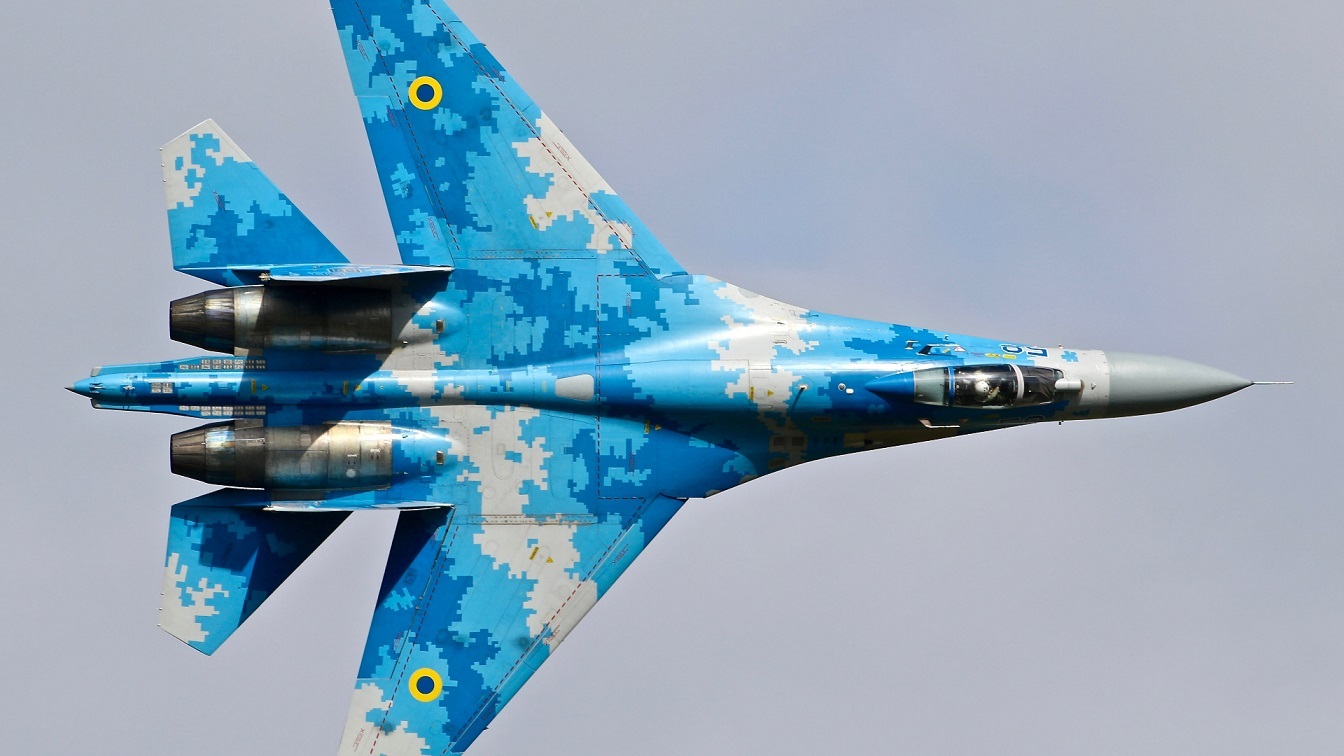
Russian Aerospace Forces Deputy Commander-in-Chief Sergey Kobylash announced this week that a Russian Su-35S pilot destroyed two Ukrainian Su-27 fighters in a single engagement, firing three missiles after what Kobylash described as skillfully maneuvering into an advantageous tactical position. The claim was made through Russian state media and has not been independently confirmed by Ukraine's Air Force or General Staff, and as with most Russian Ministry of Defence combat claims throughout this war, it should be treated as an assertion pending corroboration rather than an established fact; Moscow has a documented track record of overstating Ukrainian losses, just as Kyiv has periodically overstated Russian ones.
What makes the claim worth examining seriously regardless of whether it's eventually verified, though, is how it lands against Ukraine's already-documented Su-27 scarcity. Reporting from March 2026 citing military blogger sources put Ukraine's operational heavy Su-27 fleet, including training variants, at just five aircraft, alongside five Su-25 attack jets, following the loss of a Su-27 flown by a highly decorated brigade commander to a Russian Su-35's long-range R-37M missile. If that five-aircraft figure was even roughly accurate five months ago, and Ukraine has not received a significant infusion of additional airframes since, and there's no public evidence it has, then a genuine two-aircraft loss in a single engagement would represent a substantial proportional hit to what was already a critically thin fleet, rather than a marginal one.
The Su-27 was the Soviet Union's premier air superiority fighter when it entered service in 1984, and Ukraine inherited its share as one of four post-Soviet successor states alongside Russia, Belarus, and Uzbekistan. Four decades on, it remains in Ukrainian service not because it's still competitive against modern Russian fighters, but because Ukraine has had no alternative supply of comparable heavy air-superiority airframes; the F-16s and Mirage 2000-5s it has received from NATO members are lighter, different-role aircraft rather than direct Su-27 replacements. Russian officials have repeatedly emphasized the Su-35's role in systematically hunting down what remains of Ukraine's Soviet-legacy fighter fleet, using R-37M missiles with reported ranges up to 350 kilometers, sometimes extending further when fired by the even faster MiG-31BM, specifically to engage Ukrainian aircraft from well outside the range at which Ukrainian pilots can effectively respond.
This pattern connects directly to the broader fixed-wing attrition problem already visible across Ukraine's fleet this year, non-combat losses like the recent MiG-29 "hung missile" crash over Odesa, combat losses to Su-35s and R-37M missiles, and a total inventory that open-source tracking places at somewhere between 89 and 137 aircraft depending on the count, spread thin across multiple incompatible airframe types. A heavy air-superiority asset like the Su-27 sits at a particularly sensitive point in that math: unlike drones or ground-based interceptors, there is no meaningful production pipeline anywhere in the world still manufacturing new Su-27s, meaning every airframe lost, confirmed or claimed, is one Ukraine cannot replace in kind, only substitute with a different, generally lighter type from a completely different logistics and training pipeline.
Whether Kobylash's specific two-kill claim holds up to independent scrutiny or joins the list of Russian MoD assertions that were later disputed or quietly walked back, the underlying trend it's consistent with is not really in dispute: Ukraine's Su-27 fleet has been shrinking steadily throughout 2026 under sustained R-37M pressure from Su-35s, Su-57s, and MiG-31BMs, and every additional loss, whether it's one aircraft or genuinely two in a single dogfight, pushes what was already described as a five-airframe fleet closer to operational irrelevance rather than merely smaller.

No comments:
Post a Comment