
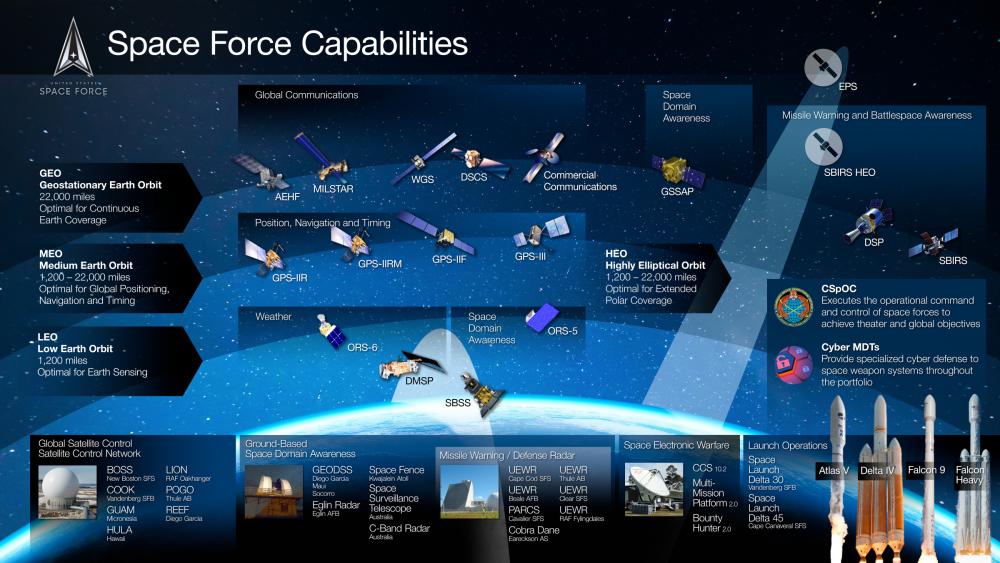
Someone in the room at National Harbor asked Troy Meink, right after his keynote, whether he'd actually meant to say what he just said. He had. The Air Force secretary told reporters the phrasing was "very well thought out," which is about as close as a sitting service secretary gets to confirming, on the record, that a sentence everyone just heard was a deliberate policy signal rather than a slip of the tongue. The sentence itself: "the United States now has on-orbit space control weapons capable of defending the joint force against hostile adversary action." It's the first time any U.S. official has publicly acknowledged weapons already deployed in space.
What Meink actually revealed is, by design, almost nothing. Not what the weapons are. Not how many exist. Not when they went up. Pressed further at a media roundtable afterward, reporters got nothing more. A Space Force spokesperson later gave TWZ the closest thing to a technical definition on record, that space control covers both kinetic and non-kinetic means used to disrupt, degrade, or destroy, spanning everything from jamming and electronic attack to physically striking another spacecraft, without narrowing down which of those categories the newly confirmed weapons actually fall into. When CNBC asked a space policy analyst to characterize what's now known, her answer was simply that it's space-based, not a ground-launched missile that could hit a satellite in orbit, which is a meaningful category to rule out but leaves an enormous range of possibilities still open.
The reason this counts as news at all, rather than a confirmation of something everyone assumed, is the decades of studied silence that came before it. Space-based weapons have been one of the most sensitive topics in American defense policy for years, with persistent public speculation about whether such capabilities already existed in some form, met consistently by official non-answers. Victoria Samson at the Secure World Foundation called Monday's statement "a very destabilizing" one, while separately predicting Russia and China's most likely immediate response will be diplomatic rather than technical, accusing Washington of militarizing space rather than rushing to demonstrate a matching capability of their own. That's a genuinely different read on the stakes than treating this as a routine capability announcement.
Meink's own framing tied the disclosure to more than a decade of watching adversaries build toward exactly this moment. He said the U.S. has known for over ten years that China and Russia were developing their own systems to threaten American space assets, and argued that maintaining "dominance in space" has become inseparable from how the country "functions" militarily, economically, and civilian-wise. That's the deterrence logic behind going public at all: a capability nobody officially admits to deters nothing, because an adversary can't be sure it's real.
The announcement didn't stop at the weapons themselves. Meink said the Space Force has reached "flight ready" status on space-based interceptors built to strike down enemy missiles from orbit, a centerpiece piece of the administration's Golden Dome missile-defense program, and separately confirmed the first of a planned constellation of air-moving target indication satellites will launch this month, part of a broader push toward continuous overhead tracking of adversary aircraft that will work alongside E-7 Wedgetail radar planes and the Navy's E-2D Hawkeyes, with a full constellation targeted for 2028 following a multibillion-dollar SpaceX award back in May. Read together, Monday's speech wasn't a single disclosure, it was several years of quietly building space-based offense, defense, and surveillance infrastructure all becoming public on the same afternoon, with the actual weapons themselves remaining the one detail Meink was careful to say just enough about, and no more.

No comments:
Post a Comment