
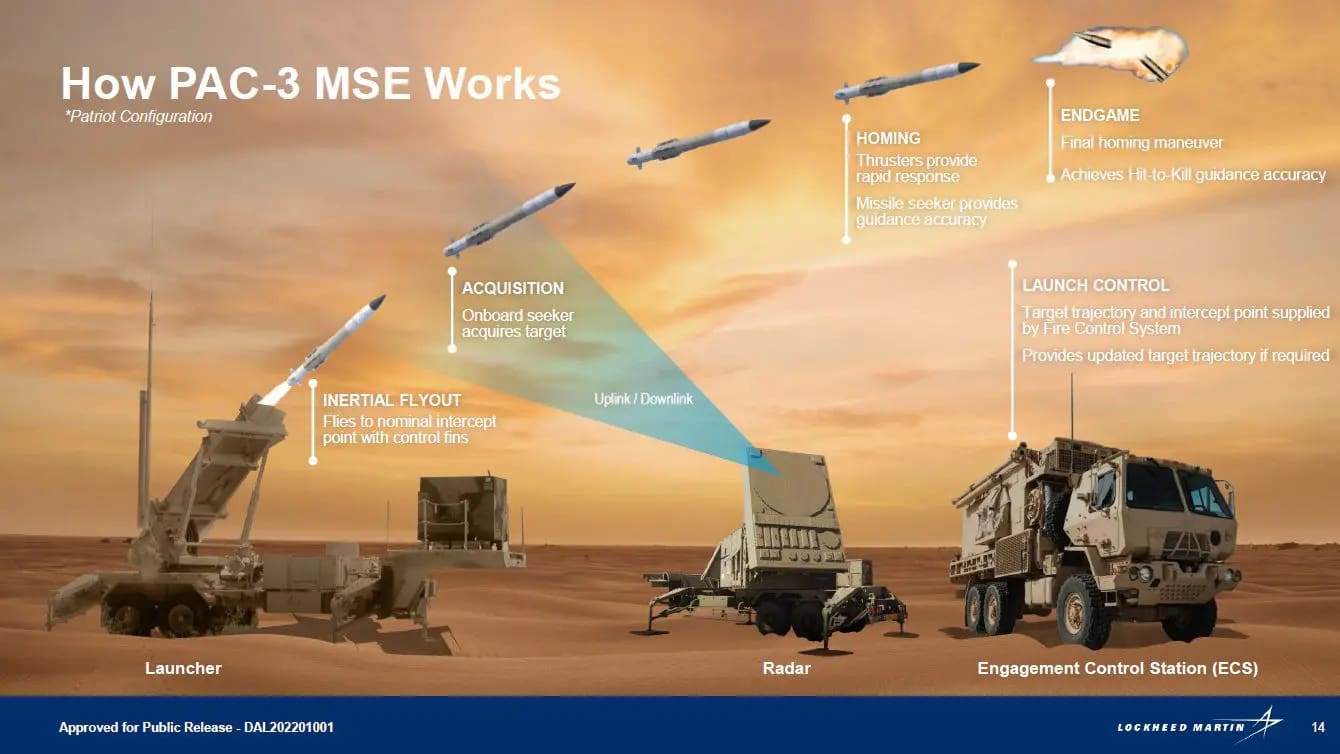
Three hundred and forty-one. That's how many PAC-3 MSE interceptors the Army and Navy requested for fiscal year 2026. The request for fiscal year 2027, according to an August CSIS analysis of the Pentagon's own budget documents, jumped to 3,203. An 839% increase in a single budget cycle is the kind of number that usually signals either a genuine emergency or a mistake, and in this case it's the former: sustained war with Iran and continued support for Ukraine have burned through interceptor stocks fast enough that the Pentagon's own demand forecasts had to be rewritten almost overnight.
Fixing that gap runs through a company most people outside the defense industry have never heard of. Lockheed Martin holds sole-source development and production rights to the PAC-3 MSE itself, but the interceptor's actual propulsion, the two-pulse solid rocket motor, attitude-control motors, and a fragment explosive device called a Lethality Enhancer, comes from L3Harris. This week L3Harris announced a $4.7 billion, seven-year contract with Lockheed to massively expand that propulsion output, the company's largest PAC-3 award to date. It's structured as an "undefinitized" contract award, meaning L3Harris starts the actual manufacturing work now, before the final price gets fully negotiated, a structure the Pentagon typically reserves for situations where waiting for paperwork to catch up isn't an acceptable option.
The physical expansion behind this contract is already underway rather than purely theoretical. L3Harris broke ground in June on two new manufacturing facilities in Camden, Arkansas, expected to be fully operational by 2027, part of a broader plan to take PAC-3 MSE production from roughly 600 interceptors a year to 2,000 by 2030. That target sits inside a larger framework agreement Lockheed itself signed with the Department of War back in January, aiming to more than triple overall PAC-3 output over seven years, a program the Pentagon and Lockheed have said will support "tens of thousands" of jobs across a supplier network spanning some 13,000 companies. L3Harris Missile Solutions President Ken Bedingfield framed the pace itself as the point: "Receiving this contract at unparalleled speed allows us to continue expanding PAC-3 propulsion production capacity to enable a wartime footing."
The interceptor's own reach has been expanding at the same time its production base is scrambling to catch up, which only adds to the pressure on that 839% demand jump. The Navy announced earlier this year it intends to integrate PAC-3 MSE into its Aegis Combat System for the first time, and Army budget documentation already lists it as compatible with the Terminal High Altitude Area Defense architecture too, meaning a single interceptor design is being asked to cover a considerably wider set of missions across three previously separate defense architectures than it was originally built for.
Even a genuinely aggressive production ramp doesn't fully answer the underlying question, and it's worth stating plainly rather than letting the headline dollar figure do the talking. More missiles alone don't solve an air-defense shortfall on their own, that also depends on enough launchers, radar coverage, command-and-control infrastructure, trained crews, and logistics to actually put every one of those interceptors to use once they roll off the line. Tripling propulsion capacity by 2030 is a real, meaningful step toward closing the specific gap CSIS flagged in its August analysis. Whether the rest of that supporting infrastructure scales at the same pace is a separate question this contract, however large, doesn't answer by itself.

No comments:
Post a Comment