
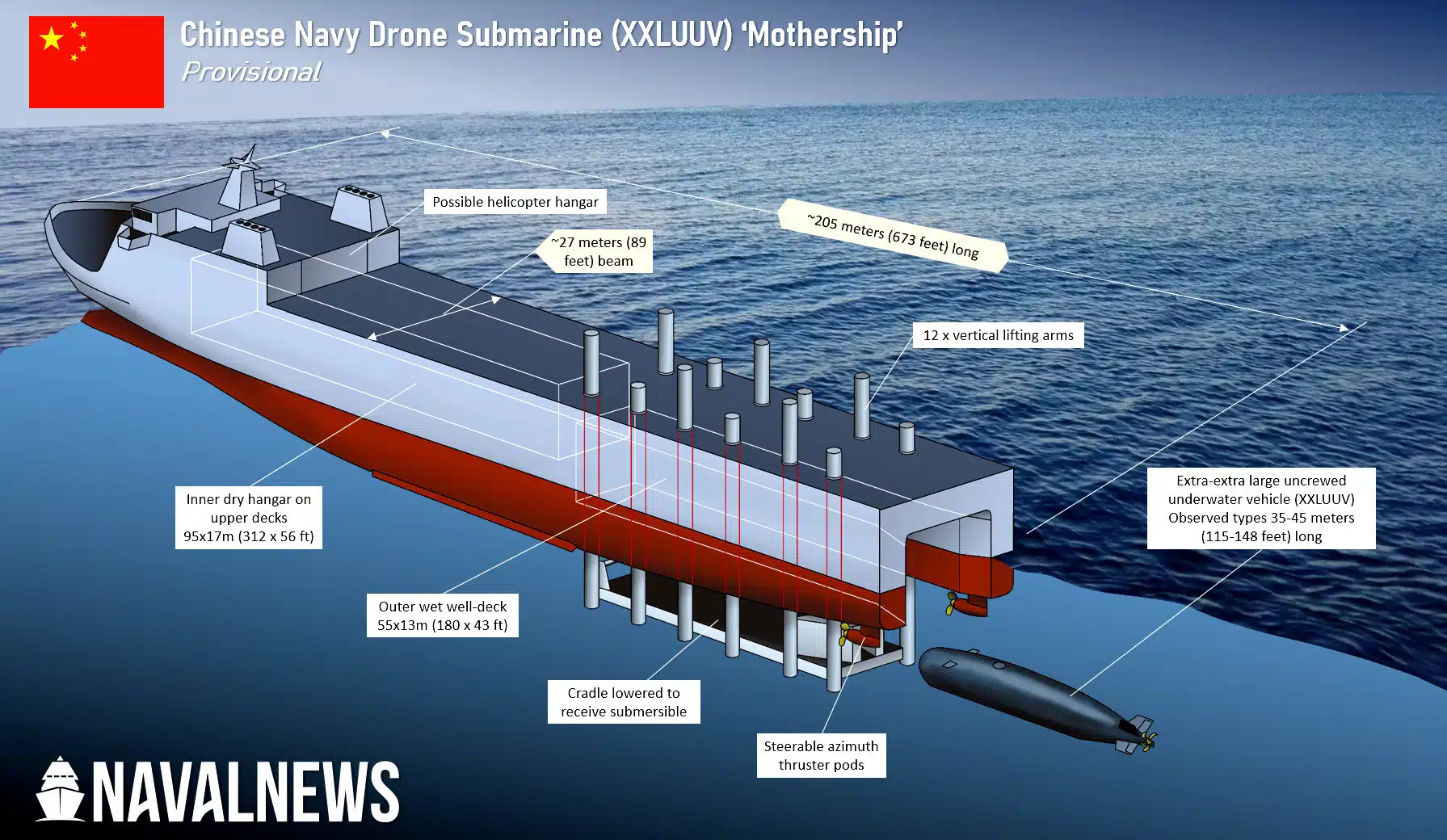
Twelve vertical jack-up arms lower a cradle down through an open well-deck, deep enough to lift a submarine straight out of the water and into an internal hangar. That's the mechanism naval analyst H.I. Sutton identified in satellite imagery of a new vessel under construction at Shanghai's Hudong-Zhonghua shipyard, and it's specific enough, and unusual enough, that Sutton's own conclusion is about as confident as this kind of open-source analysis gets: this is very likely the world's first purpose-built mothership for uncrewed submarines.
It's worth being precise about what's actually confirmed here versus inferred, because Sutton is careful about that distinction himself. Nobody has an official Chinese government statement describing this ship's purpose. What exists is satellite imagery showing a hull that resembles an amphibious landing ship, but with a well-deck that's open underneath rather than simply flooding for boat launches, plus a hangar forward of that well-deck sized to match the dimensions of vessels China has already been quietly testing elsewhere. Sutton compared the design to a 2025 Chinese proposal for a civilian research-submersible carrier, similar concept, smaller scale, submersible stowed on an open deck rather than inside an enclosed hangar. The differences, larger size and an internal hangar specifically, are what push this past "could be a research ship" into "this is almost certainly military," in his assessment.
What it's apparently built to carry is the more striking part of the story. China has already become the only country in the world operating full-sized submarines with no crew at all, extra-extra-large uncrewed underwater vehicles, XXLUUVs in the industry's own clunky shorthand, with two distinct models spotted under testing in Hainan at 35 and 45 meters long. Run the comparison against the US Navy's own flagship uncrewed submarine program, the Boeing Orca, and the scale gap is genuinely stark: these Chinese vehicles run six to eight times the overall size of an Orca. Based on the new mothership's well-deck dimensions, Sutton estimates it could carry four of the larger XXLUUVs in its internal hangar, or more of the smaller design, a meaningful jump from the current arrangement, where these vehicles reportedly get housed in specially built floating docks and towed out to sea for launch and recovery rather than deploying from a purpose-built carrier ship.
That current towed-dock setup is workable for testing, which is presumably all it was ever meant to support. A dedicated mothership is a different kind of commitment entirely, a mobile tender that can perform maintenance, keep the vehicles out of the water when they're not needed, and just as plausibly launch and recover them for actual combat missions rather than controlled trials. Building a ship specifically to service and deploy these submarines is the kind of infrastructure investment that signals China intends to actually operate XXLUUVs at scale, not just keep proving the underlying concept works in increasingly elaborate demonstrations.
Sutton's own closing point is the one worth sitting with longest: exactly how China plans to employ these vehicles operationally remains genuinely unclear from the outside, but their apparent design points toward a long-range combat role, potentially including deployment off the west coast of the United States during periods of heightened tension, a scenario this same outlet flagged in earlier reporting on the underlying XXLUUV program itself. Whatever the eventual mission set turns out to be, the practical conclusion is straightforward and doesn't require guessing at Beijing's intentions: China is investing in operationalizing full-sized uncrewed submarines faster and more seriously than any other country, and building the first known mothership to actually deploy them is a considerably bigger step than another round of dock-based testing would have been.

No comments:
Post a Comment