
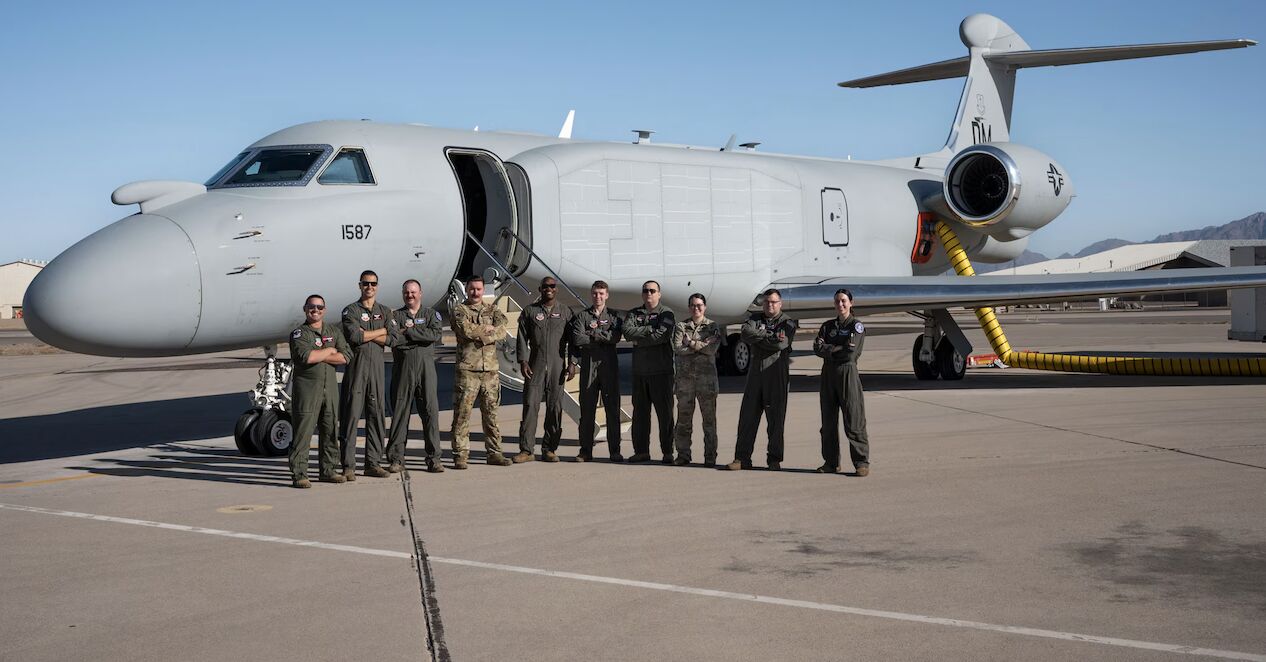
A U.S. Air Force EA-37B Compass Call, relocated specifically from Greece to Powidz, Poland, flew for nearly two hours in Polish airspace near Russia's Kaliningrad enclave on August 18, the first time this particular aircraft type has appeared near the exclave, according to a Polish military official who spoke to TWZ on condition of anonymity. The jet operated as part of a larger package including a NATO E-3A AWACS, U.S. and Norwegian fighter aircraft, an ARTEMIS II surveillance plane, and unspecified Polish ground forces, all publicly described by NATO spokesman Col. Marty O'Donnell as routine "defensive capability enhancement." The Polish official who spoke to TWZ offered a notably less anodyne read on the same activity: "expert analysis suggests that this deployment is intended to deter potential Russian provocations in the Baltic region," a direct contradiction of NATO's own public "nothing to see here" framing coming from inside the alliance's own chain of information.
That gap between official messaging and on-the-ground characterization is worth taking seriously given what this specific aircraft has been doing everywhere else it's flown this year. This blog's earlier coverage of the interceptor cost-exchange and Iran conflict already touched on the EA-37B's operational debut, and TWZ's own reporting confirms the jet flew its first combat missions during Operation Epic Fury against Iran after its first training sortie in May 2025, and was separately deployed to RAF Fairford specifically as Iran threatened to attack that UK air base directly. The same platform now sitting on NATO's eastern flank near Kaliningrad has, within a matter of months, already been used as a forward-deployed deterrent and combat asset against Iran, meaning its Baltic appearance isn't a routine capability demonstration in isolation, it's the same high-value, still-scarce asset, the Air Force is only procuring 10 of these jets total, being pulled toward whichever theater is generating the most acute pressure at a given moment.
Kaliningrad itself is the more strategically loaded half of this story, and TWZ's own sourcing makes clear why. The enclave hosts nuclear-capable ballistic missiles, anti-ship missiles, and thousands of troops squeezed between Poland, Lithuania, and the Baltic Sea, and is itself, per TWZ's linked reporting, a "notorious hub of disruptive Russian electronic warfare activity," including GPS jamming that has reportedly affected even a UK defense secretary's aircraft in the region. Deploying arguably the world's most powerful airborne EW platform directly along that enclave's border isn't a subtle signal, it's a direct capability statement: the Compass Call exists specifically to blind and deafen exactly the kind of integrated radar and communications network Kaliningrad represents, and TWZ's own framing is blunt about the stakes, "blinding and deafening Russian forces in the enclave would be critical to minimizing any military impact" in any actual contingency scenario.
The timing context TWZ's own reporting surfaces sharpens the picture considerably. This flight came the same week the Russian frigate Admiral Kasatonov escorted an LNG carrier through the Baltic, the second such escort mission in recent weeks tied to Moscow protecting energy shipments after European seizures of its shadow fleet, and just days after Wall Street Journal reporting that U.S. intelligence assessments now consider it plausible Putin could test NATO's resolve with a limited incursion against a member state in coming years, ranging from cyberattack to small-scale land action. Lithuania's president separately warned last month of intelligence suggesting Russia is preparing potential strikes on Baltic critical infrastructure. Set against that backdrop, and against this blog's own recent coverage of Russian state media invoking the Poseidon nuclear-capable underwater drone against British targets, the EA-37B's Kaliningrad appearance reads less like an isolated flight and more like one more data point in a summer where U.S. and Russian signaling has been escalating in parallel across multiple theaters simultaneously, the Baltic, the UK, and the broader Iran conflict, often within the same week.
None of this confirms an imminent crisis, NATO aircraft operating near Kaliningrad is, as TWZ notes, not unprecedented, and the alliance's own public position, that this is routine defensive posture unconnected to any specific Russian action, may well be genuine institutional caution rather than deliberate understatement. But an anonymous Polish official directly contradicting NATO's own spokesman on the record, in the same week Russian warships are conducting unusual Baltic escort missions and U.S. intelligence is reportedly assessing real incursion risk, is the kind of detail that deserves more weight than the "routine" framing initially suggests, particularly when the specific aircraft involved has spent this entire year being deployed as a direct response to acute threats everywhere else it's shown up.

No comments:
Post a Comment