
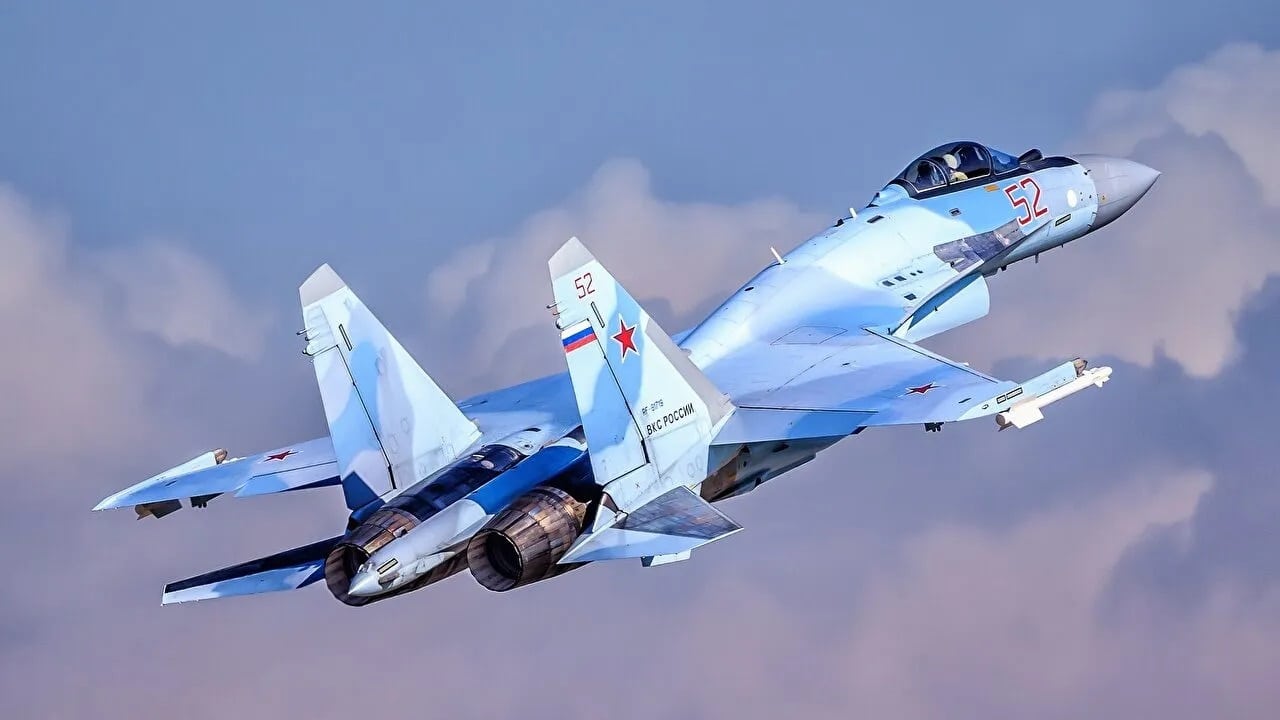
A Russian Aerospace Forces Su-35S crossed into Ukrainian-controlled airspace over Sumy region on August 18, flying over the town of Uhroidy before launching a Kh-59/69 guided missile toward Sumy City and returning to Kursk Oblast without incident. What distinguishes this from the routine cross-border strikes this blog has documented all summer is what didn't happen afterward: no Ukrainian air-defense response, no scrambled fighters, no reported engagement attempt of any kind, the first time a Russian fighter has penetrated Ukrainian-controlled airspace this deeply and openly in years. Multiple outlets tracking the incident have converged on the same two competing explanations, either a deliberate Russian confidence signal testing how far a fighter can push before drawing a response, or a genuine, exploitable gap in Ukraine's air-defense coverage over Sumy specifically.
Those two explanations aren't actually mutually exclusive, and reading them as competing possibilities understates how directly this incident connects to a story this blog has already spent considerable time documenting. The interceptor-depletion coverage this blog has tracked since Lt. Gen. Rafferty's SMD Symposium disclosures established that Ukraine's own Patriot stocks are running critically thin, corroborated by CSIS figures and, more viscerally, by this blog's coverage of the August 5 Kyiv strike in which zero of 29 incoming missiles were intercepted. A Russian pilot willing to fly a fighter, not just a drone or a stand-off missile, directly into contested airspace and openly launch a strike from inside it is making exactly the kind of calculated risk assessment that only makes sense if Moscow has genuine confidence Ukraine's fighter-intercept and ground-based air-defense capacity over that specific sector has degraded enough to make the mission low-risk. Sumy region specifically has been under sustained Russian ground pressure for much of 2026, and a fighter incursion timed to a sector already stretched by ground operations is consistent with an adversary probing for exactly the kind of coverage gap this blog's broader Ukraine coverage has already documented emerging elsewhere in the country.
This also fits directly alongside this blog's earlier coverage of Russia's own reported Su-35S combat performance against Ukrainian aircraft this year, the claimed two-Su-27-kills-in-one-engagement episode from Kobylash, and the separately reported 190-kilometer R-37M kill against a Ukrainian MiG-29, both of which this blog treated with appropriate caution as unconfirmed Russian claims rather than settled fact. Whatever the true kill counts in those specific engagements, the doctrinal pattern behind them, and now behind this unchallenged Sumy incursion, is consistent: Russian tactical aviation increasingly operates on the assumption that Ukraine's fighter fleet and ground-based intercept capability have been degraded enough, through sustained R-37M pressure, non-combat attrition like the MiG-29 hung-missile crash this blog covered, and now apparently gaps in specific sectors like Sumy, that more aggressive, closer-range missions carry acceptable risk where they wouldn't have earlier in the war.
The prediction-market detail buried in some of the initial coverage, pricing for a NATO-Russia clash by year's end ticking up slightly to roughly 23.5 percent on the incident's news, is a genuinely interesting real-time signal of how markets are reading this specific incursion, though it's worth treating with real caution as a data point rather than a forecast, prediction markets on geopolitical outcomes are thin, easily moved by headline-driven sentiment, and not a substitute for actual military or diplomatic assessment. What's more concrete is the strategic signal itself: an unchallenged fighter incursion this deep into Ukrainian-controlled airspace is the kind of incident that tends to invite follow-on probes rather than remain an isolated event, since an adversary that tests a boundary and finds no response has a rational incentive to test it again, closer, or with a less expendable asset next time, unless Ukraine and its partners can credibly demonstrate the gap that allowed this one through has actually closed.
None of this confirms Ukraine's air defenses have collapsed in any broad sense, this remains a single incident in one sector rather than evidence of nationwide degradation, and Ukrainian officials haven't yet offered their own account of why no interception was attempted. But set against this blog's summer-long documentation of interceptor shortages, non-combat fleet attrition, and Russia's own escalating standoff-strike doctrine, an unchallenged Su-35 flying into contested airspace and back out again isn't really a standalone story, it's the latest, and one of the more direct, confirmations of a pattern this blog has been assembling piece by piece since Rafferty's SMD disclosures first flagged how thin Ukraine's air-defense margins had become.

No comments:
Post a Comment