
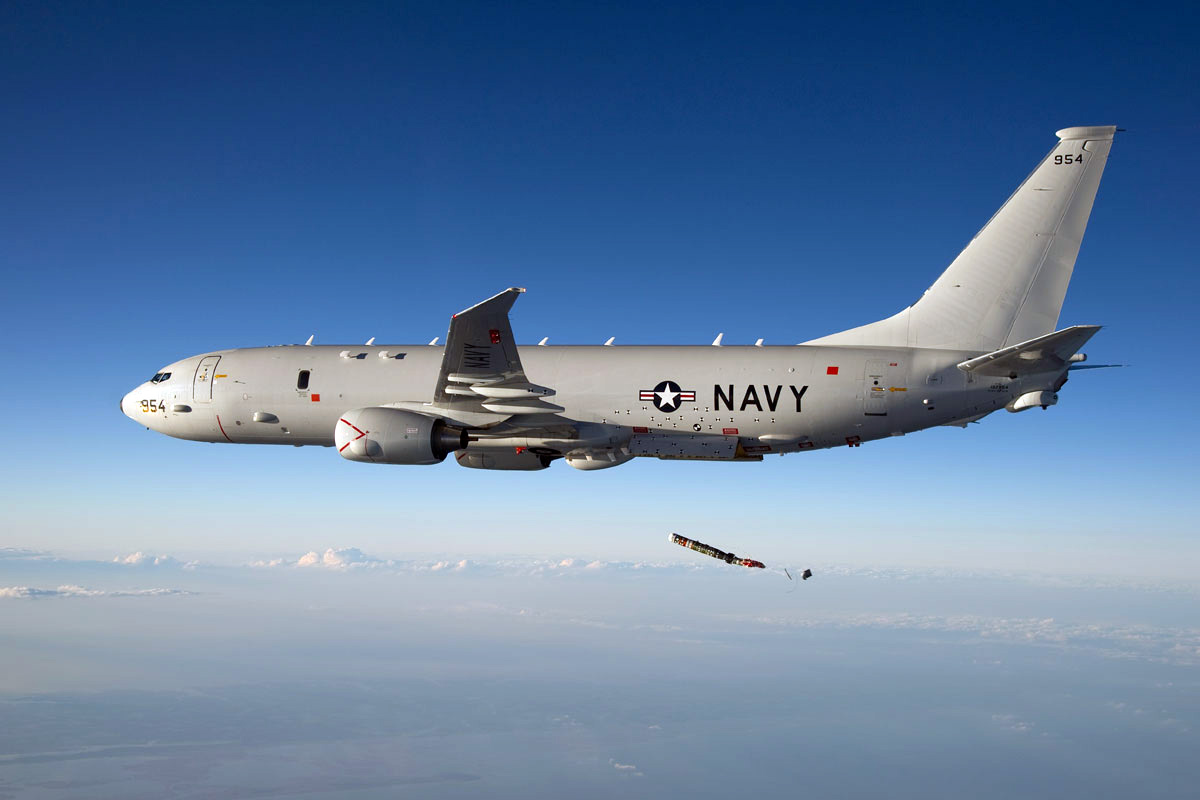
The Navy issued a Request for Information for the Silent Anvil Air-Launched Torpedo, exploring two design paths, a new torpedo built to glide from an aircraft into the water before acoustically homing on target, or a glide kit retrofitted onto an existing torpedo, with a September 29 deadline for industry responses. The specifications are genuinely demanding: compact enough to fit a standard BRU-61/A bomb rack in a form factor comparable to the GBU-39 Small Diameter Bomb, no more than 268 pounds and 70 inches long, launchable across a speed range from Mach 0.25 to 0.85 and an altitude band running from just 10 feet up to a striking 60,000 feet, well above even the P-8 Poseidon's operating ceiling and closer to the MQ-4C Triton drone's altitude envelope. The Navy's own language on water time is unusually precise, the weapon should "maximize aerial flight endurance while minimizing aquatic immersion time," restricting its time actually in the water to the absolute minimum needed to complete the engagement.
Defense News's own reporting states the strategic driver plainly, and it's worth taking that framing at face value: Silent Anvil comes explicitly as China expands both the size and sophistication of its submarine fleet, including large, long-range unmanned undersea vehicles. This blog's earlier coverage of the Orca XLUUV program already established that exact capability gap in detail, China pursuing a more diversified, faster-scaling unmanned undersea vehicle program across at least five distinct designs simultaneously, against a single-design American Orca program this blog assessed as playing catch-up rather than leading. Silent Anvil is the air-delivered weapons-side response to the same underlying threat, a next-generation anti-submarine torpedo built specifically to extend engagement range and altitude flexibility against exactly the kind of larger, more sophisticated Chinese underwater assets, crewed and uncrewed alike, this blog's Orca coverage already flagged as an accelerating capability gap.
The 60,000-foot altitude requirement is the detail worth dwelling on longest, because it signals something beyond simply "a better torpedo." Pairing an anti-submarine weapon with an MQ-4C Triton-class high-altitude drone rather than confining it to the P-8 Poseidon's lower operating envelope connects directly to this blog's coverage of the Air Force's target-drone RFI from earlier this summer, where the underlying theme was American forces training and equipping against threat profiles considerably more demanding than legacy hardware assumed. A torpedo genuinely built for high-altitude, long-standoff delivery would let unmanned platforms conduct ASW strikes from well outside the detection and counter-fire range that increasingly capable Chinese submarine sensor and weapons systems might otherwise threaten a lower-flying P-8 with, extending the same "survive by staying outside the adversary's engagement envelope" logic this blog's coverage of Japan's submarine-hypersonic program and the AIM-424 Malice's extreme range both identified as a consistent, cross-domain American and allied design philosophy this year.
The parallel Long Range Antisubmarine Warfare weapon this article mentions in passing, extending rocket-launched ASW torpedo reach from vertical launch tubes on surface ships, suggests Silent Anvil isn't an isolated program but one piece of a genuinely coordinated multi-platform ASW modernization effort, air-launched glide weapons and ship-launched rocket-boosted torpedoes both independently extending American anti-submarine reach at the same moment. Read against this blog's coverage of the UUV-based submarine resupply concept from RIMPAC 2026, which argued the Navy was building a coherent Pacific submarine-endurance strategy across multiple separate programs, Silent Anvil extends that same "coherent strategy assembled from individually announced programs" pattern into the anti-submarine strike domain specifically, magazine depth on the offensive side, this time, rather than the defensive resupply problem that earlier coverage addressed.
The 18-month prototype timeline followed by 180 all-up-round prototypes within three years is genuinely ambitious relative to the execution record this blog has documented across so much of this year's procurement coverage, and it's worth applying the same measured skepticism here that this blog extended to GMLRS's rocket-motor supply crunch and the broader munitions-production throughline. An RFI is an early information-gathering step, not a funded program of record, and this blog's own tracking of similarly ambitious announced timelines, AHEL's cancellation chief among them, suggests real caution is warranted before assuming Silent Anvil reaches fielded capability on anything close to its currently stated schedule. But the underlying strategic logic, matching China's expanding and increasingly sophisticated submarine fleet with a genuinely extended-range, altitude-flexible anti-submarine weapon rather than continuing to rely on legacy Mark 54 torpedo employment profiles, is a coherent and reasonable response to exactly the threat trajectory this blog's Orca coverage already documented Beijing pursuing.

No comments:
Post a Comment