
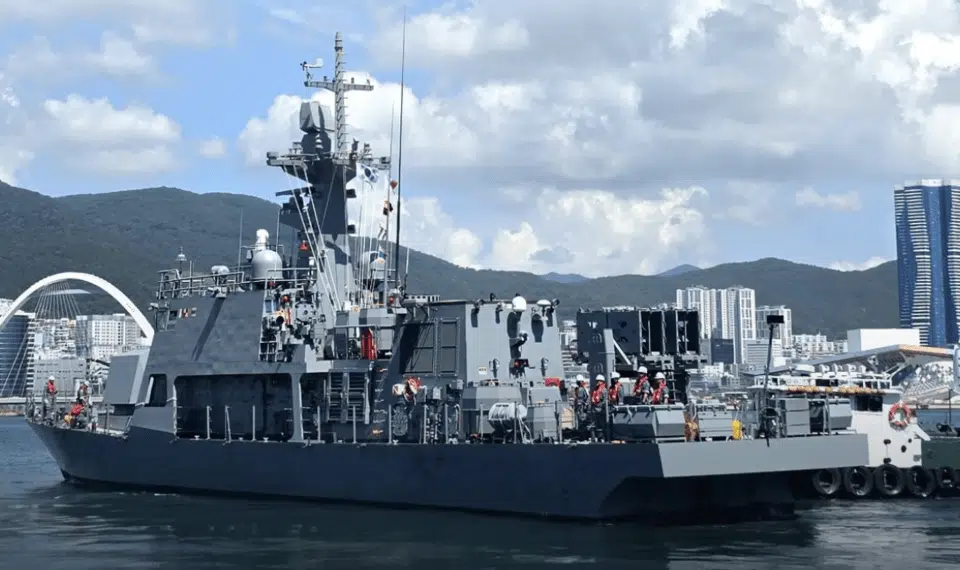
South Korea's Defense Acquisition Program Administration delivered the first PKX-B Batch-II fast patrol craft to the ROK Navy at HJ Shipbuilding & Construction's Busan shipyard on August 14, the initial vessel in a program meant to replace the aging Chamsuri-class patrol boats along the Northern Limit Line, South Korea's frontline maritime boundary in the Yellow Sea. The Batch-II design integrates control and firing functions for its 130mm guided rocket system and 12.7mm remote-controlled weapon station directly into the ship's combat system, adds enhanced anti-jamming capability against electronic warfare threats, and, per Naval News's own detailed technical breakdown, incorporates smaller but operationally meaningful fixes drawn from Batch-I experience: tripled electro-optical sensor heater output to prevent ice and seawater fouling in winter operations, finer radar frequency adjustment to reduce onboard interference, a raised helm station for better visibility, and a fire damper added to the 76mm gun magazine's ventilation duct specifically to stop flames spreading into the ammunition store during a nearby fire. DAPA's Choi Sang-deok framed the vessel's purpose plainly: deterring "the enemy from attempting provocations" while establishing "a robust coastal defense posture" along the NLL.
That framing isn't abstract deterrence language, it's addressing a maritime boundary with an actual body count. The NLL has been the site of the most serious naval combat between the two Koreas in the post-armistice era, the First Battle of Yeonpyeong in 1999, the Second Battle of Yeonpyeong in 2002, in which North Korean patrol vessels sank the ROK Chamsuri-357, killing six sailors, the 2010 torpedoing of the corvette ROKS Cheonan that killed 46, and North Korea's artillery bombardment of Yeonpyeong Island the same year that killed four South Koreans including two civilians. The Chamsuri-class the new PKX-B directly replaces isn't a hypothetical threat category, it's the same class of vessel that was sunk in the 2002 engagement, meaning this delivery ceremony is modernizing the exact patrol boat type with the most direct combat history on this specific boundary, along a maritime line North Korea has never formally recognized and continues to describe as an illegitimate imposition rather than a genuine border.
That NLL context connects this modest patrol craft delivery to the broader Korea coverage this blog has already tracked this month. This blog's earlier reporting on Trump's order to reduce joint exercises with South Korea flagged Lt. Gen. Joseph Jarrard's warning, delivered the same week, that North Korea has successfully tested ICBMs capable of reaching anywhere in North America, alongside North Korean troops gaining direct combat experience fighting alongside Russian forces in Ukraine. A domestically designed, incrementally improved patrol craft program reaching its Batch-II milestone on schedule, four follow-on vessels planned by year's end according to DAPA, sits in useful contrast to that geopolitical uncertainty: whatever ambiguity surrounds Washington's exercise commitments or the broader trajectory of the alliance, South Korea's own shipbuilding and combat-system integration pipeline for its most historically contested waters is proceeding on a steady, iterative production cadence independent of that uncertainty.
The iterative-design detail is itself worth setting against this blog's repeated coverage of the opposite pattern in Indian defense procurement, DRDO's Virupaksha radar timeline, the AMCA engine race, both of which this blog traced to institutional overconfidence about how quickly indigenous high-technology defense programs mature. PKX-B Batch-II represents essentially the model working as intended: a five-year gap between Batch-I completion in 2022 and Batch-II's first delivery this month, with concrete, specific field lessons, sensor heater capacity, radar interference, magazine fire safety, incorporated directly into the follow-on design rather than accumulating as unaddressed technical debt across a program running a decade or more behind schedule. That execution discipline is part of the same broader South Korean defense-industrial maturity this blog's earlier Korea coverage already noted, a country that has built itself into a genuine global arms exporter across armored vehicles, artillery, and now increasingly naval platforms, largely on the strength of exactly this kind of disciplined, iterative production record.
None of this means the NLL is at heightened risk of a new incident, gray-zone naval friction along the line has ebbed and flowed for over two decades without a fixed trajectory in either direction. But a modernized patrol craft, built around lessons from its own predecessor's operational service and replacing a vessel class that has been sunk in actual combat on this exact stretch of water, is a concrete reminder that the maritime dimension of Korean Peninsula tension remains an active, funded defense priority for Seoul regardless of how the broader alliance relationship with Washington evolves in the meantime.

No comments:
Post a Comment