
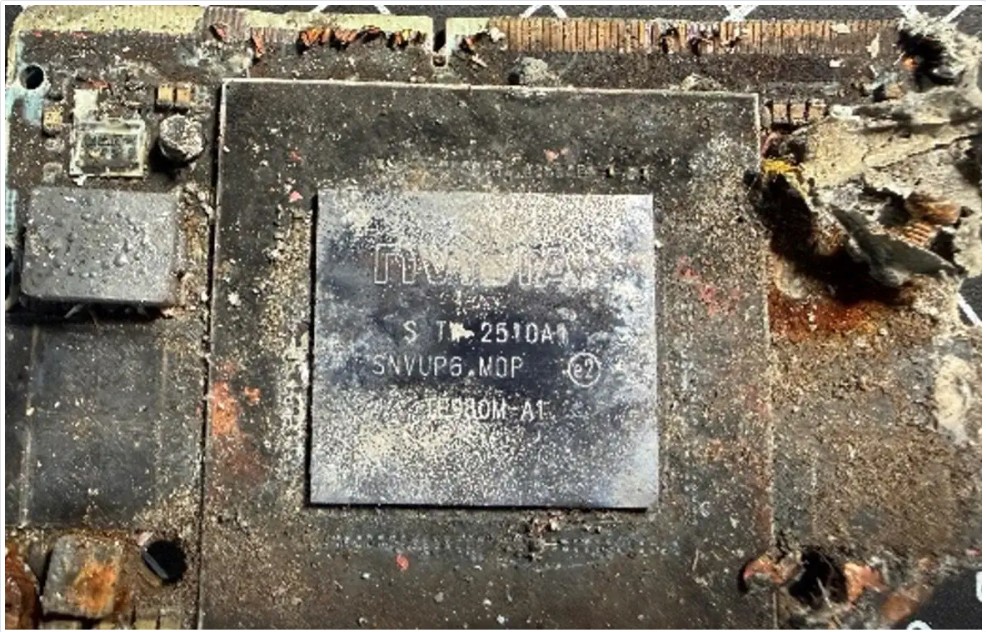
Ukraine's Defense Intelligence agency (HUR/GUR) reported this week that specialists recovered an NVIDIA Jetson Orin computer module inside the wreckage of a Russian S-71M "Monokhrom" air-launched cruise missile, a stealthy, low-observable weapon built for internal carriage aboard the Su-57 and the S-70 Okhotnik drone this blog has already covered extensively this summer. The module carries a chip marked SNVUP6.MOP TE980M-A1, consistent with an Orin NX 8GB/16GB system-on-module packaged in March 2025, and HUR's working theory is that it functions as a dedicated electro-optical perception computer, recognizing targets visually and feeding that data to the missile's guidance system for autonomous terminal targeting, a genuinely different capability than the semi-active laser homing used on the S-71's simpler sibling variant.
The technical distinction worth understanding here, because it changes how alarming this finding actually is, is that NVIDIA's Jetson Orin line isn't the export-controlled hardware most coverage of "AI chips in Russian weapons" implicitly assumes. High-performance AI training accelerators like the H100, H200, and Blackwell-series GPUs sit under strict Commerce Department export licensing requirements specifically because of their military-relevant compute density. Jetson Orin modules, by contrast, fall under a considerably more permissive export classification, NVIDIA markets them explicitly as consumer and developer-grade hardware for robotics, students, and startups, and the company maintains they aren't designed for military applications and haven't been sold in Russia since 2022. That distinction matters, this isn't evidence of NVIDIA's most sensitive technology reaching Moscow, but it also doesn't make the finding reassuring, because it means Russia is achieving militarily useful autonomous targeting capability using hardware that was never subject to the tightest control regime in the first place, an even lower bar to clear than defeating the strictest sanctions would represent.
How that chip actually reached a Russian missile factory is where the broader sanctions-evasion infrastructure this blog documented in its earlier Sahel gold-and-airbridge coverage becomes directly relevant again, just applied to semiconductors instead of gold. A New York Times investigation tracking shipments from 2022 through 2024 found nearly $4 billion in export-controlled American chips, from AMD, Intel, Texas Instruments, and Micron, reached Russia through a network of more than 6,000 companies, with a single Hong Kong address at 135 Bonham Strand alone funneling $15 million in chips through three shell firms to a subsequently sanctioned Russian military electronics supplier. The European Union's own April 2026 sanctions round explicitly named Hong Kong as "the world's largest re-export hub" for Western technology reaching Russia's war effort, and separate reporting documents parallel transshipment networks running through Turkey and the UAE, in one case a former Promtech partner network in Istanbul shipping over seven million euros in sanctioned aerospace components after the original supplier lost direct European access. Chinese customs data compiled by the Fletcher School puts the scale in even starker terms: more than 80 percent of the semiconductors Russia has purchased since the invasion began have come directly from China, sold through what researchers describe as normal, unconcealed trade channels rather than clandestine smuggling.
That's the real story sitting underneath a single recovered missile chip: sanctions have measurably raised Russia's costs, the same Fletcher research found Russian semiconductor prices have roughly doubled since the war began, but they haven't come close to severing the supply chain, they've simply rerouted it through jurisdictions willing to look past it. This blog's Sahel coverage already documented the identical structural pattern for gold-financed sanctions evasion, using intermediary states with weaker compliance regimes, UAE, Turkey, and similar transit hubs, to obscure origin and destination. Reading the two stories together, a pattern this blog keeps encountering across entirely different resource categories becomes hard to dismiss as coincidental: modern sanctions regimes are consistently better at raising the price and friction of evasion than they are at actually stopping the underlying flow, whether the commodity in question is African gold or American semiconductors.
There's also a genuine irony worth sitting with alongside this blog's recent coverage of the Unitree robot-dog investigation and America's own struggle to convert domestic innovation into manufacturing scale. The same consumer-grade Jetson hardware line built specifically for civilian robotics and startup accessibility, the kind of open, low-barrier technology ecosystem this blog credited with helping account for American research leadership, is precisely what's proving impossible to fully contain once it enters global commercial distribution channels. A chip designed to be cheap, widely available, and easy to integrate into robotics projects is, by that same design logic, difficult to keep out of a determined adversary's weapons program, regardless of how many export licenses or shell-company sanctions get layered on top of the formal control regime. Whether that's read as evidence sanctions need sharper enforcement or as evidence that commodity-grade AI hardware has simply become too ubiquitous to fully gatekeep, the S-71's NVIDIA chip is a small, concrete data point in a much larger argument about whether export controls built for a world of scarce, specialized military electronics can meaningfully govern a world where the relevant components now ship by the millions for entirely civilian purposes.

No comments:
Post a Comment