
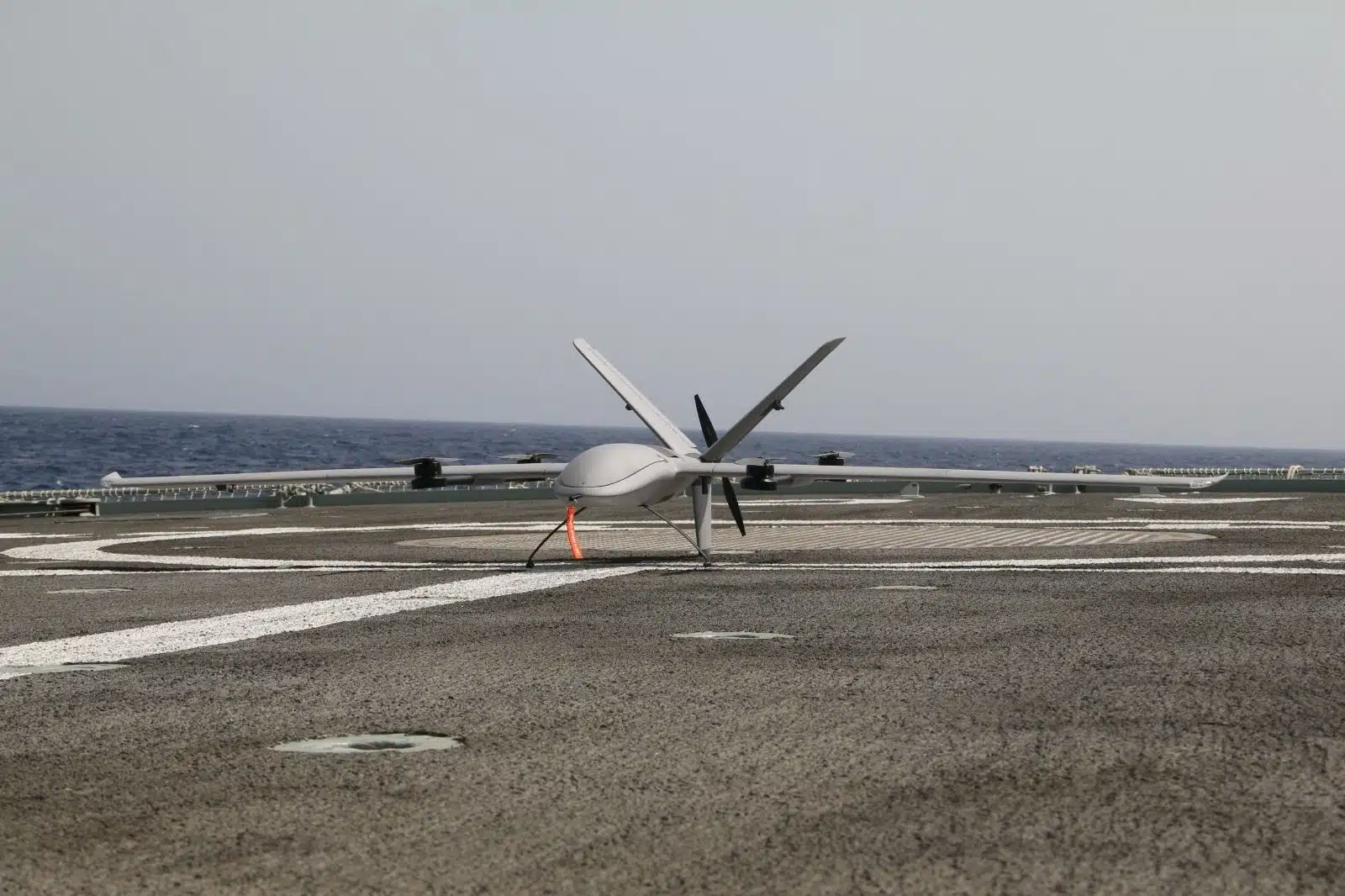
The Portuguese Navy's specialist unmanned-systems unit, X31, conducted shipborne flight trials aboard the Vasco da Gama-class frigate NRP Álvares Cabral during the Iniciativa Mar Aberto 2026 deployment, validating launch and recovery procedures, deck safety protocols, airspace management, and command-and-control links for operating unmanned aerial systems from a conventional frigate not originally designed for the role. The trials build directly toward NRP D. João II, a purpose-built Damen-constructed Multifunctional Naval Platform launched in April 2026 with a dedicated hangar and flight deck for manned and unmanned aircraft alongside uncrewed surface and underwater vehicles, meaning Álvares Cabral's improvised trials are effectively a rehearsal for procedures the newer, purpose-built platform will eventually run natively. Naval News's own coverage frames this correctly as methodical capability-building rather than a dramatic capability leap, validating people and procedures before the more capable ship arrives.
What that framing leaves unstated is where this validation is actually happening, and it's a genuinely significant detail. Iniciativa Mar Aberto is explicitly focused on maritime security and partner engagement across the Atlantic and West African region, placing these trials directly inside the Gulf of Guinea security theater this blog's earlier coverage of Russia's Sahel air bridge already established as an active zone of great-power competition and irregular security activity. That earlier reporting documented Russia's Africa Corps-linked logistics network using Guinea's port of Conakry as a strategic hub for transporting military equipment into Mali and Burkina Faso, a gold-financed security-for-resources arrangement generating an estimated $114 million a month, with Flight Unit 224 aircraft refueling through a chain running from Syria's Khmeimim air base to Libyan sites and onward into West Africa. Portugal isn't operating in a vacant or purely humanitarian maritime space, it's testing new capability inside the same broad operating environment where Russian state-aligned logistics networks are actively running.
The Gulf of Guinea's own security picture has shifted in ways that make Portugal's presence considerably more strategically relevant than a routine partnership deployment might suggest. Piracy and armed robbery incidents have dropped roughly 90 percent since their 2020 peak, and the International Maritime Bureau recorded the lowest first-quarter totals since 1991 this year, according to Al Jazeera Centre for Studies reporting. But that same reporting is explicit that declining piracy has been replaced by a more complex "grey zone" competition rather than genuine stabilization: Russia has intensified pursuit of port-access agreements across West African coastal states, separately signing military cooperation agreements with Togo and discussing maritime cooperation with São Tomé and Príncipe, while China's 48th Maritime Task Force conducted at least 15 African port visits between 2024 and 2025, part of what regional analysts describe as a shift from ad hoc anti-piracy patrols toward organized, sovereignty-framed positioning that resonates with coastal governments wary of any single external power's dominance. Washington has separately expressed what the same reporting characterizes as "grave concern" over the resulting competition for strategic access points along this coastline.
Portugal's own historical and linguistic ties across West Africa, Guinea-Bissau, Cape Verde, and São Tomé among them, give it a genuine standing basis for engagement in exactly this contested space that a purely capability-driven deployment wouldn't otherwise carry, and validating unmanned systems doctrine during a deployment explicitly framed around partner engagement suggests Lisbon is treating maritime domain awareness capability as inseparable from its broader diplomatic presence in the region, not simply as a technical box to check before D. João II arrives. A frigate capable of extending its own observation range via unmanned aircraft, investigating unidentified contacts without committing a helicopter or boarding team as Naval News's coverage notes, is directly useful for exactly the kind of ambiguous, sub-piracy maritime activity, unflagged logistics runs, irregular port calls, contested access arrangements, that now characterizes the Gulf of Guinea considerably more than the declining hijacking threat that used to define it.
None of this means Álvares Cabral's trials were conceived as a direct response to Russian or Chinese activity in the region, the deployment's stated purpose is broader maritime security cooperation, and the unmanned-systems validation itself is a multi-year program that predates any specific regional flashpoint. But reading this modest technical milestone against this blog's own Sahel coverage places it in a considerably more consequential context than a standalone naval-technology story would suggest: a mid-sized European navy quietly building exactly the maritime domain awareness capability, extended observation range, contact investigation without full commitment, that would matter most in a theater where great-power logistics networks, resource-extraction arrangements, and competing port-access agreements are increasingly the real security story, even as the piracy numbers that used to dominate Gulf of Guinea headlines keep falling.

No comments:
Post a Comment