
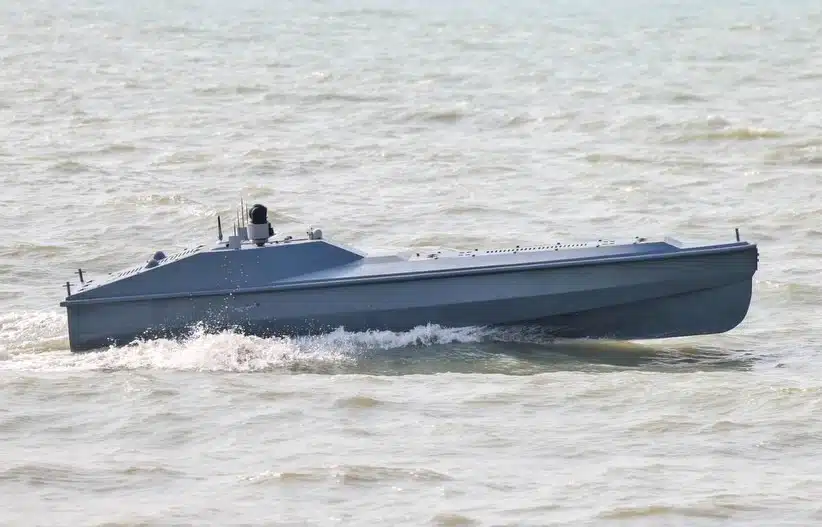
Marking a major milestone in its military modernization, the Indonesian Navy officially debuted its first domestically built one-way attack unmanned surface vessel (USV) during the large-scale 2026 Integrated TNI Exercise held off Dabo Singkep in the Riau Islands. Developed by state-owned defense enterprise PT PAL Indonesia, the compact kamikaze drone was showcased within a complex joint operational scenario involving nearly 13,000 personnel. The public operational debut underscores Jakarta's strategic transition from experimental autonomous research toward distributed, asymmetric maritime strike capabilities tailored for the world's largest archipelagic state.
During the multi-domain exercise, the uncrewed platform was deployed from the well deck of the Indonesian Navy hospital ship KRI dr. Soeharso, demonstrating an innovative mothership-based deployment concept. This approach allows existing auxiliary and large surface vessels to transport and launch autonomous strike craft far beyond fixed coastal bases, significantly extending the operational reach of Indonesia's unmanned fleet. Following release, the USV successfully navigated toward a simulated shoreline target, providing defense leadership with a clear proof-of-concept for mothership-integrated strike operations.
While the demonstration was conducted without a live explosive payload—leaving the test craft structurally intact post-impact—PT PAL revealed ambitious performance targets for the production variant. Designers intend for the final configuration to achieve high-speed maneuvers exceeding 55 knots while carrying a substantial 150-kilogram warhead. Visually, the vessel features an angular, low-observable grey hull designed to minimize radar cross-sections, paired with a raised stern section housing internal combustion engine exhausts and a mast-mounted electro-optical sensor package for remote guidance and target acquisition.
The kamikaze USV's debut formed part of a broader, multi-layered strike demonstration that also featured the launch of domestically produced KI-50 aerial loitering munitions from a naval flight deck alongside live firings of C-705 anti-ship missiles. According to defense officials, the surface drone shares underlying command-and-control architecture with PT PAL's ongoing autonomous submarine (KSOT) development program. Future upgrades will incorporate artificial intelligence capabilities designed to allow the autonomous craft to independently classify friendly and hostile contacts.
By integrating low-cost, expendable surface drones into its joint tactical doctrine, Indonesia is actively positioning itself to counter peer and gray-zone threats across its vast maritime domain. While unvalidated capabilities such as swarm coordination and electronic warfare resilience remain to be tested, the successful deployment highlights a growing regional trend across the Indo-Pacific toward leveraging affordable autonomous mass to complicate adversary naval planning.

No comments:
Post a Comment