
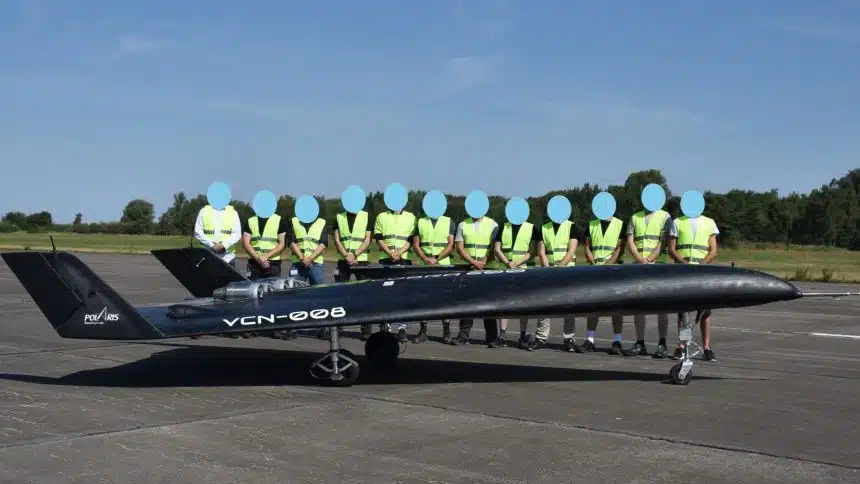
Polaris Raumflugzeuge announced the first flight of the Cobra 600 on August 22, a jet-powered, flying-wing uncrewed aircraft developed jointly with Diehl Defence specifically to carry and launch the IRIS-T air-to-air missile from a top-mounted rail. The test covered 20 kilometers and Polaris described it as "perfectly smooth," with the demonstrator built on the company's existing MIRA III platform, now fitted with four small JetCat P1000-PRO micro turbojets to handle the roughly 85-kilogram weight of the IRIS-T missile itself. Under 600 kilograms takeoff mass, Cobra 600 is explicitly framed as an inexpensive, uncrewed layer for air-defense missions under the joint AirLAS, Airborne Launching and Attack System, program, though neither company has disclosed the actual operational concept, including whether the drone will carry its own targeting sensors or rely entirely on external cueing from ground-based air-defense networks.
What The Aviationist's own reporting notes almost in passing, but which deserves to be the actual headline here, is that Cobra 600 isn't a conceptually novel idea, it's a NATO-country formalization of a tactic Russia has already demonstrated in actual combat against Ukraine. Russian Geran-2 one-way attack drones have been documented flying with R-60 air-to-air missiles and even man-portable air-defense systems mounted on top, essentially converting a cheap kamikaze drone airframe into an improvised aerial shooter rather than a pure kinetic strike weapon. Rob Lee's own documented footage of a Russian Geran-2 carrying an R-60 being shot down by a Ukrainian interceptor in December 2025 confirms this wasn't a theoretical concept, it was a fielded, if improvised, Russian tactic months before Germany's considerably more polished, purpose-built version completed its first flight.
That lineage matters because it fits directly into the attritable-systems throughline this blog has tracked across the American, Chinese, and now German sides of this same doctrinal shift. CENTCOM's Task Force Falcon Strike and its LUCAS drones, reverse-engineered from Iran's own Shahed-136, represented the American military formally adopting an adversary's cheap-drone doctrine as offensive capability. Cobra 600 represents the identical pattern applied defensively: a purpose-built, considerably more refined Western answer to a tactic Russia improvised out of expendable strike drones already in mass production. Where Russia's Geran-based interceptors are a battlefield adaptation, bolting an existing missile onto an existing strike airframe, Cobra 600 is a from-scratch design explicitly optimized around the same core insight, that a cheap, jet-powered airframe carrying a proven missile can add a genuinely useful, expendable layer to an air-defense architecture without committing an expensive crewed interceptor.
The distributed-interceptor concept The Aviationist's reporting speculates about, Cobra 600 potentially operating as a networked node fed targeting data by external ground-based systems rather than carrying its own sensors, connects directly to this blog's coverage of the interceptor cost-exchange problem that has dominated defense procurement all summer. If Cobra 600 can be produced and fielded cheaply enough to serve as a genuinely expendable, distributed air-defense layer, sacrificing individual drones rather than risking crewed fighters or expending far costlier ground-based interceptors, it addresses precisely the same magazine-depth and cost-asymmetry problem this blog has tracked through Patriot and THAAD stockpile depletion, just applied at the tactical, localized air-defense level rather than the strategic, national one.
None of this confirms Cobra 600 will actually reach operational service in a form resembling this prototype, a single 20-kilometer test flight is an early proof-of-concept milestone rather than a fielded capability, and the program's actual operational doctrine, sensor architecture, and production cost all remain genuinely undisclosed. But the underlying pattern, a NATO defense-industrial player formalizing and refining a tactic first improvised by Russia on the Ukrainian battlefield, is a small but genuinely telling data point in the broader story this blog has documented all summer: across nearly every major military power, the cheap-drone-versus-expensive-interceptor economics that first became unavoidable in Ukraine and against Iran are now reshaping procurement decisions everywhere, regardless of which side of the conflict a given military actually started on.

No comments:
Post a Comment