
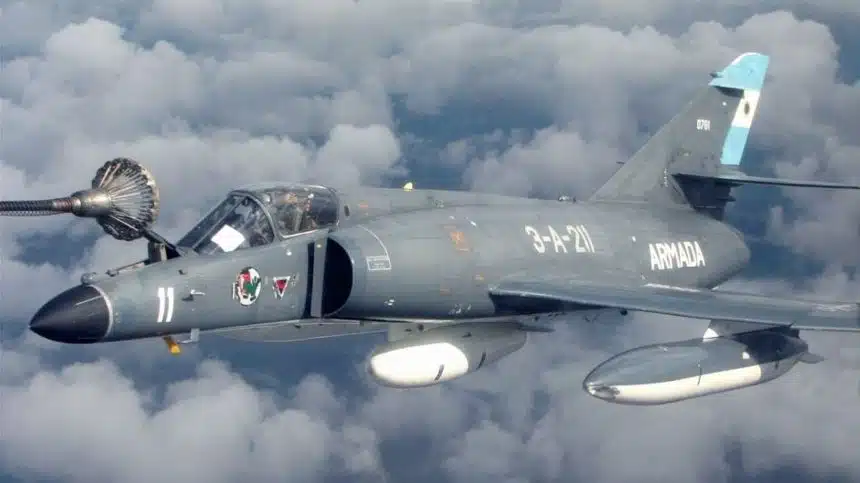
The Argentine Navy formally announced on August 20 the permanent retirement of its Dassault-Breguet Super Étendard naval fighter, closing out nearly four decades of service that included the aircraft's most famous chapter, sinking HMS Sheffield and the Atlantic Conveyor with Exocet missiles during the 1982 Falklands War. The retirement comes under Plan Dédalo, a five-year restructuring of Argentine naval aviation that also phases out the Beechcraft B-200 patrol aircraft and the AS-555 light helicopter while introducing new Beechcraft B350s, additional P-3C Orions from Norway, and four Shield V-BAT unmanned aircraft for shipboard reconnaissance. But the Super Étendard's specific end came not from the airframe itself but from a considerably pettier obstacle: Argentina simply couldn't get spare ejection seat cartridges.
Argentina purchased five ex-French Navy Super Étendard Modernisés in 2018 for €14 million, delivered in 2019, and never returned them to service, because the British government refused to release cartridges for the Martin-Baker Mk 6 ejection seats fitted to the aircraft. Then-Defense Minister Jorge Taiana's own account of a direct conversation with his French counterpart is worth quoting because it states the obstacle so plainly: France told Argentina the aircraft "cannot be recovered, for two reasons. Because of the seats, which the British did not give up, and because of a series of parts of the Super Étendard Modernisés that are now retired." A domestic attempt to manufacture the components locally through Argentine firm MBA Argentina SA also failed, with ground tests deemed unsatisfactory by the country's own airworthiness authority.
That's a genuinely striking case study in how export-control leverage operates in practice, and it deserves to be read alongside this blog's own coverage of the ITAR and end-use restriction dynamics shaping India's fighter procurement decisions. This blog's engagement with Air Marshal Chopra's "no American fighter jets" piece traced how End-Use Monitoring restrictions constrained Pakistan's F-16 employment against India, a legal mechanism operating through formal government-to-government agreements and diplomatic pressure. Britain's refusal to release Martin-Baker ejection seat cartridges to Argentina is a considerably blunter version of the identical underlying leverage, a single component in a single safety-critical subsystem, sourced from a country with an active, decades-old territorial dispute with the buyer, functioning as a complete veto over whether an entire fighter fleet can ever fly again. Where India's concern about American restrictions is largely prospective, a hedge against future leverage Washington might exercise, Argentina's Super Étendards are the realized version of exactly that fear: five aircraft, fully purchased and delivered, sitting grounded for seven years because a single allied supplier's government said no.
The persistence of British leverage here is itself the more interesting detail than the immediate ejection-seat refusal. The Falklands War ended in 1982, more than four decades ago, yet the UK is still, in 2026, actively exercising export control over a component as narrow and specific as an ejection seat cartridge to prevent an old Cold War-era adversary from returning aircraft to service. That's a genuinely durable form of geopolitical leverage, considerably more durable than the platform-level sanctions or broader defense-relationship freezes this blog's coverage of Pakistan's F-16 restrictions and India's own American-hardware hesitancy has typically focused on. A single safety-critical, difficult-to-domestically-manufacture component can function as a permanent kill switch on an entire aircraft fleet's operational status, without requiring any broader diplomatic escalation or formal sanctions regime at all.
Argentina's decision to simply give up rather than keep fighting the seat problem is itself a rational response to that kind of leverage, and it connects to the broader defense-autonomy throughline this blog has tracked across South Korea's nuclear submarine ambitions and Japan's own defense-industrial buildout this summer. A country that experiences firsthand how a single foreign-sourced safety component can permanently ground an otherwise serviceable fighter fleet has a very concrete, rather than theoretical, reason to prioritize indigenous production or diversified, less politically fraught suppliers going forward. Argentina's naval aviation modernization now leans on Norwegian P-3Cs and an Italian-American V-BAT drone rather than attempting a second French fighter restoration, a supplier mix that reads less like coincidence and more like a country that learned, the hard way, exactly how much control a single component's country of origin can exert over an entire weapons platform's usable lifespan.

No comments:
Post a Comment