
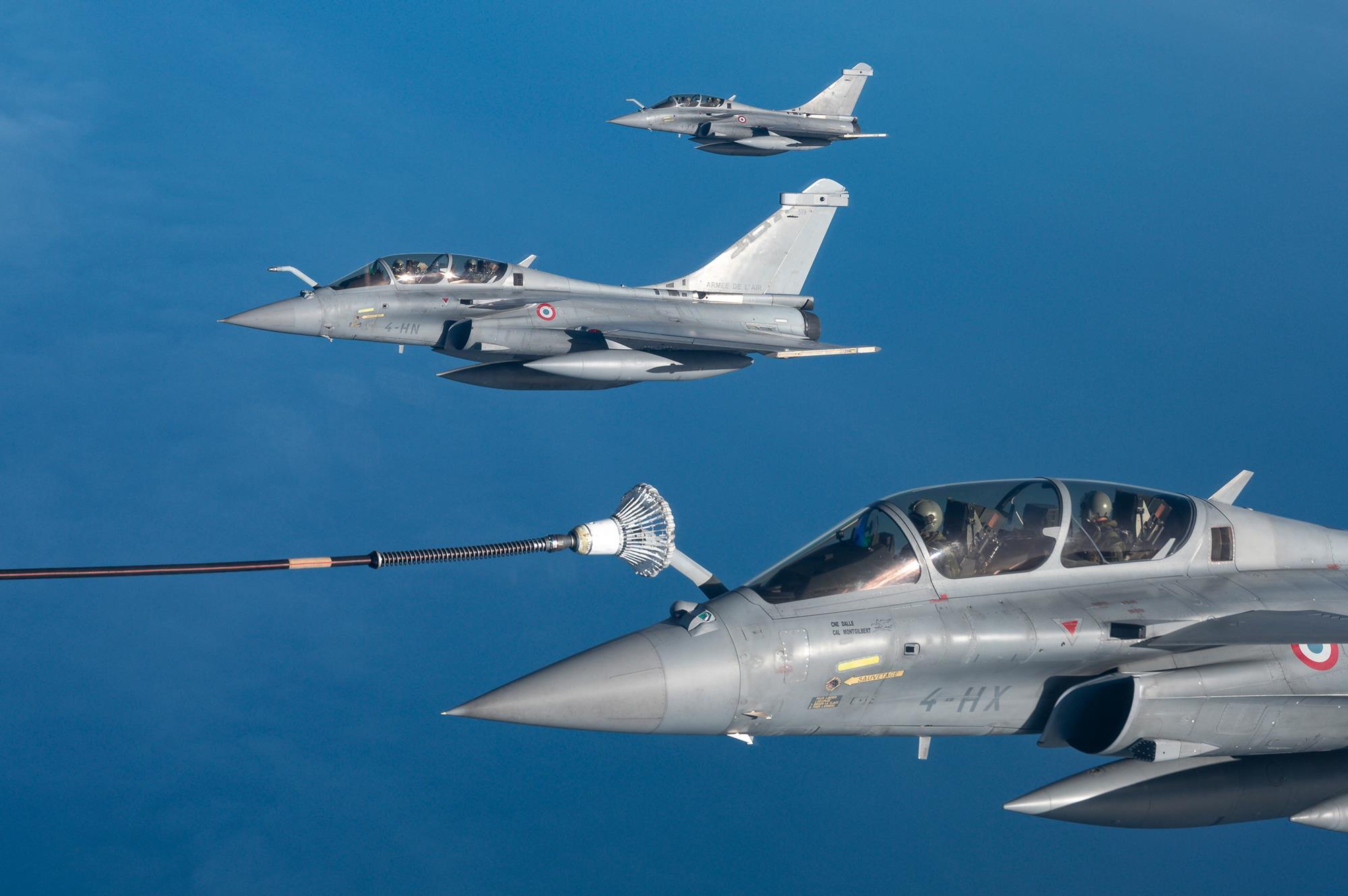
France recorded €21.2 billion ($24.8 billion) in arms exports for 2025, according to the French Ministry of Armed Forces' 2026 parliamentary report, its second consecutive year above the €20 billion mark and the third-highest annual total on record. SIPRI's independent March 2026 tracking confirms the broader trend, France holds a 9.8 percent share of global major conventional weapons exports over 2021-2025, second only to the United States, up 21 percent from the prior five-year period. The Rafale fighter was the single largest contributor to that performance, and India alone generated roughly €6.9 billion, nearly a third of France's entire 2025 export total, anchored by the first-ever export order for the carrier-capable Rafale Marine variant.
This is worth setting directly against the J-10C export struggle this blog has documented repeatedly this summer, most recently through China's deployment of the type to Egypt via a Pakistani transit corridor and its parallel showcase appearances in Thailand and the UAE. That earlier coverage established a consistent pattern: China has spent well over a year aggressively marketing the J-10C's combat credentials, particularly the contested May 2025 India-Pakistan engagement claims, across joint exercises and high-profile deployments spanning three continents, while converting that visibility into actual signed contracts at a pace this blog characterized as strikingly slow, Pakistan remains the only fully confirmed operator, with Uzbekistan's deliveries still unfolding in partially unconfirmed stages. France's Rafale trajectory is the inverse case study: eight confirmed export customers, Egypt, India, Qatar, the UAE, Greece, Croatia, Indonesia, and Serbia, a real production backlog of 208 aircraft as of July 2026, and, per Dassault's own reporting, sustained order growth attributed directly to rising global defense spending and geopolitical tension rather than to any single combat-marketing campaign.
The structural reason for that gap is worth naming directly rather than assuming it's simply about aircraft quality. This blog's earlier Turkey coverage, through Baykar's roughly 65 percent global armed-drone export share, already identified the two ingredients that actually convert combat credibility into signed contracts: genuine affordability relative to the alternative, and an export posture that avoids the kind of end-use restrictions that complicate American and, this blog's own coverage suggests, increasingly Chinese sales as well. France's own reporting confirms it's running the identical playbook Baykar perfected in the drone market, offering technology transfer and local industrial participation, willing to negotiate government-to-government deals structured around genuine relative independence from U.S. export-control entanglements. The pending India deal, 114 additional Rafales with roughly 20 delivered flyaway and the rest built locally under a reported $35 billion total structure, is a textbook application of that same formula at a scale China's J-10C program hasn't matched with any single customer.
France's setbacks are just as informative as its wins, and worth citing honestly rather than presenting this as an unbroken success story. Saudi Arabia's earlier Rafale interest cooled once Riyadh secured American approval to buy F-35s instead, and Indonesia's plans for additional Rafales beyond its existing 42-aircraft order have stalled, with Jakarta's own defense ministry spokesman explicitly declining to confirm any further commitment as of April. Those two cases underscore that Rafale's export success isn't automatic or unconditional, it wins specifically where the technology-transfer-and-independence pitch beats the alternative on offer, and loses when a customer has access to, or simply prefers, the American F-35 despite its stricter export terms.
The Ukraine dimension adds a final connective thread worth flagging against this blog's own summer of Ukraine coverage: Kyiv's own plan to acquire up to 16 Rafales, with pilot and mechanic training beginning in France this year, sits alongside the British drone deep-strikes, the American intelligence-sharing surge, and the interceptor-scarcity crisis this blog has tracked extensively, one more Western country's hardware entering a war effort already drawing on a genuinely multinational coalition of suppliers. Whether France's Rafale success continues at this pace depends heavily on whether the India mega-deal actually signs and whether the promised F5 "Super Rafale" variant, paired with a companion unmanned combat vehicle Dassault's own CEO has previewed, keeps the aircraft competitive against rising Chinese and eventually European sixth-generation alternatives. But for now, the contrast with China's J-10C marketing campaign is the more instructive story: showcasing combat credibility at air shows and joint exercises is necessary but nowhere near sufficient, the actual conversion into signed, multi-billion-dollar contracts depends on exactly the affordability-and-independence formula France and Turkey have both separately proven works, and Beijing's export numbers this summer suggest it still hasn't fully cracked.

No comments:
Post a Comment