
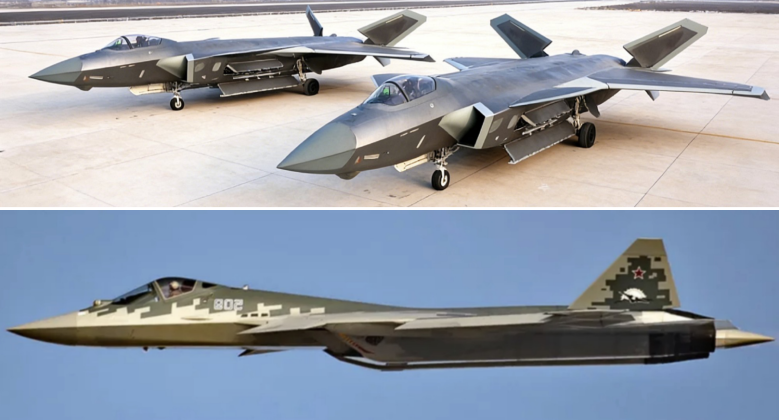
The recent deployment of Chengdu J-20 fifth-generation stealth fighters by the Chinese People’s Liberation Army Air Force (PLAAF) to key high-altitude installations near the disputed border has fundamentally altered the aerial balance of power along the Line of Actual Control.
While China has historically prioritized stationing its premier J-20 fleet in eastern and coastal sectors to counter American and allied Pacific forces, accelerating production rates exceeding 100 airframes annually have enabled wider geographic distribution.
In response to this mounting strategic pressure, discussions surrounding the acquisition of Russia's Sukhoi Su-57 fifth-generation fighter have intensified significantly. Russian and Indian defense officials have advanced technical consultations regarding local license production, bolstered by unprecedented Moscow offers concerning source-code access and deep technological co-ownership.
The potential integration of the Su-57—alongside specialized avionics customization, such as local AESA radar integration—would provide the Indian Air Force with the heavy-class kinematic performance, supercruise capabilities, and internal weapons carriage necessary to counter the J-20. However, transitioning toward a new high-end stealth ecosystem will demand immense logistical adjustments, disciplined capital allocation, and expedited defense procurement pathways. Successfully executing a joint manufacturing arrangement will be pivotal to ensuring that India retains a credible deterrent posture across its northern frontier.
Adding a profound new dimension to regional strategic competition, the Pakistan Air Force is advancing toward a landmark procurement of up to 40 Shenyang J-35 stealth fighters.
Ultimately, the expanding footprint of Chinese fifth-generation aircraft in the high-altitude border regions underscores the accelerating pace of aerospace modernization across South Asia. As regional powers race to secure technological dominance, the outcome of India's stealth procurement strategy will dictate the stability of the local balance of power for decades to come. Navigating these complex geopolitical and industrial hurdles remains the ultimate test for modernizing the subcontinent's defense architecture.

No comments:
Post a Comment