
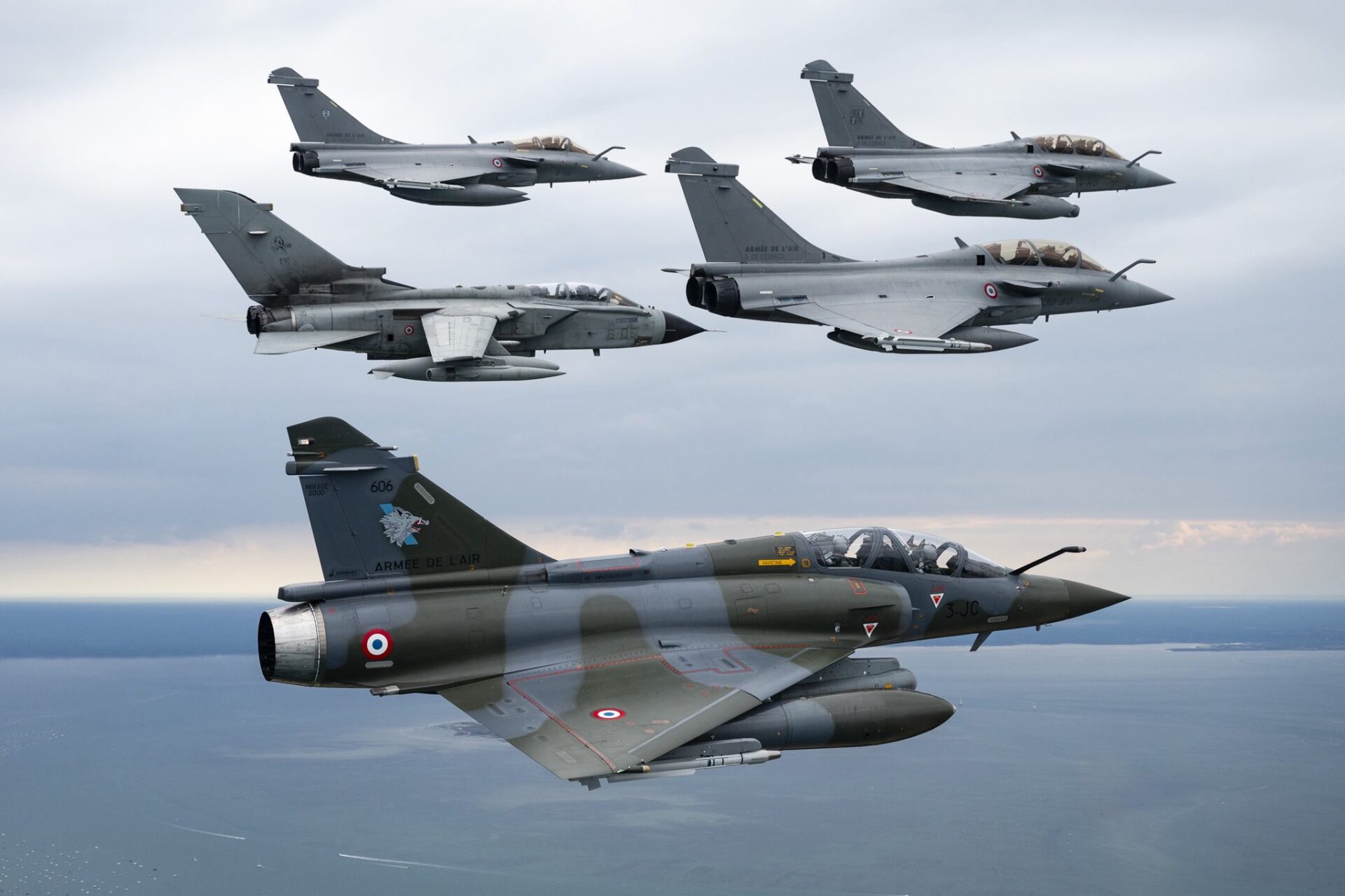
On October 2, 2026, Defense News reported that the French Air Force, working with the Directorate General of Armament (DGA) and the Ministerial Agency for Defence AI (AMIAD), plans to fly crewed fighter jets alongside AI-enabled combat drones in 2028. The effort, called Hypairion, aims to build an open, modular architecture for combat aircraft and a sovereign AI capability, so that the state keeps control of critical technology instead of depending on contractors. The first hardware step is already under way, with two Mirage 2000 fighters being modified at Mont-de-Marsan airbase as AI test beds. A new onboard computer will let engineers begin trials by the end of this year.
What stands out is how modest the opening phase is. The drone due to fly in 2028 is a test platform, and it may not be the wingman eventually planned for the Rafale F5 standard. The first stage will not necessarily deliver an operational capability and will instead examine matters like energy consumption and system interfacing. The initial use cases under consideration are optimizing flight paths and supporting tactical decisions such as when to employ air-to-air or air-to-ground weapons. AMIAD describes mission autonomy as AI that assists pilots with planning, in-flight decisions and post-mission analysis. In other words, France is treating this as an experiment in how to build the system, not a rushed race to field a drone.
The sovereignty angle is the real story. Most loyal wingman programs, whether from General Atomics and Anduril in the United States or Airbus and BAE Systems in Europe, are driven by companies. Hypairion is designed so the French state owns the overall architecture and can bring in startups and industrial partners that come and go, while the core capabilities stay in-house. The model is borrowed from the Army's Pendragon robotics project. French officers describe future fighters as "flying computers" whose software could be updated between morning and afternoon sorties to counter a new enemy measure, with flight-safety functions kept separate from mission functions. My reading is that the prize here is the speed of software updates, since whoever controls the architecture controls how quickly a countermeasure can be answered.
This also has to be read against the collapse of the Franco-German-Spanish Future Combat Air System (FCAS), which reporting says fell apart in June 2026 after mediation between Dassault and Airbus failed. That makes the Rafale F5 France's main path forward, with a first version targeted for 2033 and a stealth combat drone launched in 2024 to accompany it after 2030. The Rafale's F4 standard already includes a tablet linked to the mission system, and the DGA says this will allow crews to control autonomous platforms from the Rafale before F5 arrives. Hypairion therefore reads as the software layer for a hardware plan that is still being assembled.
There are reasons for caution. On hardware, the United States already has loyal wingman prototypes flying and rolling off production lines, so France is betting that architecture matters more than being first. Funding is another question mark, since reporting suggests F5 costs are now falling largely on France alone. And "open architecture" is easier to promise than to keep, since the DGA itself acknowledges that France relies on Dassault and other major partners for AI in the Rafale's key systems. France also says it does not foresee an all-unmanned future, and that the decision to use weapons stays with a human.
Ultimately, Hypairion is less a drone program than an argument about who owns the brains of the next air force. Three markers will show whether it works: the results of the Mirage 2000 test-bed trials after they begin at the end of 2026, the full-scale trial of drones flying with fighters in 2028, and whether the platform for the Rafale's future wingman is chosen later in the decade without the architecture being compromised by industrial interests. If it holds, a fighter squadron in 2040 may look quite different, and the Air Force itself notes that computer scientists, rare in squadrons today, could one day be commonplace.

No comments:
Post a Comment