
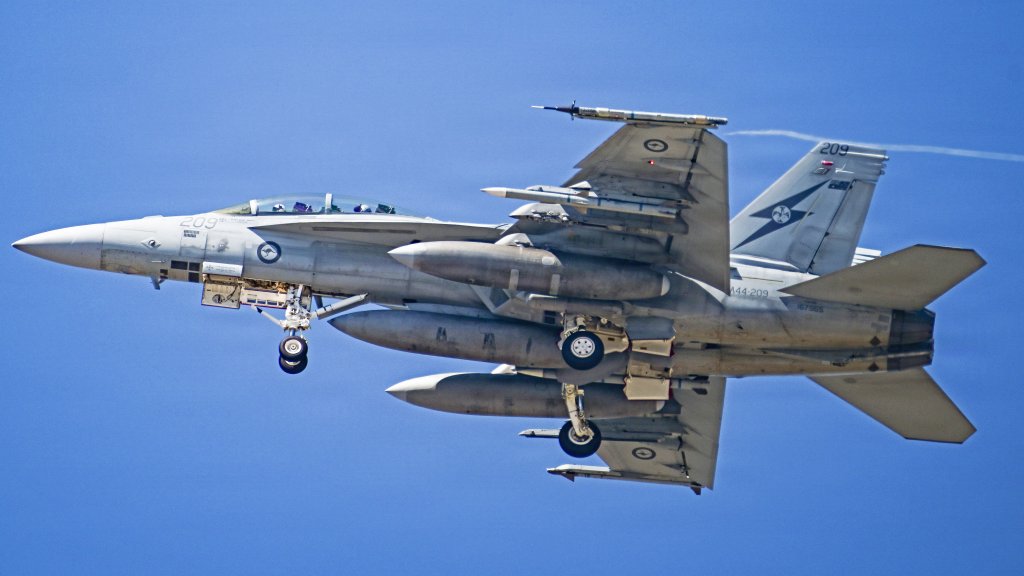
On October 1, 2026, The War Zone (TWZ) reported that a Royal Australian Air Force F/A-18F Super Hornet had been photographed carrying an inert AIM-260 Joint Advanced Tactical Missile (JATM) during a major U.S. Navy test event in California. The photo, released by the Navy, shows an aircraft from No. 1 Squadron taking off from Naval Base Ventura County Point Mugu on September 11 during Gray Flag 2026. Alongside the JATM it carried an inert CATM-9X and CATM-120, three external fuel tanks, an ATFLIR targeting pod and a Tactical Combat Training System (TCTS) pod. The sighting arrives only weeks after Canberra announced it would buy the missile, with its Super Hornets the first RAAF aircraft to receive it.
Gray Flag itself is part of the story. The Navy describes it as the naval aviation test community's flagship large-force event, and 2026 was its largest edition, with more than 3,000 personnel from over 150 organizations flying over 750 sorties and logging more than 2,000 flight hours. It is used to test how sensors, weapons, aircraft and networks work together as part of larger kill chains, which is exactly where a new long-range missile needs to be proven. Carrying the weapon there suggests that integration on the RAAF's Super Hornet fleet has progressed beyond paperwork, and it is the first apparent glimpse of an Australian JATM in any context.
The procurement behind it is significant. TWZ reported in August that Australia is set to become the first country outside the United States to operate the AIM-260 through a roughly $480 million Foreign Military Sales (FMS) deal. The missile is planned for the F/A-18F first, followed by the F-35A and EA-18G Growler, with the MQ-28 Ghost Bat collaborative combat aircraft (CCA) a possible future candidate. Australia gave no delivery schedule or in-service date. That fits a wider pattern of U.S.-Australian cooperation on air-launched weapons, including Australian Super Hornets being integrated into the Hypersonic Attack Cruise Missile (HACM) effort.
The reason the missile matters is the threat it answers. The AIM-260's exact specifications are classified, but it is intended to offer much greater range than the AIM-120 AMRAAM while keeping a similar form factor, which allows internal carriage on aircraft such as the F-22 and F-35. It was developed in response to long-range Chinese missiles such as the PL-15. Official range figures have not been released, although earlier reporting suggests at least 120 miles and possibly considerably more. As we noted in our J-10C piece, the PL-15's reputation is part of what sells Chinese fighters abroad, so a credible Western answer matters for export competition as much as for air combat.
A few cautions are needed. The photo shows a training round, and blue bands on the body confirm it is inert, so it says nothing about the missile's performance. TWZ also points out that it does not establish whether the round was Australian-owned, a U.S. test asset or part of a specific integration activity. The program has a history of delay, since the missile was originally due to enter service years ago, and the September framework agreement between the Pentagon and Lockheed Martin lays groundwork for a future multiyear deal without disclosing quantities, costs or deliveries. And a longer-range missile is only one link in a kill chain, because it still depends on sensors, networks and targeting data.
Ultimately, this is a milestone for the RAAF rather than proof of a new capability. Three markers will show how quickly it becomes real: a confirmed delivery schedule, a first live firing from an Australian aircraft, and the details of the U.S. production agreement. For Indo-Pacific air forces watching, the message is that long-range air-to-air missile competition is now a matter of fielding, integration and numbers as much as headline range.

No comments:
Post a Comment