
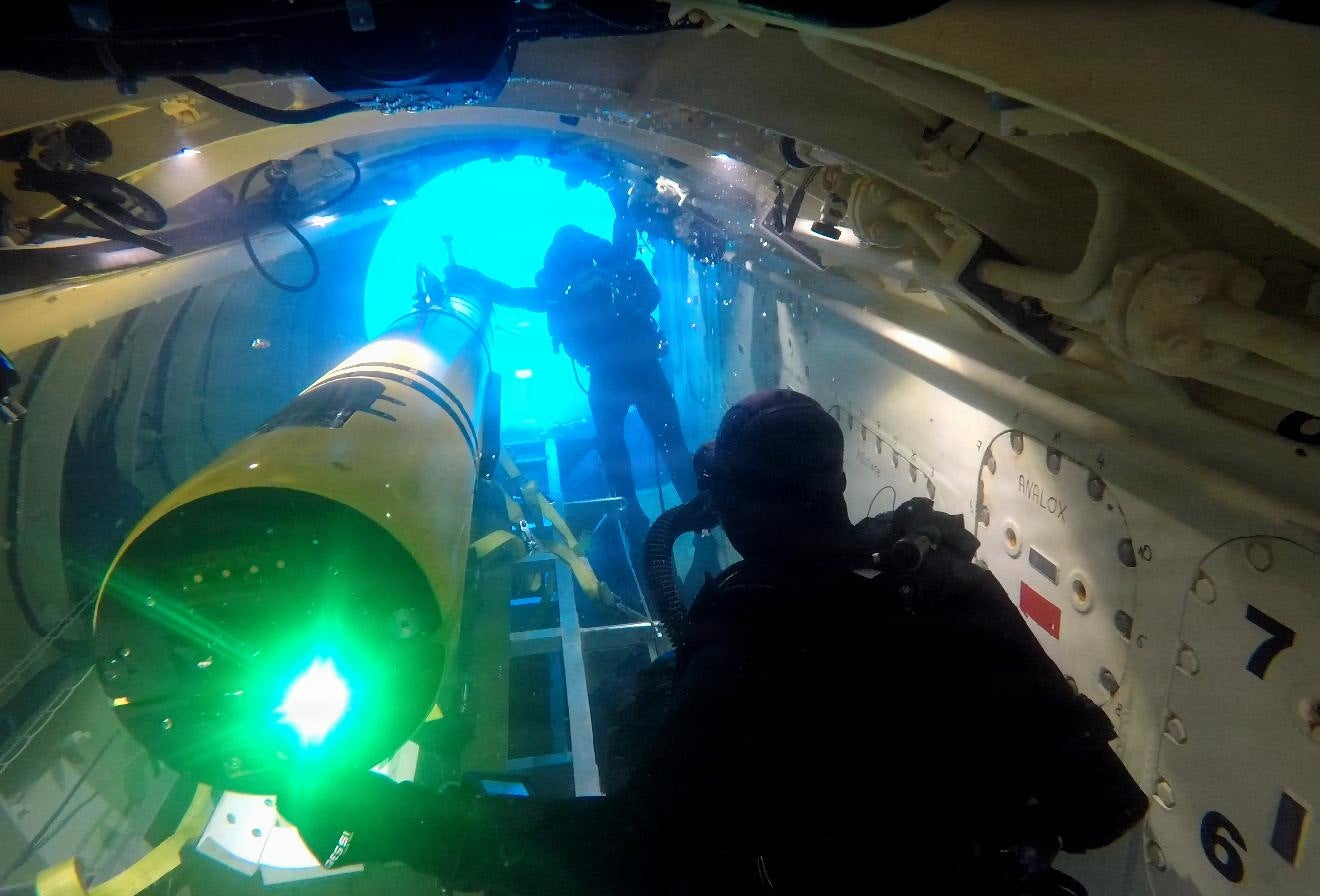
U.S. Pacific Fleet submarine force commander Rear Adm. Chris Cavanaugh and Carrier Strike Group 9 commander Rear Adm. Marcos Jasso met following the conclusion of RIMPAC 2026's at-sea phase to discuss integrating uncrewed undersea vehicles more deeply into carrier strike group operations, building on more than 35 separate unmanned-systems experiments conducted during the exercise. Two concepts stood out from the discussion: using aircraft carriers as forward operating bases for UUVs launched by helicopter or directly from the ship, extending a strike group's organic reconnaissance, strike, minesweeping, and anti-submarine capability, and, more strikingly, using UUVs to physically transfer critical parts and components between submarines and carriers while both remain fully submerged and underway, letting a submarine resupply without surfacing or returning to port.
That second concept, underway submarine replenishment via UUV, addresses a problem this blog's own coverage of naval logistics has circled without naming directly: contested-environment resupply is one of the least glamorous but most operationally decisive constraints on how long a submarine can actually stay in a fight. Naval News's own prior reporting on proposed submarine tender vessels, physical ships built to reload weapons and deliver parts, notes plainly that those tenders would struggle to perform this mission in genuinely contested waters, where a surface vessel approaching a submarine creates exactly the kind of detectable signature both platforms exist to avoid. A UUV-based transfer system sidesteps that vulnerability entirely, letting a carrier strike group act as a mobile logistics node a submarine can rendezvous with briefly and covertly rather than requiring either vessel to break cover for a port call or a surface-ship linkup.
This connects directly to a magazine-depth problem this blog flagged in earlier coverage of the Navy's in-development Revolver launcher system, which aims to multi-pack smaller-diameter torpedoes like RTX's Mark 58 Compact Rapid Attack Weapon into a Virginia-class submarine's existing 21-inch tubes specifically to extend how long a boat can fight before running dry. Revolver solves the problem of carrying more before departure; underway UUV resupply solves the separate, arguably harder problem of restocking after departure without surfacing, and paired together they represent a genuinely coherent strategy for extending submarine combat endurance in a Pacific theater where transit distances to a home port or safe replenishment point are measured in thousands of contested miles rather than the shorter, more permissive resupply lines a European or Middle Eastern theater would offer.
The strategic timing also matters given this blog's earlier coverage of the Orca XLUUV program's own July milestone, a 1,000-nautical-mile Pacific transit that, when set against China's more diversified and reportedly faster-scaling UUV development effort, this blog assessed as more catch-up story than clear American lead. Building genuinely useful mission sets around America's existing UUV inventory, carrier-basing for strike-group-organic capability, submarine resupply for extended contested-environment endurance, is a sensible way to extract more strategic value from platforms already in testing rather than waiting for a hypothetical future generation of hardware to close the gap with China's parallel program on its own. It's a software-and-doctrine answer to a hardware-scale problem, not unlike the E-2D Block II modernization approach this blog covered days earlier, extracting more capability from existing or maturing platforms through smarter integration rather than purely through new procurement.
None of this is close to operational reality yet, Cavanaugh and Jasso's meeting produced a strategic-alignment discussion rather than a funded program of record, and the "underway submarine replenishment via UUV" concept in particular still needs to clear real engineering hurdles, precise underwater rendezvous, secure docking or transfer mechanisms, payload capacity limits, before it moves from RIMPAC talking point to fielded capability. But the direction of travel is coherent with nearly everything else this blog has tracked in the Navy's Pacific posture this summer, extending magazine depth through Revolver, extending mission reach through Orca, and now potentially extending operational endurance itself through UUV-based resupply, three separate programs converging on the same underlying goal of letting a smaller, strained submarine and carrier fleet fight longer and further from home than its raw platform count alone would suggest is possible.

No comments:
Post a Comment