
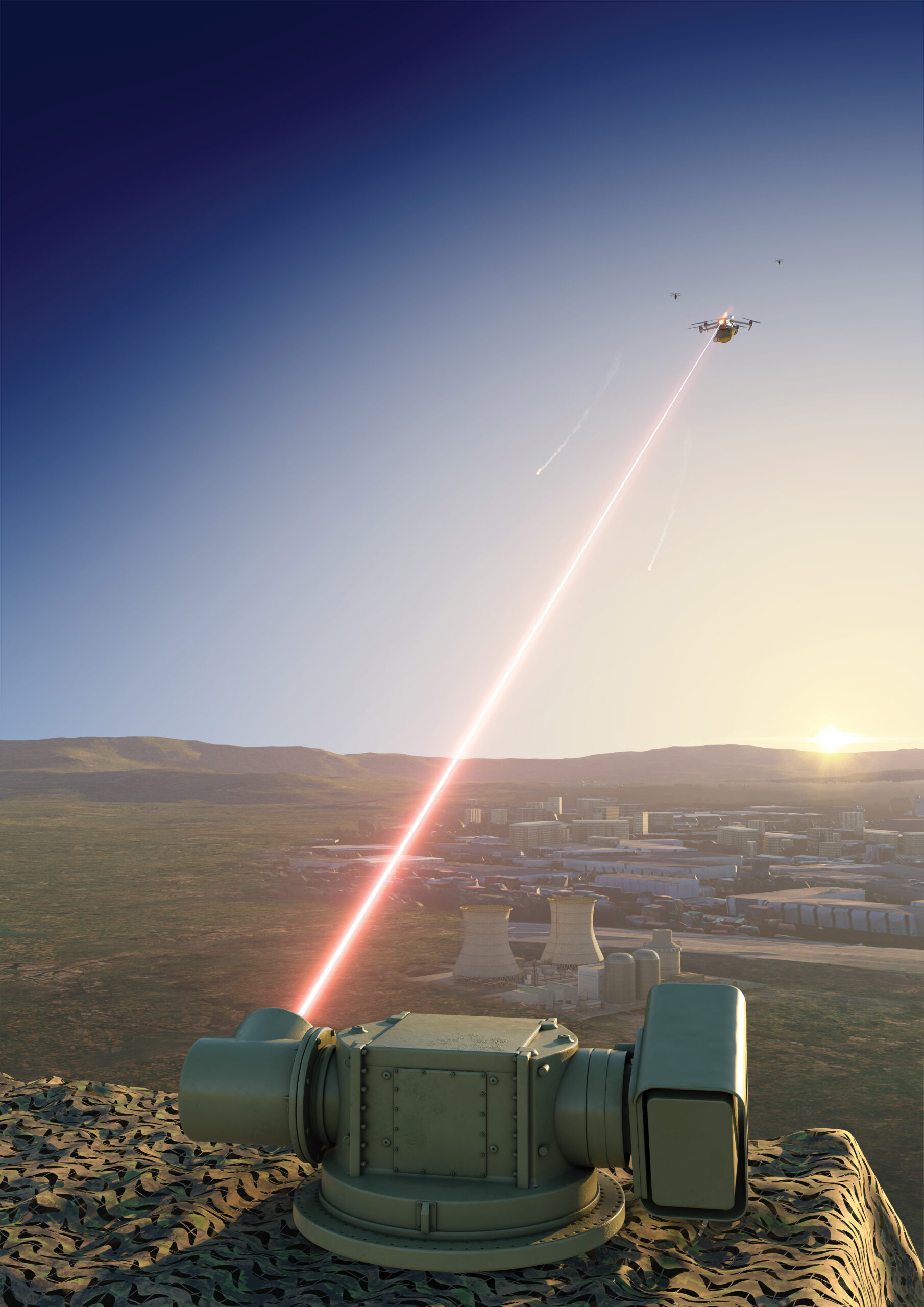
Chinese manufacturer Photon Matrix Lab announced this month that its portable laser-based mosquito killer has entered mass production, and the engineering behind it is a near-perfect miniature of how modern counter-drone laser systems actually work. The device uses LiDAR for spatial scanning, millimeter-wave radar for motion detection, and an AI vision module to confirm a target before a galvanometer-controlled laser fires a short pulse, typically aimed at the insect's wings, to disable it mid-flight. That's the same detect-track-aim-kill sequence every military high-energy laser system runs, just scaled down from tens of kilowatts capable of melting a drone's critical components to a power level barely sufficient to damage an insect's wing at close range. It's genuinely funny as a headline, and it's also a surprisingly clean illustration of the sensor-fusion architecture underpinning a weapons category this blog has already covered in a considerably more serious context.
That serious context is worth revisiting here, because the mosquito laser's commercial debut lands squarely inside the same "cost per shot" logic driving the actual military laser race this blog tracked through the Pentagon's push for airborne directed energy weapons. A single laser engagement costs less than a dollar, against millions of dollars for a single Patriot or THAAD interceptor round, precisely the economic asymmetry this blog documented driving America's own directed-energy push after Assistant Secretary Mike Dodd's SMD Symposium demand for "lighter, more efficient" weapons small enough to actually fly. Dodd's core complaint, "size, weight, and power decide what flies," is fundamentally the same miniaturization problem Photon Matrix had to solve to fit a functioning detect-and-engage laser system into something portable and consumer-priced, just at a vastly different power and stakes threshold.
China's own military laser portfolio, cataloged at length in the same EurAsian Times reporting that flagged the mosquito device, shows how seriously Beijing is pursuing the weaponized version of this same sensor stack. The Silent Hunter, a 30-100 kW fiber-optic system reportedly spotted in Russia last year, and Shen Nung, a 10-20 kW system reportedly protecting Iran's Supreme Leader in 2024, both run variations of the same radar-plus-opto-electronics targeting pipeline. The OW5 vehicle-mounted system and the ship-borne LY-1, unveiled at China's September 2025 Victory Day parade with a turret design EurAsian Times noted could plausibly adapt to ground use, round out a portfolio that spans nearly every deployment context, mobile convoy protection, naval point defense, fixed-site air defense, that a modern military might need a directed-energy answer for.
What's genuinely notable, reading this alongside the global laser survey the source article compiles, is just how crowded this specific arms race has become in a short span. The U.S. has HELIOS, already combat-tested aboard USS Preble, and the more mobile P-HEL; Israel has the Iron Beam, integrated directly with Iron Dome's targeting logic to choose between missile and laser intercepts automatically; the UK's DragonFire runs under £10 per shot; India tested its own Mk-II(A) system in April 2025 with a 5-kilometer engagement range; and Germany, per this blog's earlier coverage of Rheinmetall's naval-industrial strain, is now adding a Rheinmetall-MBDA laser weapon to its already-stretched shipbuilding portfolio, targeted for 2029. That's at least seven distinct national programs actively fielding or testing directed-energy weapons simultaneously, all converging on the identical economic logic this blog has tracked across nearly every interceptor and munitions story this summer: cheap, mass-produced threats require a cost-effective answer, and a laser that costs a dollar a shot is the cleanest available response to an adversary firing $20,000 drones by the hundreds.
None of this means China's mosquito killer represents some hidden military breakthrough dressed up as a consumer gadget, Photon Matrix's device operates at a power level and engagement range that has nothing meaningfully in common with a system built to down a Shahed drone or an anti-ship missile. But the fact that the same core sensor-fusion architecture, LiDAR, radar, AI-confirmed targeting, precision beam-steering, now exists cheaply enough to sell directly to consumers on Indiegogo says something real about how far the underlying component technology has matured and commoditized, which is precisely the kind of civilian-sector cost curve that tends to eventually bleed into military procurement, whether or not Photon Matrix ever intended its bug zapper to say anything about the broader laser-weapons race it happens to visually echo.

No comments:
Post a Comment