
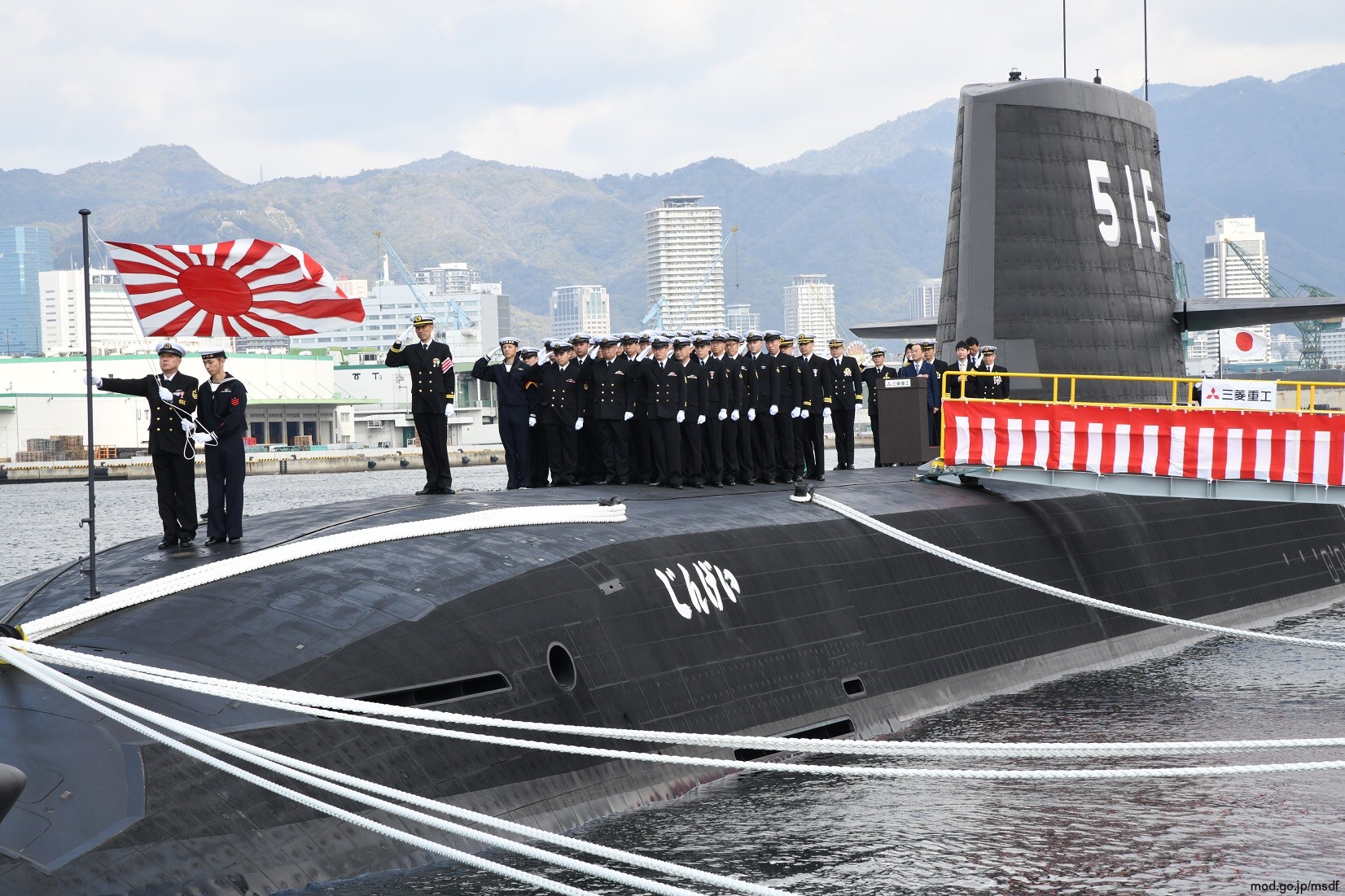
On October 8, 2026, Mitsubishi Heavy Industries (MHI) launched "Shogei", the seventh Taigei-class diesel-electric attack submarine for the Japan Maritime Self-Defense Force (JMSDF), at its Kobe shipyard, as reported by Naval News. The boat, pennant number SS-519, displaces about 3,000 tonnes and measures 84 metres in length with a 9.1-metre beam. It costs roughly 80.5 billion yen ($509 million) and is due for delivery to the JMSDF in March 2028. The name means "Soaring Whale", and it is the first time the JMSDF has used it. Like the fourth boat, Raigei, and its successors Chogei and Sogei, Shogei will use new, higher-output Kawasaki 12V 25/31 diesel engines.
The Taigei class is a conventional design, but a capable one. It uses large lithium-ion batteries for better underwater endurance, carries Japan's newest Type 18 torpedo and a torpedo countermeasure system taken from the last four Soryu-class boats, and can fire the UGM-84L Harpoon Block II anti-ship missile, reported to have a range of 248 kilometres. For readers following Japan's naval build-up, the more interesting point is the steady cadence. A seventh launch shows a production line running reliably, which is not something every navy can claim.
The headline, however, is the nuclear propulsion debate, and it deserves careful reading. The case for nuclear boats is clear. A diesel-electric submarine must periodically raise a snorkel to recharge its batteries, which raises the risk of detection, and its batteries drain quickly during sustained high-speed operation. A nuclear boat can combine speed, long transits and extended submerged operations, which matters as the Chinese Navy expands its activity in the Western Pacific. Defence Minister Shinjiro Koizumi said on September 11 that Japan would not rule nuclear-powered submarines out as it considers revisions to its three national security documents by the end of this year.
But "not ruling out" is a long way from deciding. The Naval News report stresses that Japan has made no decision, and Koizumi himself listed the drawbacks: higher costs, larger hulls, the need for specialized expertise and potentially a greater underwater acoustic signature than conventional boats. Adopting nuclear propulsion would also mean tackling reactor safety, personnel training, maintenance infrastructure and long-term operation of naval reactors. A September 2025 expert panel recommended research into "next-generation propulsion" without explicitly calling for nuclear. In my own reading, there are probably legal and political hurdles as well, given Japan's long-standing sensitivities around nuclear technology, though the article does not address those.
What is actually funded is more modest. On July 6, 2026, the Acquisition, Technology & Logistics Agency (ATLA) awarded MHI a contract worth about 3.9 billion yen ($24.6 million) for research into the total-ship optimization design of a next-generation submarine with vertical launching systems (VLS), running from fiscal 2026 to 2029. The aim, under the 2022 security documents, is a submarine that can launch long-range stand-off missiles, which fits the wider counterstrike build-up we covered in our look at the Type 25 HVGP. Adding VLS, better sonar and unmanned underwater vehicles could require a larger hull and more onboard power, and that power demand is exactly where the nuclear argument comes from.
Ultimately, Shogei's launch is the visible part of the story, and the real decision comes later. The central question, as the report puts it, is what missions Japan's future submarine force should perform and which propulsion best serves them. Three markers will show the answer: whether the year-end revision of the national security documents commits to nuclear propulsion or keeps studying it, how the ATLA design research develops through 2029, and the delivery of Shogei in March 2028. Until then, Japan's submarine fleet remains conventional, and the nuclear question is still an open one.

No comments:
Post a Comment