
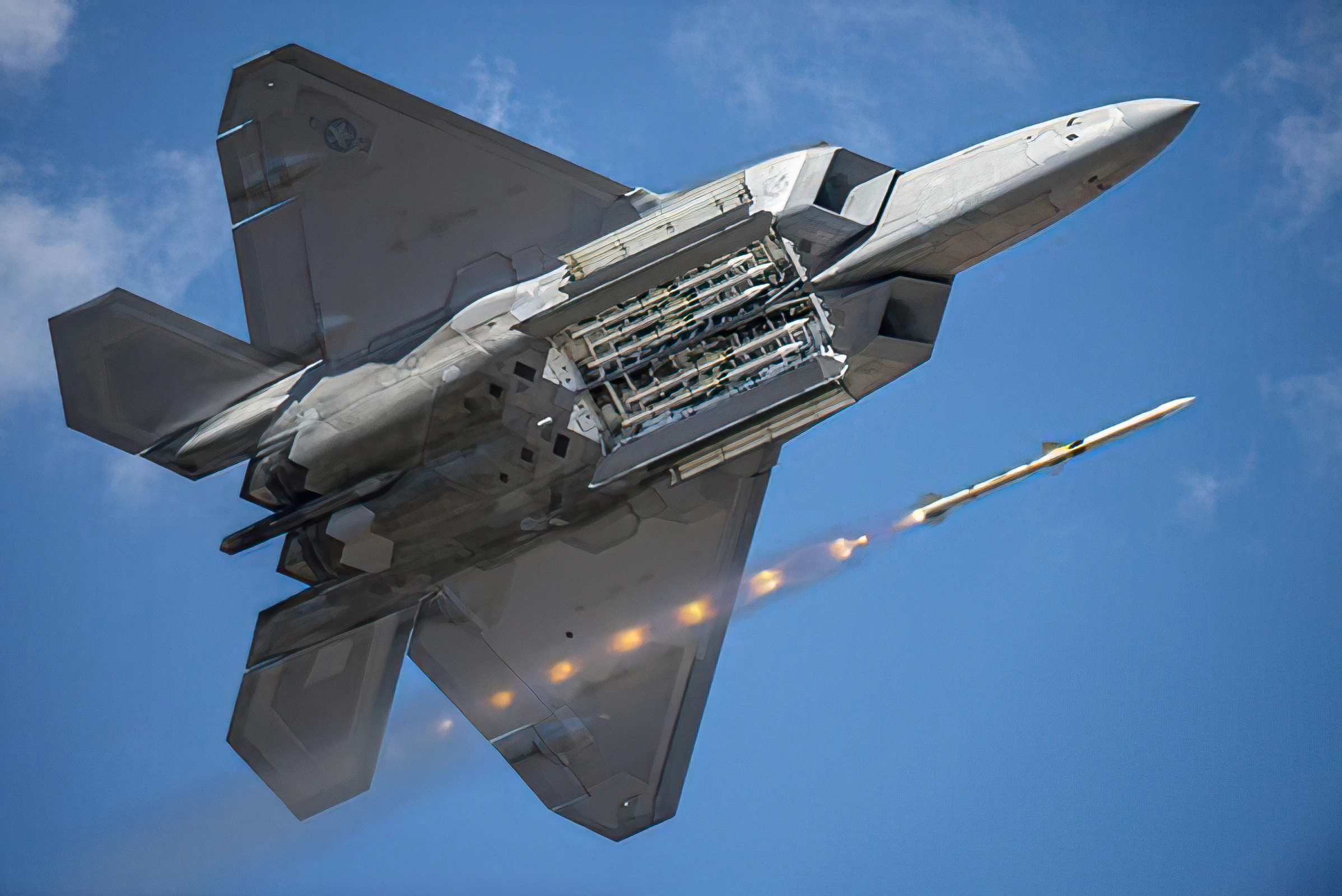
No new money. No missile count. No delivery date. That's what the Pentagon and Lockheed Martin actually signed on Thursday for the AIM-260 Joint Advanced Tactical Missile, and it's worth being precise about that from the start, because "framework agreement to boost production" sounds like a purchase order and isn't one. Officials described it plainly as a demand signal, a way of telling Lockheed and its suppliers to start investing in factory capacity, workforce, and manufacturing efficiency now, on the expectation that a real multiyear procurement contract, one that actually commits dollars, will follow once Congress approves it.
That gap between signal and funding isn't abstract, it's already sitting in the budget request working through Congress right now. The services want roughly $2.9 billion for JATM in fiscal 2027, up sharply from $894 million the year before, a more than threefold jump that hasn't been authorized yet. The Air Force has previously disclosed buying 144 of the missiles across 2024 and 2025 combined, with at least 112 more planned, numbers that give some sense of scale even though the program itself remains genuinely secretive, developed largely out of public view over roughly six years. Under Secretary of Defense for Acquisition and Sustainment Michael Duffey's own quote leaned hard into that same message rather than any concrete commitment: "Speed, scale, and stability drive acquisition excellence, and these gears must turn in unison."
What JATM is actually built to do connects directly to the same beyond-visual-range arms race driving America's other recent missile announcements. Reuters has reported the program is explicitly aimed at outranging increasingly capable Chinese long-range air-to-air threats, including weapons associated with the J-20, the same PL-15 and PL-17 family this outlet has already covered as the reason the Navy fielded the AIM-174B Gunslinger and unveiled the even longer-ranged AIM-424 Malice. JATM is positioned as the direct successor to the aging AIM-120 AMRAAM specifically for fighter-carried BVR combat, meaning the US now has at least three separate long-range missile programs, Gunslinger, Malice, and JATM, all racing to answer the same underlying Chinese range advantage from slightly different platforms and price points.
The export dimension is where this framework agreement actually has something concrete attached to it. Australia announced on August 6 it would spend roughly $520 million buying JATM for the Royal Australian Air Force, becoming the missile's first confirmed international customer, with integration planned first on F/A-18F Super Hornets, then F-35As and EA-18G Growlers, and potentially down the line on the MQ-28 Ghost Bat drone, which can already fire AIM-120s. That order is a fraction of what Washington has actually cleared for future sale, having separately approved a potential deal for up to 450 JATMs and associated test articles worth $3.16 billion. Real allied money changing hands for a missile the US itself hasn't finished funding at home is a genuinely unusual sequence, and it says something about how confident Lockheed and the Pentagon are that congressional approval for the domestic multiyear buy is coming, even if the paperwork hasn't caught up yet.
None of the coverage of this announcement, and there's been a lot of it in the past 24 hours, includes a production target, contract value, or firm timeline, and that's consistent across every outlet that's reported on it rather than one publication simply withholding detail. For a program this secretive, that opacity is probably by design as much as by circumstance. What's left for outside observers is the same pattern this outlet has now tracked across multiple 2026 missile programs: an announcement built around signaling intent and locking in supplier confidence, with the actual dollars, and the actual missiles, still waiting on a Congress that hasn't yet said yes.

No comments:
Post a Comment