
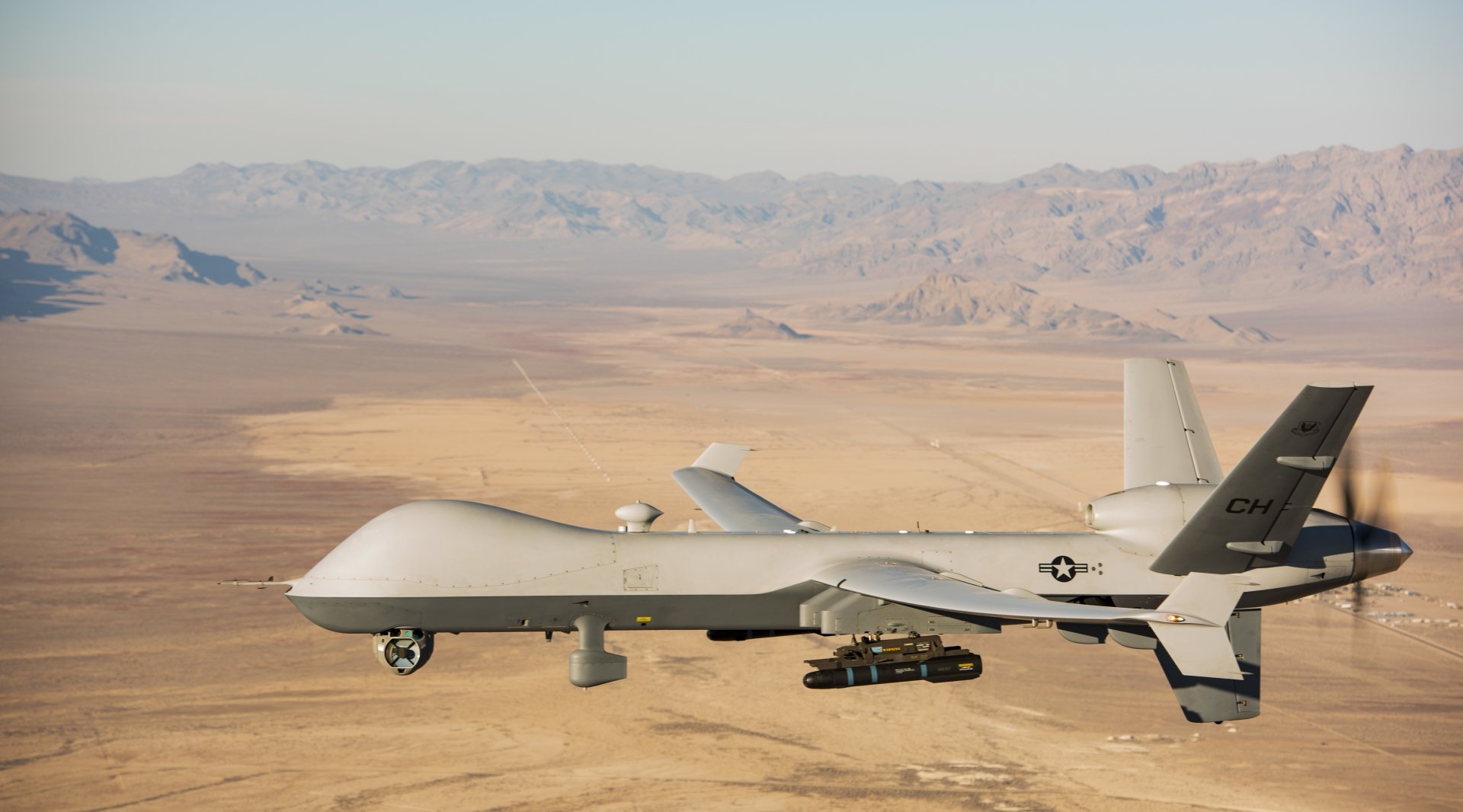
"Although we have plenty of MQ-9As today, we are going through them at a rate that is concerning to us." That's Lt. Gen. Christopher Niemi, the Air Force's chief modernization officer, describing why a program originally planned to reach initial capability by 2031 just got compressed to as early as 2029. Since the Iran war began, the Air Force has lost at least 45 MQ-9 Reapers, roughly a quarter of its entire fleet, and the service's own math on that loss rate is blunt: it can't keep losing $50 million drones at this pace and expect the fleet to hold up.
What's notable is what the Air Force decided not to do about it. Officials looked seriously at General Atomics' MQ-9B, a bigger, more advanced, more expensive version of the current Reaper, and turned it down. Niemi's reasoning cuts right to the actual problem: "If you don't like losing an MQ-9A that cost on the order of $50 million, with the sensors, you're probably not going to like losing an MQ-9B at a higher price point." A more capable replacement doesn't solve an attrition problem, it just makes each loss more expensive. Instead, the Air Force is going all-in on Massed Modular Aircraft, a program explicitly designed around the idea that some of these drones are going to get shot down, and that's fine, as long as replacing them is cheap and fast.
The target price is $10 million per aircraft, a fifth of what an MQ-9A with sensors costs today. To hit that number, the Air Force is deliberately choosing to build something less impressive rather than more. Niemi described the design philosophy as "80 percent is good enough," using mature, already-proven technology instead of pushing for cutting-edge performance. MMA drones will look a lot like current Reapers, long, efficient wings and turboprop engines, because that's a well-understood, inexpensive design rather than something requiring years of exotic engineering. The one place the Air Force is willing to spend real effort is autonomy: more automated flight control, letting a single Airman fly multiple drones instead of one pilot per aircraft, cutting personnel costs even as the hardware itself stays deliberately unambitious.
The contrast Niemi drew with the F-35 is the clearest window into why this approach matters beyond just MMA specifically. Asked about production flexibility, he didn't talk about MMA's own numbers, he talked about what happens when a fighter this complex needs to scale up fast. "If you wanted to suddenly ramp up production of something like an F-35, it's not a limiting factor so much as money, as the ability to build out your production capacity," he said. "In major combat operations, depending on who you're fighting, we could be losing dozens a day, and so you have to figure out how do you adjust the industrial capacity." That's an Air Force official openly stating that America's most advanced fighter jet cannot be surged fast enough to replace losses in a genuinely intense war, a real admission buried inside a briefing that was ostensibly about a drone program.
MMA sits alongside Collaborative Combat Aircraft, the Air Force's other big autonomous drone effort, and the differences between the two are deliberate rather than incidental. CCA is built to look and act more like a fighter, roughly $20 million a unit, flying combat missions with a higher degree of autonomy. MMA is closer to a delivery truck, in Niemi's own words, carrying a sensor package or a weapon to where it needs to be rather than hunting and engaging targets on its own, with roughly twice the range of a CCA but at slower speed. The Air Force wants at least 180 of them, both programs sharing open, standardized architecture specifically so new sensors or weapons from any vendor can be swapped in quickly, the same "conforms to this interface, we can do it speedily" flexibility Niemi contrasted directly against the F-35's notoriously difficult upgrade path.
General Atomics, whose MQ-9B got passed over, isn't sitting this one out. The company is pitching a new design called Wildfire specifically for the MMA competition, with a spokesman claiming it can deliver "years earlier" than competitors while keeping "everything that makes Reaper special" at a price that "doesn't break the bank." Whether that promise holds up against a 2029 target the Air Force itself only recently decided to accelerate is the real test ahead, one further complicated by exactly the kind of losses that made this timeline urgent in the first place.

No comments:
Post a Comment