
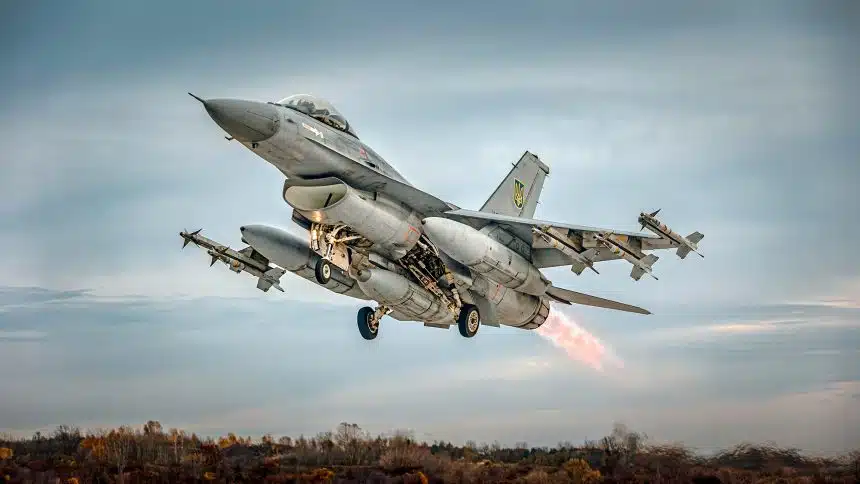
In a major milestone for modern aerial warfare, a Ukrainian Air Force F-16 has successfully shot down a Russian fighter jet in a dogfight for the very first time. The historic engagement was publicly confirmed by U.S. Joint Chiefs of Staff Chairman Gen. Dan Caine during a hearing before the U.S. Senate Appropriations Committee in Washington, D.C. Responding to questions regarding funding and the progression of Kyiv's defensive infrastructure, Gen. Caine pointed to the landmark aerial kill as clear evidence of how far Ukraine's industrial base and air-to-air operational capabilities have scaled. Until this engagement, Ukraine had primarily deployed its Western-supplied F-16 fleet in a defensive capacity—focusing heavily on intercepting thousands of incoming Russian cruise missiles and one-way attack drones rather than actively hunting crewed aircraft.
While Gen. Caine's initial congressional testimony kept the specific model of the opposing aircraft broad, subsequent reporting from defense analysts, open-source intelligence groups, and the Ukrainian Air Force tied the milestone to a July 8 combat action where a Russian Su-35 multirole fighter was shot down along the eastern front. Pro-Kremlin military bloggers and channels on Telegram also acknowledged the loss of the advanced fighter, noting that the pilot successfully ejected and survived. Defense reports indicate that the successful interception was the result of a coordinated tactical operation involving multiple Ukrainian assets—including a MiG-29 simulating a ground-attack vector to draw out the target, allowing a pair of F-16s to close the distance and secure a direct hit.
This dogfight victory is particularly remarkable due to the significant technical asymmetry between the competing aircraft. Most of the F-16 airframes operated by Kyiv were supplied by European coalition partners such as the Netherlands, Denmark, Norway, and Belgium, consisting largely of rebuilt 1970s- and 1980s-era F-16A/B variants. These legacy platforms rely on 1990s-era AN/APG-66(V)2 radar systems. In contrast, the Su-35S represents one of Moscow’s most advanced frontline combat jets, equipped with a powerful Irbis-E radar capable of tracking targets at extreme distances and armed with long-reaching R-77M missiles that out-range standard AIM-120C-8 AMRAAMs typically fielded by Ukraine.
Despite facing severe radar and missile-range disadvantages, the successful interception underscores how tactical execution, integrated layered air defenses, and innovative operational planning can overcome hardware gaps. As international allies continue to review Kyiv's battlefield performance and negotiate multi-billion-dollar defense and manufacturing agreements, this first-ever F-16 air-to-air kill marks a pivotal turning point in the air war, signaling that Ukraine's aviation forces are successfully transitioning from pure defense into confident counter-air dominance.

No comments:
Post a Comment